

There is a new golf club brand on the scene, and it appears to be using a similar playbook to another now-established 21st-century equipment manufacturer.
After some advance announcements in March, McLaren, the England-based brand best known for its presence in Formula 1, other motorsports and high-performance automobiles, officially launched McLaren Golf and its first collection of golf clubs on Wednesday. Its initial offering consists of two sets of irons: the Series 1 and the Series 3.
The McLaren Golf website describes the Series 1 iron as “precision-engineered irons built for players who demand control, workability, and pure feedback” while the Series 3 iron is “engineered for distance, speed, and consistent performance across every shot.” In other words, the Series 1 is a blade-style iron geared towards low-handicap golfers while the Series 3 fits comfortably into the player’s distance iron category.
Now available for fittings through Club Champion and True Spec Golf locations as well as online ordering with estimated delivery starting June 22, McLaren’s Series 1 and Series 3 irons start at $375 per club.
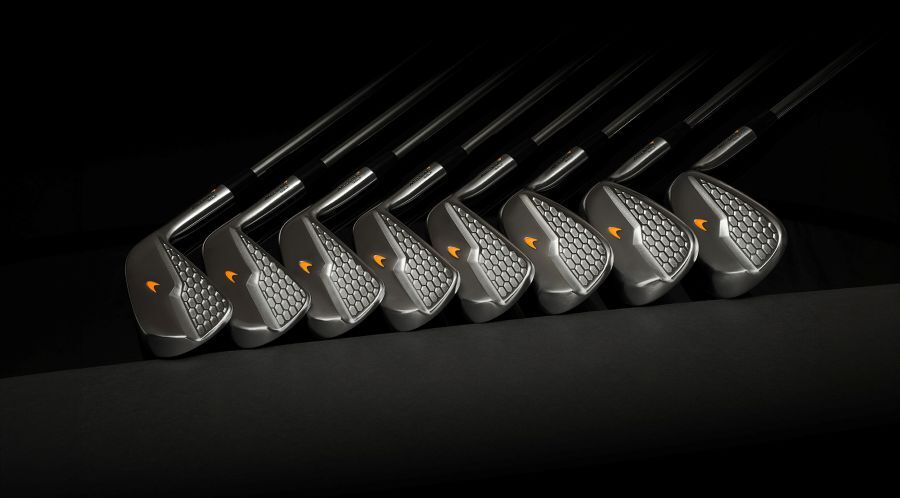
The McLaren Series 1 iron is a compact, player-oriented model geared towards low handicappers. McLaren Golf

McLaren’s Series 3 iron is a player’s distance model, oriented towards middle-handicap players. McLaren Golf
The new Series 1 and Series 3 irons are neither forged nor cast in the traditional fashion. Instead, McLaren Golf touts its use of Metal Injection Molding (MIM) as a differentiator driving the build quality and performance of its new irons. The MIM process combines metal powders and binding agents as the base material. Then, the hot fluid is channeled into a mold to achieve the intended shape, burn away the binding agent and leave extremely high and consistently dense solid metal as a finished product. This process is most often used in the production of small, specialized metal parts, often under 100 grams. In a release, McLaren describes it as “an advanced and highly specialized manufacturing process rarely used at scale in golf due to its complexity and cost.”
McLaren is far from the first golf equipment manufacturer to leverage the MIM process in club production. Cobra Golf has used MIM technology in its King wedges and Callaway Golf has used it in its Opus wedges. MIM has been described as a best-of-both-worlds solution that allows manufacturers to achieve the tight design tolerances and structural integrity that traditional cast molding can produce, while the physical metal density allows a club to feel as good as a forged one.
The launch of McLaren Golf also includes a squad of brand ambassadors: two major champions in Justin Rose and Michelle Wie West, plus LIV Golf member and past Ryder Cup hero Ian Poulter.
Commentary: A familiar playbook surrounding McLaren Golf’s Series 1 and Series 3 irons

The launch of McLaren Golf coincides with Formula 1’s Miami Grand Prix. From left to right: McLaren F1 driver Lando norris, Justin Rose, Ian Poulter, Michelle Wie West and McLaren Racing CEO Zak Brown. Cliff Hawkins/Getty Images
Longtime observers of the golf equipment scene will find the rollout of McLaren Golf’s Series 1 and Series 3 irons somewhat familiar. In July of 2015, PXG burst on the scene with a single iron model, the 0311, stirring curiosity and debate among golfers with a striking design, intriguing technology and eye-watering price tag of $300 per iron.
The years have proven PXG founder Bob Parsons’ seemingly over-the-top approach, backed by plenty of capital, disruptive and influential. The 0311 was in the vanguard of the polymer-filled player’s distance iron category. Over time, PXG leveraged the initial rush of attention to release more affordable and expanded lines of clubs, helping push them practically into the mainstream of golf equipment as they embark on their second decade in business.
Is McLaren Golf the next PXG? It is way too early to tell. I am skeptical of any well-established brand that suddenly seems to be charging into the golf space. These companies tend to massively over-promise and under-deliver on their ambitions, never fully appreciating what it takes to crack the golf equipment manufacturing and distribution code. The attitude that golf is a conquerable commercial space by any non-golf entity has been refuted time and again. Nike made golf clubs and had Tiger Woods as its #1 pitch man, but ultimately shuttered its manufacturing operation in 2016.
The automotive industry has its own cautionary tales in golf. Porsche sold clubs for approximately the time it takes for one of their cars to drive a lap around Le Mans. One of the more pathetic setups I have ever seen at the PGA Merchandise Show was a not-even-half-hearted attempt to promote Aston Martin-branded golf clubs.
In fairness, the composition of McLaren Golf’s team offers some hope of substance. CEO Neil Howie was high up with Callaway for more than a quarter-century. Ambassadors Rose, Poulter and Wie West have business relationships with the company beyond the typical endorsement agreement, giving them input into R&D. And for all the fanfare around its launch, McLaren seems to see itself as a smaller-batch player in golf, which was how PXG started out, also by virtue of a high price point. The tariff for McLaren irons is still steep, but the froth around golf in the 2020s may make it more viable than it seemed when PXG debuted.
If McLaren proves more serious about making a go in the golf business than their predecessors in the luxury space, it should be applauded. I will watch the evolution of their brand with interest.