

“This isn’t cowtown,” says Mike Taylor. “This is Golftown.”
The cofounder of Artisan Golf has a point. After all, Fort Worth can claim legends Byron Nelson and Ben Hogan, and it’s home to Colonial Country Club, a perennial host for the PGA. And for decades the sport’s best players have been visiting an unassuming, roughly 10,000-square-foot facility where the smell of industrial grease permeates the air. Inside is a wall bearing the signatures of luminaries like Lee Trevino, Tiger Woods, and even Michael Jordan, all of whom have come to get their clubs made to their exacting specifications.
The space was originally built by Nike to produce golf equipment; Taylor worked as a model maker for irons and wedges, and his Artisan partner, Granbury native John Hatfield, was a putter craftsman. It’s where they got to know Woods and what he wanted from a club. “You look into that man’s eyes—he’s not messing around when it comes to this game,” says Taylor, a self-described country boy from Bertram.
But in 2016, Nike announced it was getting out of the club-making business. The company asked Taylor and Hatfield to stay on, along with five other employees, to help it meet its contractual obligations. For six months the team worked overtime making clubs while the duo plotted their next move. Which, it turns out, wasn’t much of a move. “February 17, 2017, was Mike’s and my last day on Nike payroll,” Hatfield says. “And Monday, February 20, we walked in the same door, flipped on the lights, and started Artisan.”
The name on the building might have changed, but the golfers kept coming. And whether you’re Scottie Scheffler or one of roughly 47 million Americans who play casually, you’ll start with an in-person visit, during which Hatfield will ask about your tendencies and your shortcomings. You’ll swing a few sample clubs, sorting out the ideal angle and weight of the clubhead, and get a general assessment of your strengths and weaknesses.
Then the team of eleven full-time employees gets to work, crafting your putter, irons, or wedges by hand. Artisan is focused on the short game, because that’s where Taylor and Hatfield believe their work has the greatest impact. “When you get to your short game, everybody becomes equal,” Taylor says. “Fact of the matter,” Hatfield agrees, like a parishioner responding to a homily. “The difference between good golfers and great golfers is the short game,” Taylor concludes. Amen.

Cofounders Mike Taylor and John Hatfield.
Photograph by Jeff Wilson

A custom steel putter with a tungsten insert.
Photograph by Jeff Wilson
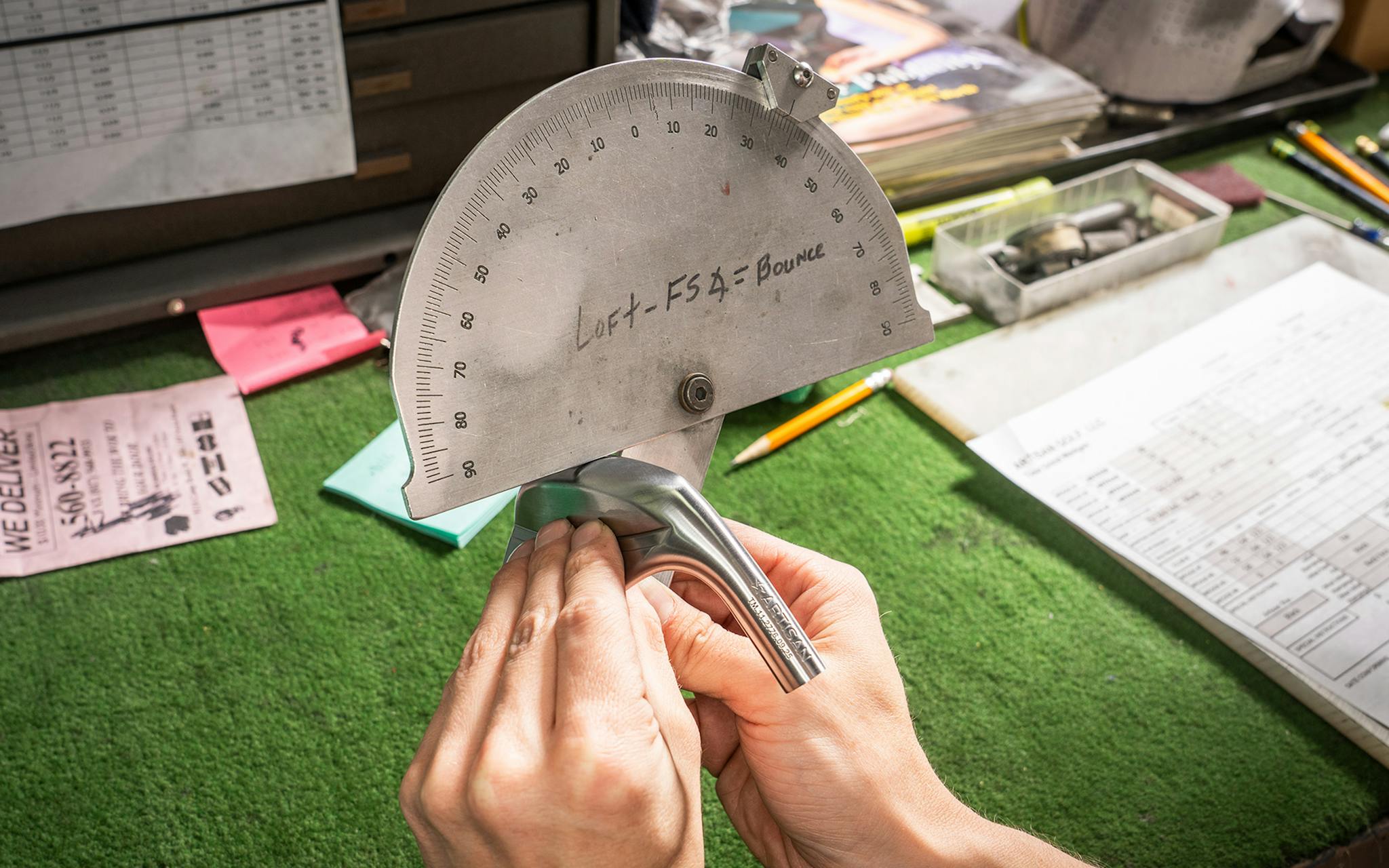
An employee measuring the loft angle of an iron.
Photograph by Jeff Wilson

A custom-order sheet.
Photograph by Jeff Wilson

A wedge getting a finishing touch.
Photograph by Jeff Wilson

A putter head being carved from a block of solid steel.
Photograph by Jeff Wilson

Employee Jay Johnson conducting a custom iron–fitting session.
Photograph by Jeff Wilson

A signed Paul Casey golf bag in Taylor’s office.
Photograph by Jeff Wilson

Taylor using a sander to fine-tune the weight and shape of a wedge.
Photograph by Jeff Wilson

A tungsten load being welded to the back of a wedge.
Photograph by Jeff Wilson

An employee painting a custom detail on a wedge.
Photograph by Jeff Wilson

Mementos in Taylor’s office.
Photograph by Jeff Wilson
Wedge Issues
The process behind Artisan’s three flagship clubs.
The Putter
There are many variables in putting, Hatfield says, citing everything from how you set up over the ball to which of your eyes is dominant. Then there’s your stance, which he measures to determine whether you’d benefit from a putter that’s shorter or longer, lighter or heavier. You’ll choose from ten head shapes and eight neck profiles before deciding on the finish, sight lines, and more. Putters start at just over $1,000.
The Irons
Taylor is the expert at middle-distance clubs. Each one begins as a block of Japanese forged steel, which is then shaped to your specifications. There are three models, ranging from the muscle back blade (preferred by pros) to the full cavity, which is wider and more forgiving. They’re currently offered to righties only (apologies to Phil “Lefty” Mickelson) and start at $360.
The Wedges
These are the go-to clubs for short approach shots, pitches, and chips, and Taylor can outfit yours with the best angles, lengths, and widths for your game. You can ask for a little flash, with finishes like Artisan Gold, which is created by torching the raw carbon-steel clubhead by hand. Artisan will also add company logos, cattle brands, or family crests, which will raise the base price of $330.
This article originally appeared in the December 2025 issue of Texas Monthly with the headline “The Kings of Clubs.” Subscribe today.
Read Next