
July 31, 2026, 8:04 a.m. ET
The putting greens at Winter Park Golf Course were accidentally killed by a chemical misapplication.Architects Keith Rhebb and Riley Johns rebuilt the greens, improving them with new contours and more hole locations.Planned bunker renovations were also completed during the course’s closure.
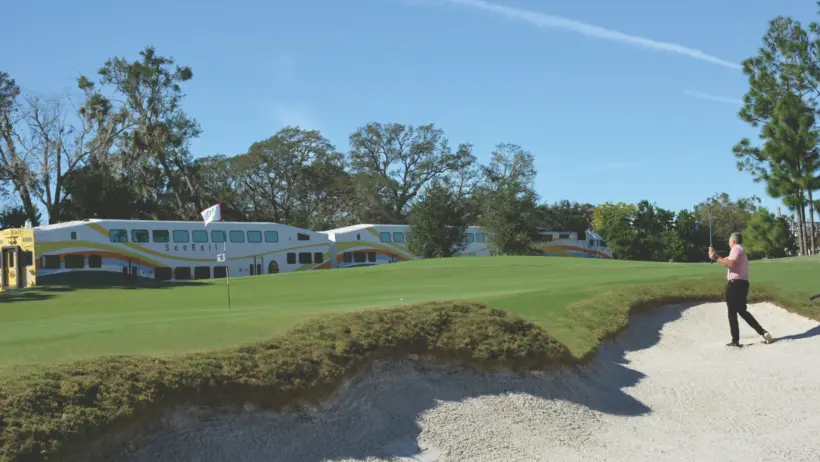
WINTER PARK, FL – Long story short: The putting greens at the popular Winter Park Golf Course have been rebuilt after they were accidentally killed in the spring, and players will get their first shot at them Saturday, August 1. As a bonus: Planned bunker work has been completed. An even bigger bonus: The price tag was reasonable.
For the short story long, keep reading.
Golf architect and well-regarded course shaper Keith Rhebb was in Pinehurst, North Carolina, sitting at The Cradle par-3 layout when he got word that the greens were dying on another incredibly popular short course. Eventually he would learn that the putting surfaces at Winter Park Golf Course – aka Winter Park 9, or WP9 – near Orlando had been accidentally poisoned.
Ed Batcheller, who worked as the superintendent at WP9 for nearly 20 years before leaving for the Country Club of Orlando in 2022, called Rhebb with the bad news. Rhebb said it was the day before April Fools, and at first he thought it might be a prank from his longtime friend or the result of some AI-generated spoof. If only.
Along with design partner Riley Johns, Rhebb had in 2015 and 2016 rebuilt Winter Park’s municipal course. Rhebb lives in Winter Park and often pops in at the course, and he has done follow-up work on the layout since it reopened a decade ago. It has since become a social media darling, a profitable community asset and a model for municipal golf across the country.
Explore how to live where you love to play Access community guides, golf real estate insights, trusted agent connections, and content built for passionate golfers.
The death of the greens, the results of a misapplication of weed killer left in a tank that was then used to apply fertilizer to the greens, raised eyebrows in golf’s architecture and agronomy circles around the country. For Rhebb, it was a gut punch.
“When I got home and went out and saw them, I was like, ‘I’m not going to get mad,’” Rhebb said. “Accidents happen. The only way I’m going to be mad is if we don’t fix this the right way, you know? We didn’t need to try to, you know, just put a Band-Aid on it, or limp them through, or try to grow them back and things like that. So that was the biggest thing, just making sure that the city was going to fix them right.”

After the course closed the greens in May, Johns and Rhebb dug in, literally. They rebuilt the putting surfaces and re-grassed them, with help from a course construction team that already was in Florida for another job. The course remained open throughout the spring and early summer, utilizing temporary greens.
Now the new greens are ready for play and will open to golfers Saturday, August 1. Rhebb said they’re better than ever. He and Johns pushed the greens back out to their original footprints and altered some of the internal slopes to create more hole locations to better accommodate all the players who flock to the course, locals and national visitors alike.
“We never in our wildest dreams imagined how popular WP9 would become,” Rhebb said, noting the course handles 45,000 to 50,000 rounds a year. “We needed more pin placements to handle the traffic.”
WP9 fans will notice such a difference right away on No. 1, a short par 4 with a green that features dramatic slopes up to the right and back, all tucked behind a bunker. The architects modified the front right portion to create a new hole location, Rhebb said, although he noted that it won’t be exactly easy to get to. That’s fitting for a hole that is reachable off the tee in one shot for many players.
The par-3 second hole also has a new hole location on the back left, where a mound behind the green bleeds into the putting surface. Before this recent work, golf balls wouldn’t come to rest on the mound, which served as a banked backstop of sorts. Now, Rhebb said, it’s possible to cut the hole in that section of the green, freeing up traffic from other portions of the green.
“You hate redoing greens, they were great, but we made them better,” Rhebb said. “You know, we took a situation that was a difficult challenge, and I think we came out of it on the other end better.”
The greens are the usually the stars of the show at any great golf course – not just the condition or speed of the grass, but the contours and tilts utilized by the architects. It’s especially true at WP9, where the par-35 course’s modest length of 2,480 yards isn’t much of a threat to many players. The greens, rising from the layout’s otherwise flat terrain, are another story.
Quite often at WP9 – especially when the pins are tucked as they are in the course’s Winter Park City Amateur Golf Championship each year – a player can be directly off the side of an elevated par 4 green in one shot and still wondering how to get down in three strokes to save par. The par-3 greens at Nos. 2, 7 and 8 in particular are more interesting than those found on many big-name, high-dollar courses around the world – this at a course that costs $35 for adults on weekends.
The work to renovate and improve these fun putting surfaces involved deep tilling, which revealed several inches of unintended organic material that had built up in the past decade. All that dead material was removed, as Rhebb and Johns took the greens back down to their sandy bases. After recreating the old contours in places or adding new ones in others, they installed Tif Eagle Bermuda grass, a favored greens surface in the South. The seasonal timing worked in the architects’ favor, too, as the greens will reopen less than four months after work began.
“If they had been killed in September, the course would have been out of luck for a long time,” Rhebb said. “But because it was May when they shut down, we were doing the work in the best growing season in Florida. … It was brutally hot doing the work, hotter than a normal May at home. Riley was burning up out there. I was burning up out there. The whole crew was burning up out there in that heat. But we got it done, you know.”
The work to the bunkers at WP9 already had been planned and was rolled into the project, Rhebb said. All but two of the bunkers were rebuilt with capillary concrete liners, which improves drainage. Two large traps, greenside at Nos. 3 and 7, will receive their liners next year. Contaminated sand also was removed from all the bunkers.
All told, the project cost about $250,000, Rhebb said. That’s a low price for such work in an era in which golf construction prices have soared since COVID. “Hey, I live in Winter Park and I’m a tax payer, too,” Rhebb said with a chuckle.
The fact is, all the work and expense likely would have been required in the next couple years regardless of the mishap. The bunker renovation and liner installation already was planned, and greens don’t last forever in Florida. It’s not uncommon for course operators to resurface greens every 10 to 20 years to maintain great conditions, even without such dramatic circumstances as those at WP9. Now the short course that has garnered such admiration in the past decade is primed to shine again, starting Saturday.
From the beginning of the first restoration a decade ago, “We just wanted to build something people could be proud of and have a great golf course,” Rhebb said. “Now, wherever you go, even international, when people hear you’re from Winter Park, they ask if you’ve played WP9. We never could have imagined that.”

Jason Lusk is Golfweek’s travel and golf course architecture editor, as well as the print magazine’s creative director. He has written for and designed Golfweek for more than two decades. The Central Florida resident also has a 2:42 p.m. tee time on Saturday at WP9 so he and several friends can return as soon as possible to one of their favorite courses in Florida.