
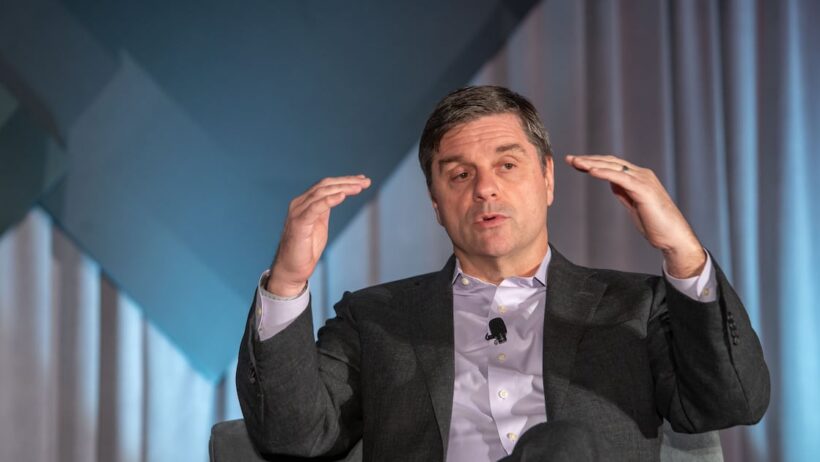
Brian Rolapp continues to bring the aggressive innovation approach he helped shape at the NFL to his position as PGA Tour CEO, whether that be with changing the competition model, scheduling, media deals or sponsorship. Rolapp, who came aboard last year as the tour was going through substantive changes to its business, likened the positive future for golf to other seminal league moments, such as basketball taking off after the ABA-NBA merger and football exploding after the NFL-AFL merger.
“The sports business is not that difficult,” said Rolapp, at SBJ’s Dealmakers event in Manhattan. “It’s all about the product. And if you get the best competitive product, people will reward you with the time and attention. And if they reward you with your time and attention, all the commercial stuff will take care of itself. Figure that out — media, sponsors and stuff — but it really starts with the product and it has to be the most competitive, valuable thing that you can create.”
The tour’s media rights come up in 2030, but in 2028, there will be substantive changes to the calendar with the creation of the Championship and Challenger series. Rolapp talked about the importance of media rights, which is a $30 billion per year business in the U.S. and continues to rise.
“It’ll go up because more and more money will be reallocated from scripted programs and other things that are more commoditized into sports live events, but it doesn’t mean it’ll feed everything,” said Rolapp. “That means that anyone who’s in the sports business cannot take that for granted and needs to continually focus on their product, how are they serving fans, how are they serving partners and how to make yourself the most valuable property out there.”
Rolapp walked through the structure of the Championship and Challenger series. Between February and August, the Championship Series will be contested three weeks on, one week off (including the majors and Players Championship). Meanwhile, the Challenger Series will consist of 20 events across the season, split between seven, stand-alone network TV tournaments and 13 more that will be played opposite the Championship Series on cable television. It’s expected that the seven network tournaments will take place during the off weeks for the Championship Series.
Tatum: NBA Europe on schedule
With a EuroLeague merger still uncertain and the clock ticking on a proposed fall 2027 launch, NBA Deputy Commissioner Mark Tatum said that NBA Europe’s timeline has not changed and the goal is to unveil ownership groups in Q1 of next year.
In a discussion alongside one of those presumed owners — RedBird Capital Partners’ Gerry Cardinale, who is expected to head the team in Milan — Tatum doubled down on the notion that, with or without EuroLeague, NBA Europe will become a reality on schedule. He declined to say what Year 1 would look like, although he implied there could at least be a qualifying tournament for the four non-permanent franchises. But he and Cardinale pointed out that Europe needs the NBA, considering EuroLeague has not earned a profit in its 26 years of existence.
“The reason why we will keep going is because we’re the ones that will be left standing,” Cardinale said of the stalemate with EuroLeague. “There’s not room for multiples of these things in the marketplace. … At the end of the day, I can’t imagine doing something for 26 years and not making a profit and not being able to pay for yourself.”
 RedBird Capital Partners’ Gerry Cardinale and the NBA’s Mark Tatum said NBA Europe will stay on schedule, with or without EuroLeague. Marc Bryan-Brown
Tatum confirmed that Arctos, Ares and Blackstone will be part of an arena development fund to help develop Americanized venues; that NBA Europe will have a commissioner or CEO separate from the NBA’s league office; and that Year 1 will look a lot different than Year 10.
“We’re taking a really long-term view of this,” Tatum said. “This is not going to be a one and done. This is going to take five, 10, 15, 20 years for us to really revamp the entire basketball ecosystem in Europe.”
Investors see sports’ next growth wave beyond team ownership
Sports’ blend of live audiences, scarce content and highly engaged fans continues to attract capital. But investors increasingly see the next wave of growth coming from the revenue streams built around teams, leagues and premium events.
That was a central theme during a panel featuring Marc Allera, CVC’s global sport group chair; Assia Grazioli-Venier, Muse Capital founding partner; Steven Justman, who has roles with Goldman Sachs, Excel Sports Management, TAIT, Cirque du Soleil and the Fever; and Michael LaSalle, Shamrock Capital co-president and partner.
For Justman, the strongest investment case begins with premium live experiences. Even with entertainment available on demand, consumers continue to seek shared experiences and show a willingness to pay for them.
“There’s a somewhat insatiable demand for premium live experiences,” Justman said. He described “premium live” as a durable asset class that also drives value through media rights and brand partnerships.
LaSalle said Shamrock evaluates sports opportunities through three qualities: premium live experiences, the ability to gather large audiences in real time and the strength of fan engagement. “It has tremendous engagement. It’s tribal,” LaSalle said of sports.
Grazioli-Venier identified another opportunity in fandom among women and properties capable of reaching men and women through the same product. Muse Sport’s portfolio includes an early investment in the NWSL’s Washington Spirit, U.S. and Italian SailGP teams and the Women’s Pro Baseball League.
“We do think that the female fan is a very lucrative one to tap into,” Grazioli-Venier said.