
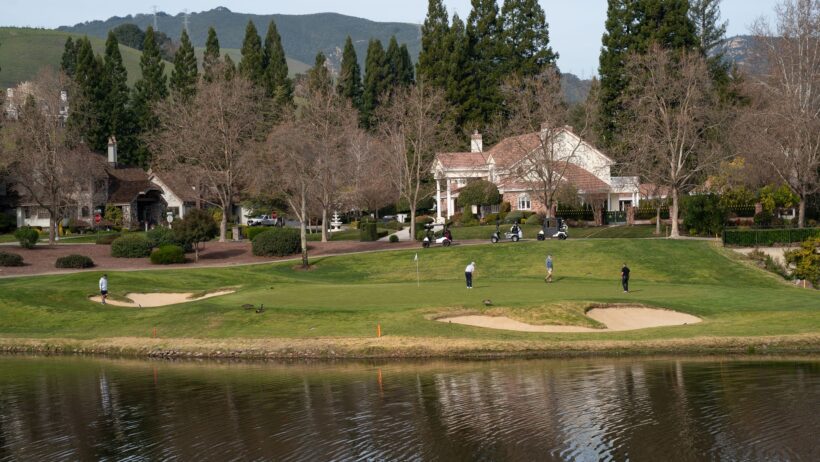
Golfers finish their hole in front of an accumulation of pond scum at the Falls Course at Blackhawk Country Club. Residents are expressing frustration at the potential for decreasing home value as a result of the sludge, mosquitoes and other concerns.
Don Feria/For the S.F. Chronicle
Pond scum grows in the stagnant pools of water between the rocks of a defunct waterfall of the Falls Course in Blackhawk, as seen Jan. 30.
Don Feria/For the S.F. Chronicle
The pond at a Blackhawk golf course wasn’t always a mess. Eight years ago, water cascaded out of a waterfall into the pond, a pristine feature of the posh Tri-Valley neighborhood where homes routinely sell for several million dollars.
Today, the pond water sits stagnant and murky green. Algae blankets the surface. Mosquitoes swarm above it. And residents like Laurie Cindric, who drives past it multiple times a day, can’t stop noticing.
“It’s been frustrating, it’s an eyesore,” Cindric said. “The condition just continues to deteriorate with storms.”
Article continues below this ad
Fixing the situation has proved elusive and wildly complex. The Blackhawk Country Club, which oversees the pond, has barely touched it since 2019, when a worker noticed a red-legged frog, a federally protected endangered species, living in the water. That discovery froze any plans to dredge, treat or restore what residents considered a neighborhood amenity. Some believe the neglected pond has dragged down their property values. Now, there’s movement to finally get the project moving, but it could cost at least $2 million.
The yearslong ordeal in the posh country club community shows what happens when a routine problem collides with environmental protections: even basic maintenance can become exceedingly complex and expensive, leaving property owners with a very tricky problem.
The situation gets messier when factoring in that the club doesn’t control all elements of the pond. The Blackhawk Homeowners Association owns the now-defunct waterfall that once spilled into the pond. The Blackhawk Geologic Hazard Abatement District, an independent state agency, is responsible for the West Alamo Creek that flows through the pond. Getting anything done requires the different groups to navigate a maze of county, state and federal permits and comply with the Clean Water Act, the Rivers and Harbors Act and the Endangered Species Act.
An accumulation of pond scum grows, worrying residents.
Don Feria/For the S.F. Chronicle
They’ve tried before. In 2018, the three groups spent months securing approvals from at least four government agencies. Then came the discovery of the frog. By 2019, they’d abandoned the effort due to the cost.
Article continues below this ad
Now the club is trying again, though the waterfall may stay broken.
“Everybody’s much more motivated to do the work now because it’s not getting better, it’s only getting worse and what is that going to look like in 20 years from now?” said Kevin Sullivan, the club’s director of agronomy. “Is it just going to be this big old bog or wetland that is going to smell of algae?”
Will Pickering, the chief operating officer at Blackhawk Country Club, said when he started working at the club 2½ years ago, he surveyed members on the issues they care about. The top issue, which nearly 2,000 respondents raised, in the survey’s comments section was the condition of the pond.
“They just drive by it every day, see how terrible it is, see how much it’s ruined the property values, it’s ruined the signature golf hole,” Pickering said. “The course and the clubhouse is called ‘The Falls’ after the waterfall that hasn’t run for several years.”
Geese gather in front of a defunct waterfall at the Falls golf course.
Don Feria/For the S.F. Chronicle
The problem has been building for decades. Crews built the golf course in 1985 and designed the pond as a “silt retention basin” to catch runoff from landslides on Mount Diablo’s ridges, Sullivan said. The sediment was supposed to settle there.
Article continues below this ad
For years, the club handled maintenance itself. When crews noticed the sandbar showing in 2005, they used an excavator to scoop out muck, work that didn’t require permits, Sullivan said. They did it again in 2011 and 2017.
But by 2017, the simple scooping they did wasn’t enough to address the problem. The club joined with the HOA and the hazard district to pursue permits for a full dredging. They got approval in 2019 to remove 2,000 cubic feet of material a year over five years. But then county biologists found the frogs.
Everything stopped. Engineers and consultants had to redesign the project to protect the frog’s habitat. The new plan required carving out an area where the frogs could live — unaffected by the dredging. The three groups planned to split the $600,000 cost of the project. The club would also need to hire a biologist to monitor the frogs permanently.
The groups all walked away. And the pond kept getting worse.
This time, the club and the hazard district are moving forward without the HOA, though it’s unclear why. The HOA board didn’t return requests for comment.
Article continues below this ad
Golfers drive to the green of Blackhawk Country Club’s Falls Course.
Don Feria/For the S.F. Chronicle
This time the club and the hazard district are planning to split the cost of the project, with the club paying two-thirds since the HOA is not involved, Pickering said. The club estimates that work to dredge the pond could cost about $2 million, plus ongoing maintenance. The club will pay a biologist to oversee the frogs. They’ve hired consultants to navigate what Sullivan calls “the complicated permitting process.”
The new plan includes a herpetologist to protect the frogs during construction. Vincent D’Alo, a principal land surveyor at Aliquot Associates, is working with the club on their plans. He said his firm intends to move the frogs to a different side of the pond and protect them from the dredging by putting up a fence. The herpetologist spotted the frogs as recently as six months ago when he went to survey the pond, D’Alo said.
D’Alo said he hopes to submit applications for the permit within two months. It can take up to eight months to get approvals. If the permits are awarded, the club will then communicate with members about the timeline, costs and funding.
And that’s without the cost of fixing the waterfall. The club, which doesn’t have authority over the waterfall, is focusing on restoring the pond, Pickering said.
Article continues below this ad
While club members say they are willing to potentially front costs to fix the problem, they said the waterfall is a critical piece to their desired outcome.
David Bowlby, a Blackhawk resident, said he wants the club, HOA and other entities to come together to present a solution that addresses the pond and the waterfall.
“I’d like to see both come together and be part of the total solution,” Bowlby said, adding that it will ultimately come down to the cost and what the Blackhawk community is willing to support.
Cindric echoed his sentiment, but noted the pond’s restoration is more urgent.
“It’s the signature of the whole Falls golf course and it’s prominently located in the center of the community,” Cindric said. “It’s unfortunate that it’s in the state that it is right now.”