
July 18, 2021, 7:00 a.m. PT

Jeff Jensen knows that the sheer volume of water needed to keep a golf course alive and green in the Coachella Valley can be alarming to golfers and non-golfers alike.
“That number does seem like a huge number, when you are talking 750,000 to a million gallons a day,” said Jensen, the southwest field representative for the Golf Course Superintendents Association of America.
Those numbers can be even more concerning when California is in a drought, as it is again.
Gov. Gavin Newsom in April asked for a voluntary 15% reduction in water use across the state. In May, Newsom issued a drought emergency for 41 of the state’s 58 counties, a number that was increased to 50 in early July, though Riverside County is not included. Newsom also codified that 15% voluntary request in an executive order this month, though that orders is still without mandatory cuts.
While Jensen and local golf and water professionals don’t expect official mandates from Sacramento on water usage for golf courses, other businesses, or households this year, future mandates are something the golf industry is already thinking about.
Love crosswords? Explore the Crossword page and play the new MidGrid Crossword.
With a major source of water for the southwestern states — Lake Mead outside of Las Vegas on the Colorado River — at historically low levels, Jensen is preparing for a new level of drought emergency declaration that he thinks will be coming by 2022.
Craig Kessler, chairman of the Coachella Valley Golf and Water Task Force which was established in 2013, says that for now, it is better for desert courses to take matters into their own hands by cutting usage and continuing conservation efforts rather than waiting for mandates for reductions.
“If they continue to do that and meet some not-so-onerous mandates, they can keep Sacramento out of their business,” Kessler said. “I think that is the underlying fear that came out in the last drought, that Sacramento could come and start mandating things.”
Lessons learned, but is it enough?
During the last drought which lasted five years and ended in 2016, many Coachella Valley golf courses cut water usage by eliminating acres of irrigated turf, converting areas to native desert and drought-resistant plants, and by switching from groundwater to non-potable supplies like Colorado River water.
“The actual water situation is much stronger; the conservation situation is much stronger in the golf industry,” said Kessler, who is also the director of governmental affairs for the Southern California Golf Association. “And because we are close enough in time (to the last drought), there were a lot of lessons that came out of that, it appears. And so I think we approach this one better.”
Some believe the efforts of the golf industry and the overall water savings from those efforts aren’t enough.
“I think it is a stretch to say that fully turfed golf courses are really a beneficial use of water,” said Joan Taylor, chair of the Tahquitz Group of the Sierra Club, which reaches from the Coachella Valley to the Morongo Basin and east to Blythe. “Here we are in one of the hottest and driest deserts in America and these vast swaths of green are absurd.”
Kessler argues that the golf industry needs to justify the water usage to skeptics with a message that a large part of the desert’s and the state’s economy could be damaged by letting golf courses dry up to save water. Kessler said that includes 8,000 jobs in the desert and more than $83 million in state and local taxes generated by the game, part of a $1.2 billion economic impact of golf in the state according to the California Alliance for golf, a nonprofit golf trade association.
“To ask the valley’s golf courses to curtail their use of water during a drought is a reasonable request that the valley golf community has always accommodated,” Kessler said.
Golfers understand the need to use thousands of gallons of water to keep courses alive, though some question whether courses can do more.
“I love playing the courses, even in the summer, and I know when it is hot they use more water,” said Carl Richards of Riverside. “But you can look at a course and see plenty of grass that isn’t really in play and might not be needed. And I know some courses have experimented with not being quite so green in the summer months.”
Others see the economic benefit of the water usage.
“The golf courses bring tourists here. They bring snowbirds here to live,” said Betty Rodgers of Moreno Valley. “How many houses in the desert are on golf courses? Those people live here for the golf, so the courses are important to the desert economy.”
Protecting the aquifer
Golf and water officials in the desert believe the golf industry is in better shape for the current drought because of changes and actions taken in previous droughts, said Jim Schmid, director of operations at The Lakes Country Club, a 27-hole facility in Palm Desert.

“It’s continuous. It not like, ‘Oh, it’s a drought, we’ll turn the faucet off and we will turn the faucet back on when the drought ends,’” said Schmid, also president of the Hi-Lo Desert Golf Course Superintendents Association. “When you remove that turf, it’s a hard-end savings that you are going to be able to carry forward. Every single year you are going to see those savings.”
Unlike many golf courses elsewhere in the state which rely heavily on groundwater, Coachella Valley golf courses have sought to reduce reliance on the local aquifer, known as the Coachella Valley Groundwater Basin.
No one knows exactly how much water sits below the desert cities. A 1964 survey estimates the aquifer holders 39 million acre-feet down to 1,000 feet, but Katie Evans, director of communications and conservation for the Coachella Valley Water District, says the district knows the aquifer is much deeper than that. Protecting that groundwater, the main source of water for households and businesses in the desert, is a focus of the Golf and Water Task Force. That panel includes officials from local golf courses and water districts.
“Because the aquifer is literally the lifeblood of everything that happens in the desert, as important as it is reducing the overall water usage footprint over time, we do put more emphasis on the health of the aquifer and getting it into a state of replenishment,” Kessler said. “The one thing golf can do to that end is wean itself off of pumping (from the ground) to the greatest extend possible.”
Desert courses have been moving away from aquifer water in the last decade, said Evans, whose district serves 105 of the 121 courses in the desert. But Taylor says the need to protect the aquifer should be more urgent.
“We have to recognize that we are in a desert and the aquifer isn’t endless and that recycled water has other beneficial uses.” Taylor said. “The little guys are being asked to conserve, It’s time for the golf courses to really step up to the plate.”
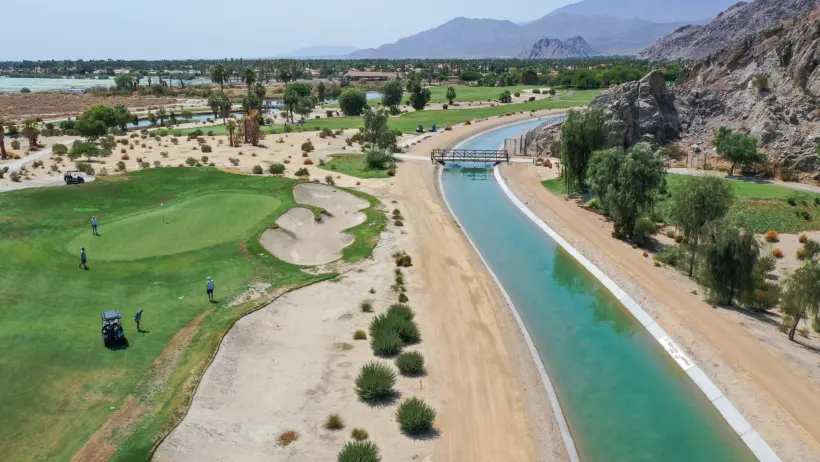
Courses can use Colorado River water delivered to the desert through the Coachella branch of the All-American Canal, recycled water from CVWD plants, or groundwater pumped from the aquifer. The water district can replenish and store water in the aquifer with rainwater and snow melt during wet years, like 2017 through 2019, or with river water.

Within the CVWD boundaries, 36.5 18-hole equivalent golf courses use river water. Another 17.5 courses use a combination of river water and recycled water, meaning 54 of the 105 courses in the CWVD area no longer uses groundwater for irrigation. According to the CVWD Annual Review recently submitted to that board, another 41 golf courses have pledged to switch from aquifer water to the non-potable recycled or river water in the coming years when possible.
“Part of it is you have golf courses that will do (the switch to non-potable water),” said Schmid, who has been at The Lakes for 10 years and in the desert for 16 years. “They are just waiting for CVWD to bury the pipes underneath the streets to get that water close enough to their facilities to where they can make that connection.”
A focus on turf reduction
Another key to water efficiency in a drought is converting irrigated turf to native, drought-resistant landscaping.
Desert courses can range from as few as 70 acres to as many as 200 acres of turf for an 18-hole course. Through a rebate program in the last drought, CVWD gave $15,000 to golf courses for each acre of irrigated turf removed, up to 7 acres per course. That $1.5 million program, funded by a grant applied for by the Golf and Water Task Force, is now out of money, but Evans said CVWD is constantly looking for new funding through grants or from the state for similar programs.
In the past six years, CVWD reports 165.5 acres of turf have been removed from a combined 26 courses in the desert, producing a savings of 956 acre-feet of water per year. An acre-foot of water — the amount needed to cover an acre of land with 12 inches of water — is 325,851 gallons. The average golf course in the desert uses 2 to 3 acre-feet of water per day. Overall, CVWD reports 41,101 acre-feet of non-potable water were used in its district in 2020.
For all that golf courses have done since the start of the last drought to cut down on water usage, Evans said that, much like typical households and other businesses, not every course has instituted all the conversation efforts they could.
“One of the things we talk about a lot with drought is people get what we call ‘drought fatigue,’” Evans said. “So when we are messaging ‘conserve, conserve, conserve, we are in a drought, we are in an emergency,’ just like when people got COVID fatigue, they stop hearing it or that message becomes less effective. But the golf industry has really stayed engaged with us since the last drought.”
Some facilities, like Ironwood Country Club in Palm Desert, removed nearly 40 acres of turf from 2014 through 2016 while also taking out two lakes with a surface area of 1.2 acres and replacing those with native desert areas. The Lakes is a more typical example of what can be done to save water with turf elimination. Rather than taking grass away from playing areas of the course, Schmid said the process at The Lakes started about six years ago when it switched from aquifer water to a blend of recycled and river water. Five years ago the facility took out about 5 acres of turf from the perimeter of the property along Country Club Drive, Cook Street and Eldorado Drive.

“Since then it’s just kind of been an ongoing program, just slowly but surely removing turf,” Schmid said. “We kind of nibble around the edges. We are always looking for opportunities to continue that tradition around from turf that we can afford to part with to a transition of those large efficient landscapes. We have a small project going on right now.”
Golf courses also have updated irrigation systems with better hardware and updated computerized equipment to maximize water usage.
“Less than a decade ago it was very rare to see a soil moisture meter on a golf course,” Jensen said of equipment that analyzes water content in the ground. “And now it is rare that you would go to a golf course that doesn’t use one.”
Taylor would like to see fewer golf courses in the desert, and for operators to transform those that do exist into so-called target golf courses with far less turf and more native desert landscaping. Those courses could still have an economic impact for the desert without using as much water, she said.
“I don‘t see the golf courses disappearing, although some may,” Taylor said.
Tenuous water supply in the West
Jensen, who lives in Henderson, Nevada, and oversees GCSAA operations in California, Nevada and Arizona as well as Hawaii, agrees that Coachella Valley golf courses are in a better position than courses in Nevada and Arizona, where mandates are already in place. Cities like Las Vegas are already mandating the elimination of “non-functional” grassing, which will eliminate more than 30% of all grass in the city of Las Vegas. Recreational grass, such as golf courses and parks, as well as grass for residences, are excluded from the mandates for now.
Jensen said that because southern Nevada is so dependent on Colorado River water, water officials have pushed to get 900 acres of irrigated turf eliminated in the past two decades, in part through financial incentives for courses.
“We have saved over 2 billion gallons of water on that program alone,” Jensen said, “That program is very well-funded.”
Jensen and Kessler said mandates are already in place in Nevada and Arizona because those states have worse water situations than the Coachella Valley.
“The water supply situation in the Coachella Valley is significantly better and more secure,” Kessler said. “Southern Nevada and Arizona simply don’t have the benefit of one of the world’s deepest, richest aquifers and California’s generous Colorado River allocation.”
Jensen acknowledged that river water might not be as reliable in coming years as the drought deepens and Nevada and Arizona fight California for allotments.
“Obviously the Colorado River, Lake Mead, we are going to go into another tier of drought. They will probably announce that in August,” Jensen said. “(Allotment changes) will take place in January of 2022. Arizona as a state is talking about approximately an 18% cut, and certainly some of that is going to go to the golf industry there. So as the levels of Lake Mead diminish, as we get to a certain level, California is going to feel cuts down the road. Certainly, some of those could affect our courses that are using Colorado River water.”
Kessler and Jenson both say golf courses and water agencies in the desert and through the southwestern states must accept that water will be more scarce and valuable in the future because of droughts.
“The old numbers just don’t work anymore, because it is warmer and it is drier than it used to be, so that changes things, too,” Kessler said.