

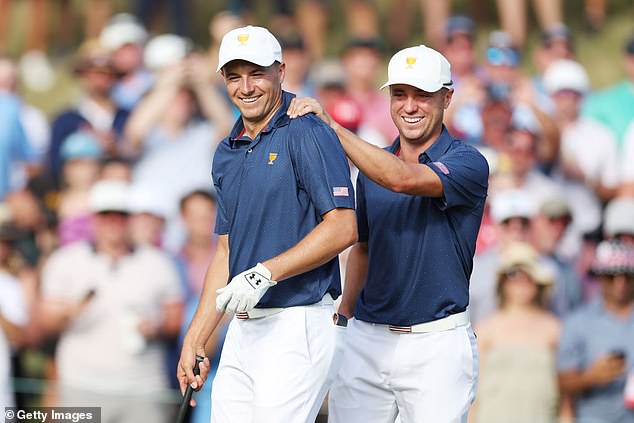
It’s the Tuesday morning after the 2024 Open Championship and a couple of special guests arrive at The Island Golf Club.
At first glance, the coach that coughs out the dozen or so in the travelling party looks like any regular bunch of American tourists who drive in through the gates of the Donabate venue on Dublin’s north coastline.
Except these are no regular Joes. Well, certainly not the couple of very familiar faces that step off after the sleepy bus ride.
The entourage that follows them to the first tee offers one clue. The boombox banging out tunes another. Could it really be?
Two former World No1s — who were literally on television competing for a Major less than 48 hours earlier — are here and ready to have the craic and let their hair down.
Good buddies Justin Thomas and Jordan Spieth have long had an Irish road trip planned. At least in theory.
A bucket list golf trip, taking in the picture postcard links along the East Coast —– The Island, Portmarnock, The European Club and County Louth.
Think Bill Murray’s current television series, ‘A Course Called Ireland’ except with two of the faces of the PGA Tour who had just competed at The Open Championship at Royal Troon.
And on the very Tuesday after the tournament, here they are.
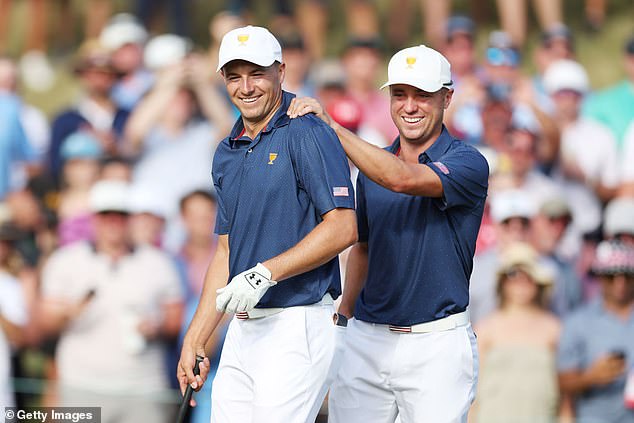
Jordan Spieth and Justin Thomas had a great time on a recent visit to The Island in Donabate
Humphrey Kelleher’s privilege as president of The Island Golf Club in 2024 meant he was one of the few in on the visit that would be recorded for an episode with Smylie Kaufman for his own YouTube show and podcast.
The former Dublin hurling manager, author and keen historian has seen plenty over the years in a sporting context — he’s a former captain and member for almost 50 years — but he wasn’t quite expecting two players with five majors to fully embrace the céad míle fáilte and make themselves right at home.
‘There were about 12 or 13 in the group and I went out to see them on the third or fourth hole.
‘So I heard this loud music being played — I was really mad because I thought one of our members had their phone on and I said, “Oh God, these fellas, we’ll be upsetting them.”
‘But when I got up to the tee box I couldn’t believe… there was a guy and he had the music as part of their setup.
‘We talk about decorum and making sure you stay quiet on the tee — “shuuussh, don’t say a word” — and the next thing this music is blaring out. They looked like they were having a ball.’
They were. At one point, Thomas took the caddy’s bib and let his local bagman play the shot.
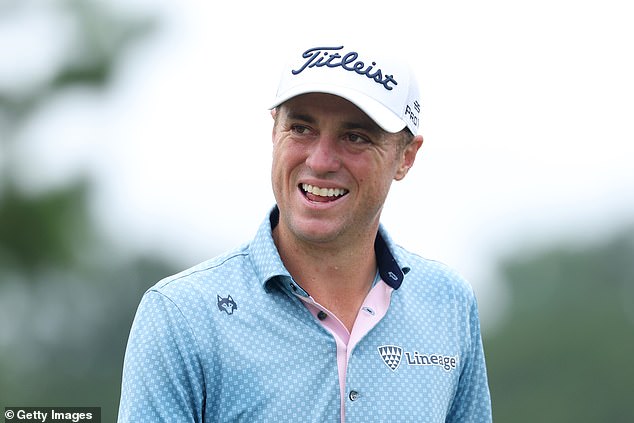
Justin Thomas waxed lyrical about his experience at The Island as did fellow pro Jordan Spieth
The connection came about via Island member Gavin Moynihan, who played with Thomas during his time at the University of Alabama.
When the podcast aired, Thomas waxed lyrical about the day – and the whole trip. Spieth described it as ‘one of the coolest courses’ he has played.
‘If I was to join a club, The Island is the one I would join. The reason why? The vibes and the people there.’ That was Kaufman’s own take on the trip, himself a PGA Tour winner.
Rewind just over 50 years and there would have been no entrance by bus.
Thomas and Spieth would have experienced something truly unique in world golf: a boat ride to the first tee.
Suddenly, the club crest would have made perfect sense: a rowing boat as the defining image, framed by a lark above and two golf clubs crisscrossing — the date 1890 a nod to how it even predates its illustrious neighbour Portmarnock.
Because until 1973, ‘The Island’ was just that. At least for all those who played it and made what has to be golf’s ultimate journey to the first tee — via boat.
The sculpture of the rowing boat, outside the clubhouse, is a nod to a unique history.
THE HISTORY
‘In September 1887 four men rowed across the channel which separates the North Dublin village of Malahide from the spur of land to the north known locally as the Island. Their mission was to survey the wilderness and assess its suitability as a golf links.’
This visionary boat journey is described thus in the first hand-written account of The Island’s history by John Horish, a farmer who lived in the house at the entrance to the club and whose father did most of the work preparing the links.
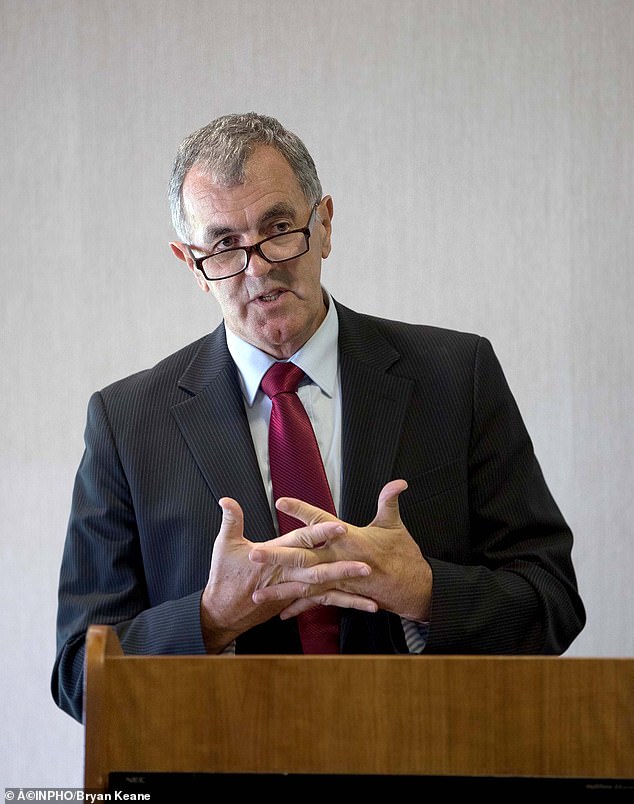
Humphrey Kelleher was president of The Island in 2024 and is steeped in the club’s history
Kelleher takes up the story. ‘The foundation of it is very interesting because what happened was, there were members of nearby Royal Dublin [Golf Club] of a particular persuasion shall we say, Church of Ireland, that weren’t allowed to play golf on the Sabbath.
‘So these three or four guys decided that they’ll do something about it. And they were standing at where The Grand Hotel in Malahide is and looked across and they saw that bit of land and they went over and bought it.’
The founder members would number 10 in total and were collectively known as the ‘Syndicate’.
‘They were bankers and solicitors and stockbrokers — you had to be in the right crowd to get into the club. They decided who’d be allowed in who would not be allowed in. Golf was only for a certain few in those days as you can well imagine.’
And yet, the Ladies’ branch of the club was trailblazing in its own way.
The great lady golfers of The Island were Mabel Harrison, Janet Jackson, Patricia Jameson, Sheelagh Jameson, and Pat Walker.
Jackson, for example, won the Ladies’ Close Championship six times. Walker was selected for every Irish team from 1928 to 1938 and went on to become the first Irish player to be selected for the Curtis Cup in 1934.
It’s worth emphasising that from 1890 to 1973, access to and from the links was by rowing boat from a slipway in Malahide.
‘I had a history night when I was president,’ adds Kelleher ‘and I had people telling stories about what happened and one story was that the guys were on the tee at, say, two o’clock and they got the boat across around half one or so.
‘At that stage it was an engine in the boat, it wasn’t just rowing, but the motor engine conked out and the boat drifted down to Portmarnock Beach.
‘And the guys had to get out with their bags! They disembarked at Portmarnock. And no doubt they didn’t get on the timesheet on time!
‘And there was no way to get back — I’d say they had to get a bus back from Portmarnock to Malahide to go home.’
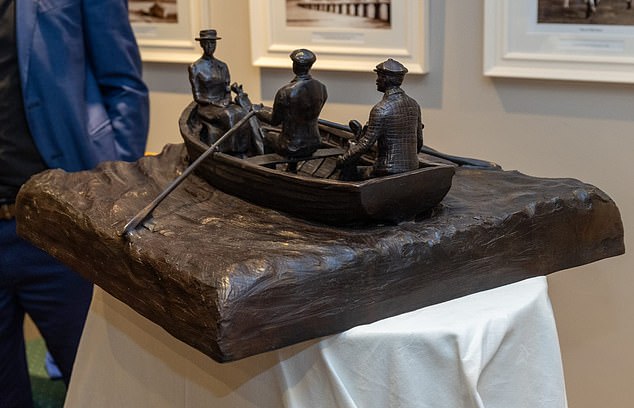
A sculpture of the famous boat by renowned artist Paul Ferriter, son of Donegal GAA star, Seán
THE BOAT
Philip Quinn was one of ‘the boat people’ as he quaintly puts it. His mother, Kitty, was a lady captain and his father, Maurice, was also immersed in the club.
Perhaps it was those unique journeys as a kid that stoked the imagination of someone who would grow up playing The Island — and end up covering The Masters and playing Augusta in a career as a sportswriter that would see him bear witness to so many indelible Irish sporting moments.
‘I can remember 1970, my first competition. I was eight years of age. Every Easter there was always what they called a parent and child competition over the old short nine holes. You brought a prize and you won a prize.
‘I remember I played with my mother’s friend, a Mrs McMahon, who was the lady captain, and I remember winning a 1970 World Cup football and an Easter egg and I thought all my birthdays had come together. Out on the road in Malahide with a World Cup football.
‘It was most unusual, probably one of the very few clubs that you can only access by boat. Most of the original members were from Malahide — well-to-do, landed gentry, living close by to Malahide railway station.
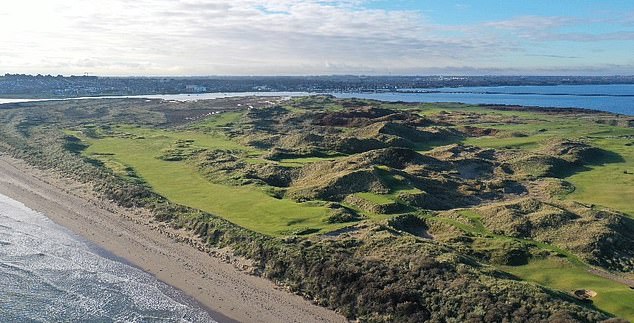
The Island is one of the most scenic golf courses in the country with stunning views all round
‘So to get across the links that they spotted when they formed the links in 1890, they said, “well, the only way across there is by boat”.
‘The local boat service was provided by the Hatch family for years, and they ran a service over from the jetty, which is still there, across the Broadmeadow estuary, across to the links.
‘Johnjo Hatch was the fellow who ran it when I was there. The boat ran from dawn to dusk, every half hour.
‘That was the rule. So if you wanted to get across there, you went down to the jetty and you just hung around for a little while, hoping that Mr Hatch would turn up with his little boat — outboard motor, no cover.
‘You would put the golf clubs in, lean across the side. It was a short run across the channel. If the tide was in, it might take 15 minutes, if the tide was out, it took half that.
‘If the tide was out, you also had a long walk across the soft sand to get to the bridge that brought you up to the clubhouse.’
What was also unique was the system of notifying this special water taxi.
‘If you were coming back from the clubhouse, there was a big disc on the side of the clubhouse wall and it was green, but when you opened it up, it was white with a red diamond, and that was visible from across the shore of Malahide.
‘So Mr Hatch could see that somebody wanted to come home, and then he would come across in his little outboard motor.’
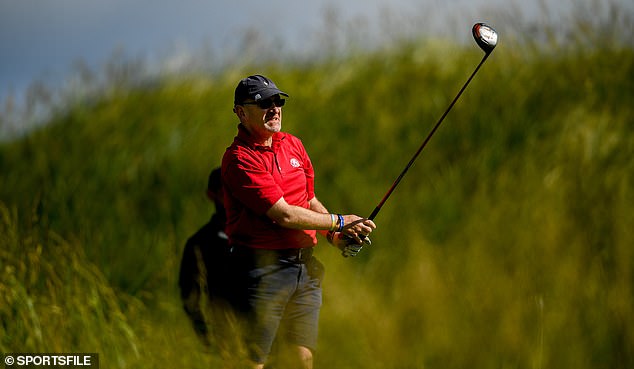
Philip Quinn recalls the boat: ‘It was wonderful, it was mad. I’d say it fitted about 16 to 18 max.’
HOME FROM HOME
If it all sounds a bit wonderful and mad, Quinn says it was all of that.
‘It was wonderful, it was mad. I’d say it fitted about 12 max, with clubs. You might have got six on each side.
‘This was an old outboard motor yoke that went “phut-phut-phut-phut,” and it was choppy. I remember, like, I still see the spray spraying up in my face, and Johnjo, with the sort of Captain Popeye hat and the cigarette, and you were trusting your life with him. And he never lost anybody!
‘So if it was a big day like the Captain’s Prize, you’d have to go across and back six or seven times in the morning to get everybody across.
‘I remember my mother was a lady captain and an honorary life member, which she took great pride in being.
‘Now there was no alcohol license in the golf club. But she said when it was Captain’s Prize Day — the ladies had their own Captain’s Prize — they got a special licence to serve alcohol.
‘And she would tell me stories, and male members told me stories as well, that the boat would bring “x” number of people over on the morning of the Captain’s Prize.
‘And then when they were doing the tally to get everybody back, there’d be a few people missing. They might be found in the dunes the next morning, sleeping off a hangover!’
The original clubhouse, a quaint wood and corrugated-iron pavilion, was situated overlooking the estuary.
In 1973, a new clubhouse was built at the other end of the links at Corballis, making the club accessible by road, and the regular boat service to the club was discontinued.
‘It was a place of wonder,’ says Quinn.
‘And I was convinced as a young fella, that it was an island, that there was no way around it. I was very disappointed when I got to about 11 or 12 to realise that there was a back road.’
As Kelleher explains: ‘There was no health and safety in those days! Some people brought caddies with them and they were tightly packed in. There were no lifeboats or lifebelts so you literally sank or swam!
‘There are still stubs of the jetty there for people to see. When I was president, I put up a photograph in the clubhouse so that people could put it in perspective because the common thread there was The Grand Hotel in the background.’
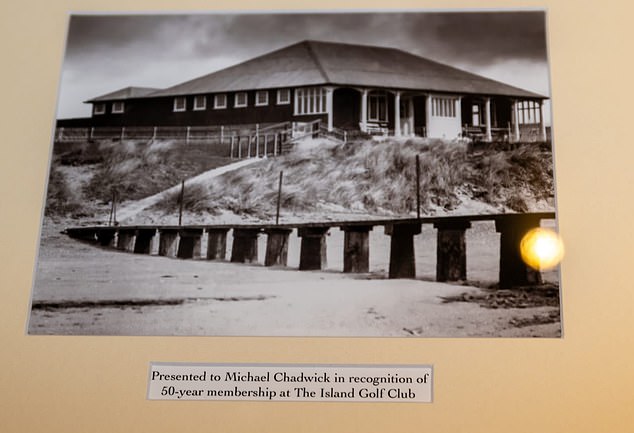
A photograph of the famous old clubhouse, still remembered fondly by club members
CHANGING TIMES
The game changer, from a membership perspective, was the ‘Syndicate’ recognising the need for a new generation to come through and handing it over to ordinary members from 1952.
Family ties connected the story of a first Senior Cup success in 1967 and then a second in 1983.
There were two Rogers brothers on the ’67 winning team, Bernard and Liam, with Bernard and a third brother Kevin on the ’83 team.
The Kanes, father and son, Peter and Raymond, were on the ’67 team, with Raymond there in 1983. Bernie Moore played in both finals too.
Ryder Cup hero Philip Walton is an honorary member while Paul McBride has just got his own card on the HotelPlanner Tour.
Gavin Moynihan’s golf talent took him from rubbing shoulders Stateside with Thomas to the European Tour.
A course redesign amidst rolling duneland makes it a long-established spot for hosting top tier competition, whether that’s the Men’s or Ladies Irish Close Championship, the Irish PGA Championship or, its current billing as a qualifying venue for The Open Championship proper.
Accessibility issues, given that narrow, coastal approach road, is the chief stumbling block to hosting flagship events like the Irish Open or The Open, given the quality of the course design and challenge presented, where each hole has its own name and its own backstory.
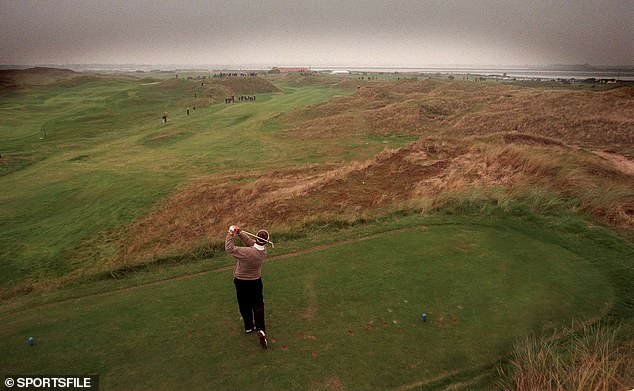
A course redesign amidst rolling duneland makes it a long-established spot for hosting top tier competition
Hole 11 — ‘Cricket Field’ — is bound up in a famous visit by renowned cricketer WG Grace.
It’s why the likes of Justin Thomas and Jordan Spieth had a ball and couldn’t say more about their whole Irish golf getaway.
Maybe, for the 150th anniversary, it will be worth recreating that boat ride.