

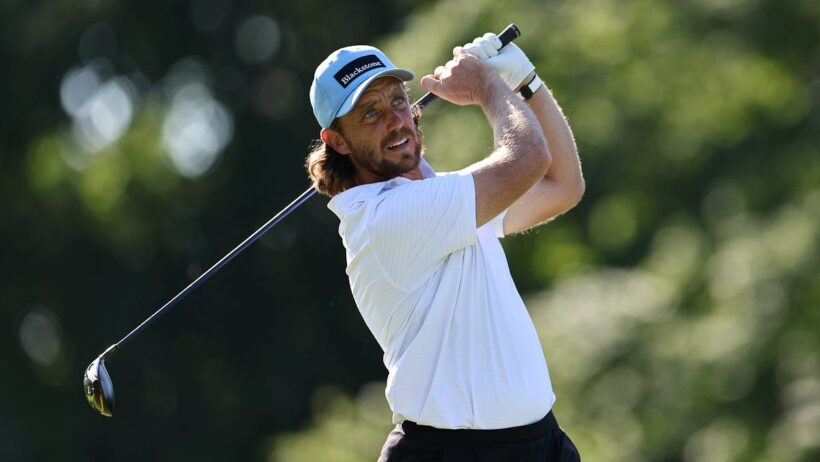
 Tommy Fleetwood of England plays his shot from the 18th tee during the final round of the the Memorial Tournament presented by Workday 2026 at Muirfield Village Golf Club on June 07, 2026 in Dublin, Ohio. (Mike Mulholland/Getty Images)
The Sunday charge up the leaderboard at a Major championship is something every golfer fantasizes about — producing a number that puts the rest of the field on notice, and maybe even steals the tournament before the leaders realize what happened.
Tommy Fleetwood knows what that feels like better than just about anyone — well, except for the whole “stealing the tournament” part.
In the 2018 U.S. Open at Shinnecock Hills, Fleetwood began Sunday six strokes behind the co-leaders and outside the Top 20. He proceeded to go on one of the great final-round scoring binges in golf history, making eight birdies — including four straight at one point on the Back 9 — and shooting an impossibly low 63, tying the tournament record.
But a missed 8-foot birdie putt on the 18th green proved costly when Brooks “All He Does Is Win Majors” Koepka managed his way to finish 1 stroke better than Fleetwood, despite the Sunday heroics, leaving the Englishman in sole possession of second place.
Then, incredibly, Fleetwood did it again. At another U.S. Open 5 years later, Fleetwood began Sunday in 38th place, 12 shots off the lead, before making four birdies and two eagles (!) in the first 14 holes of the round — narrowing the lead to four strokes with as many holes to play, before finishing five back in the end. With those two performances, Fleetwood joins Greg Norman as the only player since 1958 with two of the Top 20 best final-round Major performances relative to the field average that day:
One other thing he has in common with Norman, unfortunately: Neither of them actually won the tournaments where they made their desperate final climbs up the leaderboard. And while Norman did win Majors elsewise, at the British Open in 1986 and 1993, Fleetwood has never come closer than second place at that 2018 U.S. Open, and again at the British Open in 2019.
Now, Fleetwood will return to Shinnecock Hills, site of that epic (but ultimately failed) comeback bid, for this year’s U.S. Open — which starts Thursday — in its first time hosting a Major since 2018. Surely, he would take another final-round 63… but it would be even better to not need it.
For many years, another British “-wood”, Lee Westwood, was the answer to golf’s most ignominious title: Best Player to Never Win a Major. And, technically, Westwood is still the most accomplished player on the career Data Golf Points list (No. 19 since 1983) without a Major title to his name. But among the players who’ll be in this year’s U.S. Open field, Fleetwood (No. 77) is second only to Rickie Fowler (No. 49) among the Major-less ranks. At No. 6 in the world, he is also second to No. 4 Cameron Young in the Data Golf world rankings among would-be first-time Major champs.
And unlike some of the other names who rank highly in either category, he has a realistic shot at the victory: Fleetwood currently sits tied for third in the Polymarket odds to win the tournament, having produced one of the best True Strokes Gained seasons (+1.67 versus the field per round) of his career so far in 2026, despite a couple of disappointing showings at the Majors to date.
Statistically, there was a very good reason why both of Fleetwood’s record-challenging final-round performances happened at the U.S. Open — and why the best of those came at Shinnecock specifically.
Fleetwood is not a long-bomber of a player — his driving distance only ranks in the 49th percentile of players, per Data Golf — which is the one weakness in his game relative to other top players. But he is very accurate and great both approaching and around the green, plus strong with the putter, a combination that fits perfectly with the U.S. Open’s tendency to punish the slightest mistakes.

In addition to outperforming expectations at Shinnecock Hills when he last played there in 2018, Fleetwood checks in with the fifth-highest “course fit” adjustment for how Shinnecock projects to play in 2026, based on Data Golf’s model — trailing only Russell Henley and Si Woo Kim among players with 2 percent Polymarket odds or higher.
Looking at the relative importance of different skills at the course, it’s easy to see why: distance takes a back-seat to accuracy, approach shots and touch around the green, which happen to be Fleetwood’s best categories.

There are no guarantees in golf. Fleetwood has had the statistical profile of a Major champion before, and he’s had the Sunday rounds of a Major champion before, too. But he’s never put it all together to earn the trophy at the end.
If he’s anywhere near the lead this time, though — especially at a course where he already knows he can go historically low — the rest of the field should probably feel a little nervous. Fleetwood has spent years proving he can scare Major tournament leaders on Sunday. Maybe at Shinnecock, he’ll finally do more than that and escape the dreaded “Best to Never Win a Major” list at last.
Filed under: Golf, History