


Twenty editions in, the Abu Dhabi Championship has a new date, a new role in the Play-Offs and a course that bites back when the wind blows. Here’s how it sets up
For most of its history, the Abu Dhabi Championship opened the European season in January, when players arrived still shaking off the winter. The 21st edition, at Yas Links from 5-8 November, sits at the other end of the calendar, and it now carries more weight.
RELATED: Rory McIlroy confirms Abu Dhabi Championship return as Aldar named title partner
Since 2024, the event has opened the DP World Tour Play-Offs. The top 70 available players on the Race to Dubai tee it up on Yas Island, and the top 50 after Sunday move on to the DP World Tour Championship at Jumeirah Golf Estates. The fourth Rolex Series event of the season offers US$9 million (approx. Dhs33 million) and 9,000 Race to Dubai points. Around the qualifying line, the week is about reaching Dubai. At the top of the rankings, it is the first of two chances to settle the season.
What’s at stake
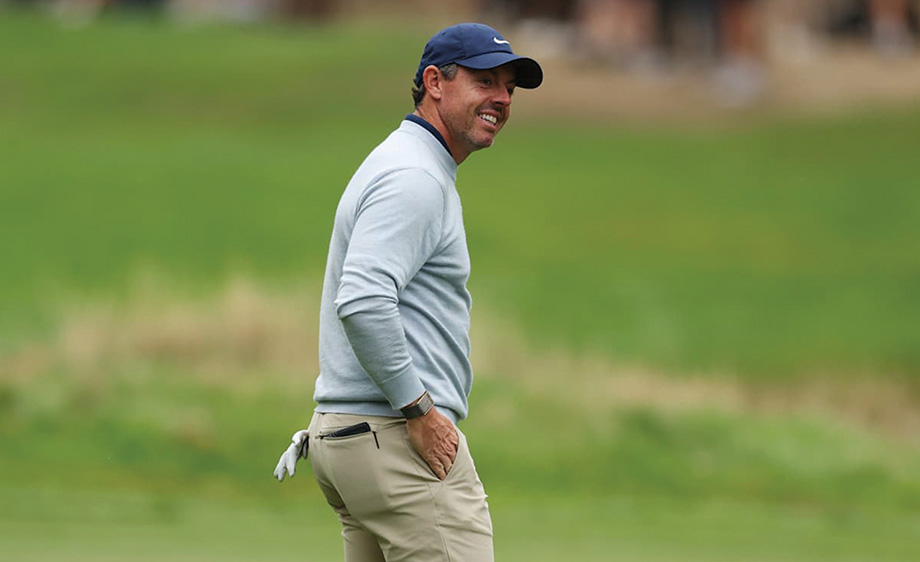
At the time of writing, Patrick Reed leads the Race to Dubai. He won the Hero Dubai Desert Classic in January, lost a play-off in Bahrain the following week and then won the Qatar Masters, and he has stayed at the top of the rankings since. Rory McIlroy, the Masters champion, is chasing an eighth title as Europe’s No. 1, which would draw him level with Colin Montgomerie. A share of second at Wentworth last month cut Reed’s lead to a little over 300 points, on a week when Reed retired injured during the second round. His fitness is the unknown heading into the final stretch.
Third is Eugenio Chacarra. The 26-year-old Spaniard left LIV Golf, won his way back on to the DP World Tour at the 2025 Hero Indian Open, and this summer won the KLM Open and the Open d’Italia in consecutive starts. With a PGA Tour card all but secured, he arrives with less to lose than most.
“I don’t need to focus on making it to Abu Dhabi and Dubai,” he says. “That’s a great thing, to play these events with a little less pressure. Rory and Patrick are two world-class players, but I know if I play my best, I’ve got a good chance. My goal is to win the Race to Dubai and finish the year in the top 15 in the world, so I can make my debut on the PGA Tour a little easier.”
From Abu Dhabi Golf Club to Yas
The tournament spent its first 16 years at Abu Dhabi Golf Club, where Chris DiMarco won the first edition in 2006 and Martin Kaymer won three of the next five. His eight-shot victory in 2011 remains the largest winning margin in the event’s history. Tommy Fleetwood won back-to-back in 2017 and 2018. The event joined the Rolex Series in 2019, when Shane Lowry led from start to finish, moved to Yas Links in 2022 and switched to November two years later, when Paul Waring won after opening with a course-record 61.
 David Cannon/Getty Images
Last year Aaron Rai missed from three feet for par at the 14th, then hit a 5-iron to eight feet at the 16th and holed an 18-footer at the 17th to catch Fleetwood. Both missed birdie putts at the 72nd to finish at 25 under, a tournament-record 263. Rai won at the first extra hole and has since added the US PGA Championship.
McIlroy’s name is still missing from the honours board. He has finished second here four times, including one-shot defeats to Robert Rock, Pablo Larrazábal and Gary Stal, and last year closed with a 62 to miss the play-off by one.
The course
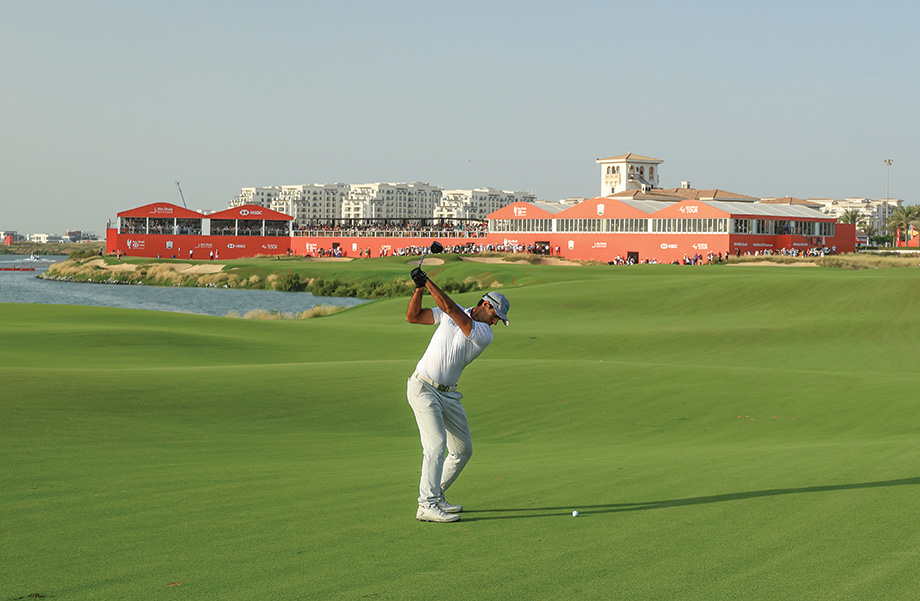
Kyle Phillips, the architect behind Kingsbarns and Dundonald, opened Yas Links in 2010. It plays as a par 72 of around 7,400 yards, with eight holes running along the coastline. It is a links in the sense that matters: firm, fast-running turf on warm-season grasses, with the wind as the main defence.
 Yas Links Abu Dhabi
“The golf course is incredible: the conditions, the layout, how beautiful every shot is,” says Chacarra, who made his debut at Yas last year. “It makes you move the ball both ways, right-to-left, left-to-right. When the wind doesn’t blow, it’s a course that you can go low. But if it starts blowing, it gets tough.” He singles out the holes facing the water, 7 to 9, 14 and 16 to 18, as the stretch where rounds are made or lost.
The 2nd has a new elevated back tee, about 25 metres further back, which brings the fairway bunkers into play on what had become a driver and a wedge.
The 9th, the Cape hole, asks for a carry over water on the right, and the more of the corner a player bites off, the shorter the approach to a green that falls away at the back. Its bunkers have been reworked with native grasses.
The 11th, a par five, is where Waring made the tournament’s first albatross in 2023.
The 17th is a par three played over a bay.
The 18th is a par five of more than 600 yards, with the shoreline running up the left. Neither Rai nor Fleetwood went for it in two last year.
RELATED: Rahm signs up for Abu Dhabi debut as Race to Dubai nears end
Corey Finn and his team have made firmer greens the focus this year, so approaches should release more. If the wind arrives as well, the winning score will look nothing like last year’s.
Who to watch
 Richard Heathcote/Getty Images
Rai and Fleetwood have both played Yas well, McIlroy has more reason than most to want this one, and Reed’s schedule depends on his recovery. Chacarra, Open champion Ryan Fox and the South Africans Jayden Schaper and Casey Jarvis all have Race to Dubai business to settle, and Waring is worth watching on any week the wind stays down.
The Record Book
21 – editions of the tournament, including 2026.
2006 – Chris DiMarco wins the first edition at 20 under par.
19 – Holes-in-one in the event’s history, starting with Darren Fichardt’s ace in 2006.
3 – Wins for Martin Kaymer (2008, 2010, 2011), the most by any player.
8 – Shots, Kaymer’s winning margin in 2011 and the largest in the event’s history.
2 – Wire-to-wire winners: Kaymer in 2008 and Shane Lowry in 2019.
2017–18 – Back-to-back wins for Tommy Fleetwood.
2 – Paul Waring’s score at the par-five 11th in 2023, the tournament’s first albatross.
61 – Waring’s opening round in 2024, the course and tournament record.
263 (–25) – The record aggregate, shared by Aaron Rai and Fleetwood in 2025.
Getting there
Entry is free on Thursday 5 and Friday 6 November with pre-registration at abudhabichampionship.com. Weekend tickets start from Dhs75, and under-18s go free with a ticket. Bar On Nine starts from Dhs170, including a Dhs100 food and drink voucher, and the Championship Chalet on the 18th from Dhs1,600.
Before the gates open
Corey Finn, director of agronomy at Viya Golf Abu Dhabi, on a four-month build-up in the heat, why firmness matters more than speed, and what’s new at Yas Links for 2026.
 Andrew Redington/Getty Images
When does preparation for November start?
The day after the last one finishes. We review last year’s tournament straight away and work on anything that wasn’t good enough. This year that meant a drainage and bunker project behind the 18th green, where the hospitality stands and irrigation had left it too wet. The intense work runs from the end of July to November. About four weeks out, we start on the bunkers, getting the sand levels right and adding new sand, while slowly bringing the cutting heights down and lifting the rough.
How has the move from January changed things?
January was much easier because it was cooler. Now the build-up happens in the heat, so we manage staff welfare very closely. Humidity, disease and insect damage are all higher at this time of year, and at times we struggle to get enough irrigation water. That’s what gives me sleepless nights, not any one hole.
What’s your conditioning philosophy?
Firmness, not speed. You can have super-fast greens that are soft, and they won’t challenge the professionals. The Tour gives me their green-speed number for tournament week, and the art is hitting it and adjusting each day. Two weeks out, I want to be around 11.5 to 12 feet, so I can go either way without much work.
How different is the tournament course from everyday Yas?
Not very. We cut short all year to produce a links-style course on warm-season grass, so our heights barely change for tournament prep; the frequency of cut might. For eight to ten months of the year we’re close to tournament-ready.
What has changed for 2026?
The biggest change is a new elevated back tee on the 2nd, about 25 metres longer, with a view to the city on a clear day. It brings the fairway bunkers into play and makes the players think, so it won’t be a gimme birdie any more. We’ve also planted native grasses around the bunkers on the 9th for a more links feel, brought some fairways in and made some greens bigger.
What part of the job do people not see?
Irrigation. There are 3,600 sprinkler heads on the course and a team of six who look after nothing else, around the clock. It’s the boring part, but we can’t do anything without it. My assistant Jack is from Scotland, and the wider team comes from the Philippines, Bangladesh, India, Pakistan, Sri Lanka and across Africa, and their pride in the course is most of the reason the conditions are what they are.
Who else helps in tournament week?
International volunteers who work for two weeks for free, from places such as New Zealand, Poland, England, Scotland, Ireland and Prague and clubs including Gleneagles and JCB. My guys get a real kick out of working with them. Staff from Saadiyat Beach and Yas Acres come across too, working from mid-morning until late at night.
What do the players say?
The feedback is very positive. A lot of the leading players speak highly of the conditioning and how it compares with what they play overseas, including Augusta. But as greenkeepers, we’re always looking to improve.
What should spectators watch for?
The firmness of the greens. We’ve worked hard to make them firmer, so the ball should bounce more and be harder to stop. Watch how the 2nd plays from the new tee. And hopefully we get some wind, because that’s the real defence on a links.