

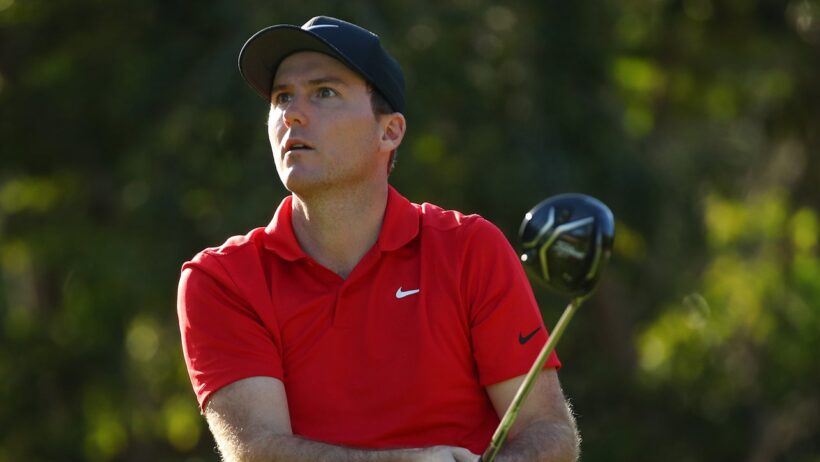
“I want to do the right thing, and I don’t want to cheat, so once I realized what I had done, it was a pretty simple decision, to find a rules official and explain it,” Henley said in a phone interview Monday night. He had been signing balls after a second-round 69 in Mexico when he saw the extra dash. He thinks he picked up the balls, thinking they were his, on the practice putting green, pre-round.
For those of you playing at home: you can change balls, including make and model, as you wish. But on the PGA Tour, and in many other serious competitive golf environments, that is not permitted. That’s the One Ball Rule. Without it, and players used to do this when it was legal, you might use one type of ball for a downwind tee shot and another one when heading into-the-wind.
“It’s a sensible rule,” Henley said.
The penalty, two shots per hole where you used the wrong ball, he thinks is extreme. “I don’t think the punishment fits the crime,” he said. But he puts the penalty he received, and that any other stroke-play golfer would face in the same situation, in this familiar category: it is what it is. Such few words, so many applications!
As for living with the consequences of not calling a penalty on yourself, every golfer in the world, straight up to Jack Nicklaus his own self, has something in their past. Henley remembers playing in a two-round junior event as a 12-year-old. He stepped on his ball in the second round and didn’t tell anybody.
After 36 holes, he was tied for the lead. He and Harris English faced each other in a playoff. To this day, Henley is relieved Harris won. But he knows Harris shouldn’t have needed the extra golf in the first place. Live and learn. Not the cliché, the actual thing: live and learn!
Nicklaus’s thing came in a long-ago British Open. He played a shot in a bunker. The ball didn’t get out. He thought the ball might have hit him after ricocheting off a bunker wall. A rules official standing there told Nicklaus that the ball didn’t hit him. Jack still has not let it go. The rules official might have been wrong. The golfer is responsible for his own card, and for calling penalties on himself. It says so right on the first page.
“I struggle with anxiety, and I can blow things out of proportion in my mind,” Henley said. “I had a thing in Hilton Head a few years ago, where I had to move my marker back. And I know I did, but I’m not certain I did it the right way. I think I did, but then you wonder. Playing by the rules, and being responsible for our penalties — that’s a beautiful part of the game.
“You can put this in if you want to: I’m a Christian,” Henley said. “The Lord has opened my eyes to the truth. There are going to be trials in a person’s life, for all of us.” His ball issue in Mexico, Henley said, was a trial. In the grand scheme of things, not a big one, but you could also say life trials defy measurement. He’s received maybe 20 calls and texts from people, congratulating him on, quote, doing the right thing. He finds it a little embarrassing. But he understands the thought process.
“It’s unfortunate, that playing by the rules is considered a cool thing,” he said.
The event with Henley has generated the usual high-minded discussion that comes whenever pros call a penalty on themselves. Before long, the conversation turns to how different golf is from every other sport, because of that act. It oversimplifies how it all really works. Golfers keep their cards, in accordance with the rules. But Big Brother is always watching, in case they don’t. It’s a classic example of trust, but verify. Imagine how accurate tax returns could be if we could all look at each other’s returns.
Henley turned pro in 2011, a year after being the low amateur at the U.S. Open. He became devout in his Christian practices in 2015. He was asked how he would have handled a rules infraction like his Mexico one before 2015.
“I would have called it on myself,” he said. “But it would have crushed me.”
This week’s Sea Island event is everything and nothing. It’s the first tournament of the rest of his life. It’s the first tournament where he is marking his ball in a new way, so he can see readily what model it is. He used to have black dots by the ball’s number. Now he has the three initials near ProV1x, TRR, for his wife, Teil Duncan Henley, an artist, and their two young children, Robert and Ruth.
Henley has a suggestion for anyone in a situation along the lines of the one he faced in Mexico. In other words, he has a suggestion for every tournament golfer, everywhere, because sooner or later you’re going to be where he was. And this is it:
“Something happens. You ask, `Should I call it on myself?’ And the answer is, Of course!”
Michael Bamberger may be reached at Michael_Bamberger@Golf.com