

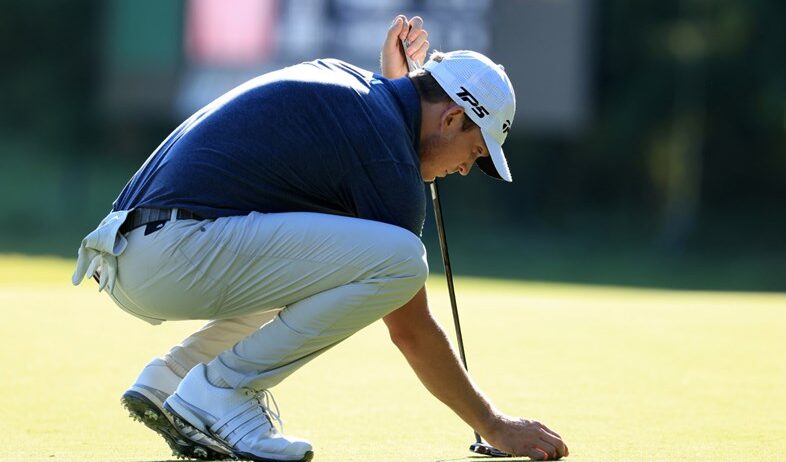
He’s delivering a putting performance better than any ever seen on the PGA Tour – and his approach could help your game too.
Jacob Bridgeman is having the season of his life.
The 26-year-old has played eight tournaments this year and finished inside the top-25 in all of them. He’s racked up four top-10s and one win – the Genesis Invitational – bagging more than $6.5m in prize money with the season still young. He tops the PGA Tour’s FedEx Cup standings. And he’s rocketed from outside the top-200 in the world in 2025 to 18th now.
The reason?
He’s currently delivering the best putting stats ever seen on the PGA Tour.
For context, Jason Day’s 2015-16 season remains the gold standard, with the Australian averaging +1.13 in ‘Strokes Gained: Putting’.
Bridgeman currently leads the PGA Tour in the same stat with an astonishing average of +1.339.
Bridgeman still has a lot of golf left to maintain his average and officially break Day’s record, but he’s currently on pace to produce the greatest putting season in PGA Tour history.
And he recently revealed three secrets behind his sensational performance on the greens – things you can copy to start holing more putts.
 (Don’t) practice what you preach
Last month, Bridgeman was playing a practice round with students from Clemson, his former University, when one spotted a blade putter in his bag – a surprise, considering he’s a committed mallet user.
“Yeah, that’s my practice putter,” he explained. “I practice for, like, 20 minutes a day with a blade, probably.
“I do my stroke stuff, short putts, and then when I put the spaceship in, it’s like I can’t miss.”
The “spaceship” is Bridgeman’s TaylorMade Spider Tour X – the super-stable mallet he used to win the Genesis Invitational, which also won three of the four majors in 2025.
The logic is simple but clever. A blade is less stable and harder to keep square. Train with that, and the mallet suddenly feels automatic.
“The more toe hang you have, the harder it is to keep the putter straight,” Bridgeman explains. “If I don’t use this [the blade] for a while, it starts to feel really wonky. And then I putt with this for 20 minutes and then I pull that one [the mallet] out and it’s so smooth.”
It’s not his idea – Bridgeman admits he picked it up from fellow PGA Tour pro Carson Young – but it fits into a broader trend of players making practice deliberately more difficult to make the real thing feel easier.
Bridgeman highlights a clear parallel with Tiger Woods, who famously practised with an old-school Bullseye putter to sharpen his feel, while Rory McIlroy’s long-time putting coach Brad Faxon has used a similar concept – but taken it even further.
Faxon, one of the best putters of his generation, helped transform McIlroy from 159th in SG: Putting in 2018 into one of the best on Tour. His philosophy? Putting is about touch and feel, not perfect mechanics.
One of his favorite drills is to have Rory hit six putts from six feet… with six different clubs.
A wedge, a hybrid, even a fairway wood – the idea is to strip away technical thinking and force players to react.
Bridgeman’s blade drill taps into the same idea: make practice harder, and the real thing feels easy.
 The no-line approach (and why it works)
Bridgeman’s approach on the greens is just as revealing.
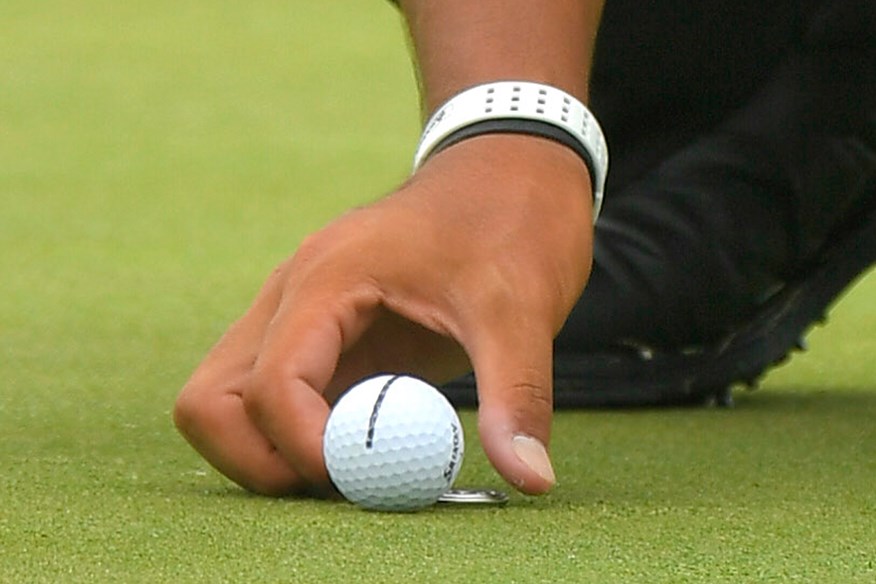
“I don’t use any alignment aids. The line always looks wrong,” he said. “I put my ball down so I can see just blank white.”
That puts him firmly in the feel-first camp.
Players like Jordan Spieth, Jon Rahm, and Scottie Scheffler have all leaned away from using a line, largely because of the doubt it can create at address.
Michael Kim sums it up perfectly: “Most amateur golfers shouldn’t use a line, because they’re usually not great at green reading and they rarely start their putts on line. They think they’re aiming at one spot, but they’re really aiming at another.”
That’s the trade-off. A line can help – but only if your read is solid and you trust it completely. If not, it can pull you away from your natural instincts.
It’s why Rory McIlroy has gone back and forth with it over the years – often finding his speed control improves when he ditches the line and reacts to the target.
A simple routine – with room for instinct
Bridgeman’s routine is built on feel, not overthinking – something he explained to former PGA Tour player Smylie Kaufman on The Smylie Show.
“I read the putt, figure out my line… then when I get to address the ball, I take two practice swings… looking at the hole, back at the ball, back and forth.”
A big part of that process is visual.
Like Jordan Spieth, Bridgeman talks about actually seeing the putt before he hits it.
“One of the few people I’ve talked to who reads putts the same way as me is Jordan Spieth. He sees a line flowing on the ground,” Bridgeman said. “When I’m putting my best, I’m seeing a line going from my ball into the hole. When the putts are going in, it’s a thick line.”
By the time he’s over the ball, everything is simplified.
“I see the line and I come straight back, and that’s all I’m thinking about… because the two strokes before it, I’ve figured out how hard I want to hit it.”
Crucially, though, he doesn’t treat his routine as rigid.
Sometimes, if the picture is clear enough, he skips it entirely.
“Maybe twice a tournament I’ll hop in there and just hit the ball. Every time I do that it goes in.”
Golfers know that consistent routines are beneficial, but if giving yourself a little leeway helps you see the shot clearly and react instinctively, it can be just as powerful.
 The takeaway
Bridgeman isn’t doing anything overly complicated. He’s just doing the right things, in a way that works for him.
He practises in a way that makes the key putts feel easier.
He trusts his instincts instead of forcing precision.
And he sticks to a routine without becoming trapped by it.
That balance – structure and freedom – is what great putting looks like. And right now, no one in the world is doing it better.