

March 3, 2026, 8:30 a.m. ET
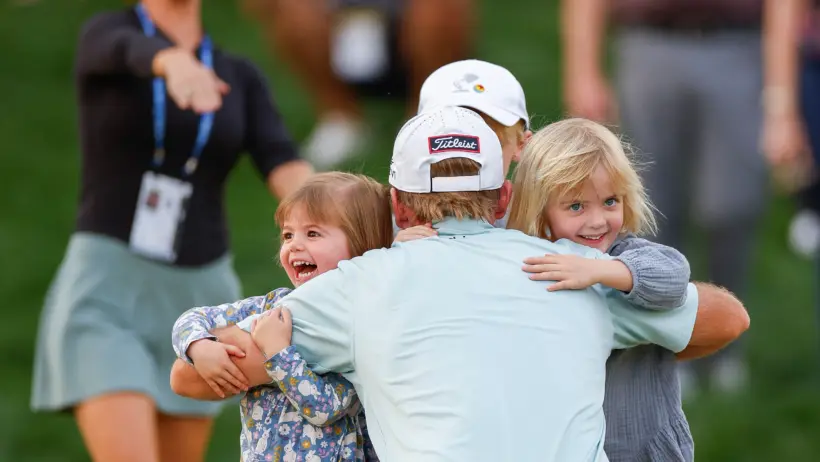
Moments after making a nervy 4-foot par putt to win the 2025 Arnold Palmer Invitational, Russell Henley’s three kids rushed on to the 18th green at Bay Hill Lodge & Club. Ruth, his five-year-old daughter, wrapped her arms around her daddy first and squealed with delight. Framed by a soft blue sky, Henley next spread his arms wide to hug wife Teil. It was a moment he long dreamed of enjoying and when he was asked what it meant to have his family witness him chip-in for eagle at 16 and win by one stroke over Collin Morikawa, Henley said of his wife, “She puts steel in my spine.”
Teil Henley said she struggles like many in the world with fear and anxiety and so when she sees it in others, she likes to say the words that would make her feel better. Sometimes those words consist of tough love and about three years ago, while she and her husband were talking in bed about his putting woes ahead of the Players Championship, she sensed such an occasion.
“I felt the nudge to say, ‘Russ, if that is the attitude you are going to carry around, then we should just go home. Because it is dog eat dog out here. These people want to beat you, they want to see you fail, so you have to be an animal. Otherwise, if you’re going to open that door to all the negativity, we might as well pack and go home,’” she recounted to Golfweek after her husband completed his winner’s press conference last March. “He got out of bed and said, ‘Thanks, I needed that.’ ”
Recounting the importance of that pep talk, Russell added, “It was a good re-set for me mentally.”

Henley, 36, has worked hard at every part of his game, becoming one of the best ballstrikers on Tour in recent years. But desperate to improve a balky stroke with the short stick, Henley sought help from one of the top putting instructors, Phil Kenyon.
Need a news break? Check out the all new PLAY hub with puzzles, games and more!
“I’ve just tried to listen to everything he said. From the start, working with Phil, I’ve just said, ‘What do you want me to do?’ Because I was just so lost with my game, with my putting a few years back and just super inconsistent, didn’t really have a great plan,” explained Henley, who ranked 10th in Strokes Gained: putting en route to the API title.
With his repeatable action and pinpoint control, Henley has transformed his game into one of the most consistent golfers on Tour. Before winning the Arnold Palmer Invitational, he was tied for the most top 10s without a win since 2024 — 10 with Sungjae Im — and from The Memorial in late May through The American Express in late January, he hadn’t finished outside the top 20 in 10 starts. Sam Saunders, the grandson of Palmer and former Tour pro who is now involved in making sure the tournament bearing his grandfather’s name is a success, described Henley as a gritty competitor and said he wasn’t surprised at all to Henley rise to the top at Bay Hill.
“We get the course running firm and fast, which has become the identity of Bay Hill, and there’s nothing that identifies the best player at the highest level better than firm and fast conditions,” Saunders said. “It means you have to drive the ball in the fairway, you have to hit greens with good iron shots and your short game better be sharp if you get out of position. When the course is soft, it can become a putting contest and I never think of Bay Hill that way. It’s a course that tests all parts of your game and that’s where Russell can excel.”
In 2024, Jim Furyk didn’t hesitate to use a captain’s pick for the U.S. Presidents Cup team on Henley, a rookie in international competition, who reminded Furyk of himself.
“He’s quiet, he goes to the course and gets his business done, gets out. But if you put players in categories, we’d be in the same one: Doesn’t make a lot of mistakes, doesn’t beat himself, mentally tough, hits the ball straight and I thought he’d be a good teammate,” Furyk said.
Henley was all that and then some. Furyk paired Henley with world No. 1 Scottie Scheffler and Henley more than held his own, earning three points out of a possible four.
“That week I’m trying to not throw up basically, I’m so nervous,” Henley said. “You definitely, the more you play golf when you’re nervous in big tournaments, I think the more comfortable you get…I think the more I can try to put myself there, the better I’ll get at it.”
Henley has dealt with pressure, sometimes better than others. Take the third round of the 2017 Masters. Henley was treading water at around 20th place when he blocked his tee right at the par-5 13th. He and his caddie at the time, Todd Gjesvold, surveyed the situation and decided to go for it. Henley hit a great shot on the green but it’s what happened next that is most memorable.
“My caddie pulled me over,” Henley recalled, “and said, ‘Hey, Pro, that’s our last ball.’ I was like, ‘How did that happen?’ He said, ‘I lost track, didn’t get any before the round.’ I still had Nos. 15, 16 and 18 to play. Somehow, I didn’t lose a ball. That was very daunting.”
So, too, was trying to chase down Morikawa, the 54-hole leader, who holed a bunker shot at the first and took a three-stroke lead to the back nine at Arnie’s Place. Henley had made bogeys at both par 5s on the front nine, including making two lousy chips at No. 6.
“I didn’t really feel like I had a great chance at that point,” he said.
But it’s become a mistake to underestimate Henley, one of the most underrated players on Tour. With his victory he moved to No. 7 in the world and would later climb to a career high of No. 3, but even Henley admitted he doesn’t think of himself as one of the top 10 in the world. Sanders has been on the bag for more than three years and his nickname for Henley is Casper the Ghost. “Because nobody knows who he is,” Sanders said.
Henley’s run of good form can no longer be overlooked after the way he made his move on the back nine at Bay Hill a year ago. Things were starting to look bleak after a bogey at No. 10 but he bounced back with a birdie at the par-5 12th and drilled his tee shot inside 10 feet at the 210-yard par-3 14th for a deuce. Then came the heroics at the par-5 16th after Henley blocked a 7-iron for his second shot and missed the green. But he drew a favorable lie in the rough and his chip came out just the way he pictured it to be with one exception. “I hit my landing spot but clearly misjudged the speed because if it didn’t hit the pin, it probably would’ve gone 8 feet by the hole,” Henley recounted.
After holing out from 54 feet, Henley slapped hands with Sanders but that was the extent of his celebration.
“I didn’t feel like there was much to smile about at that point,” Henley explained. “There was just a lot of really tough golf ahead of me. I felt like it was time to get really focused on what I need to do on my next shot.”
Two hard-earned pars sealed the deal for a final-round 2-under 70 and 72-hole total of 11-under 277 for his fifth career Tour title.
“It’s the best golf I’ve played to win one,” said Henley, who played the last seven holes in 4 under to win on one of the most demanding courses on the PGA Tour and against a strong signature-event field. “To have my name on that trophy along with all the greats who have won it before me will always be very special. To have won Mr. Palmer’s tournament and think about what he meant to the game is even cooler. I remember how he wrote me a letter after I won my first pro tournament (on the Korn Ferry Tour as an amateur) and that was cool to see his signature on a note to me. I got to meet him at the Arnold Palmer Cup and I got to thank him for the letter.”
Perhaps that explains, too, why Henley wore the red alpaca winner’s sweater so much the following week at The Players Championship. Three years later, after being called out by his wife for his negativity during a low moment in his career, Henley woke up at the Players and rocked his new sweater while drinking his morning coffee and reflected about how thankful he was to have won the biggest tournament of his career. Having his name attached in some small way to that of Palmer’s was just beginning to sink in during the Sunday trophy presentation on the 18th green as he slipped on the red sweater for the first time. It was a fitting representation of all his hard work to reach this new peak in his career and only then did he finally smile and wonder aloud: “Do I button the top button?”