

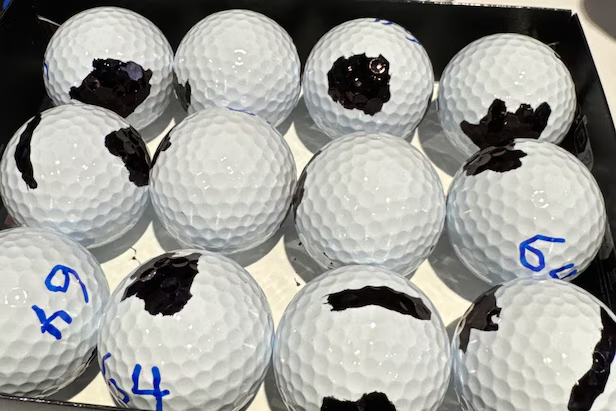
The concept of “soft” is a curious one when it comes to golf balls. It’s universal that most golfers prefer golf balls that lean toward the softer end of the spectrum, but most golfers also know that the penalty for too soft is a less-than-energetic response at impact on tee shots. No one wants to give up on soft, but they certainly don’t want to sacrifice any distance, either.
The golf balls that rated the softest in the Urethane category are a largely distinct sub-group within the grouping. While most balls in this category feature a multilayer construction, it’s how the firmness levels within that construction can be tweaked to produce a soft feel. Certainly, urethane as a more grabby cover material can engender softness, but most tour-level urethane-cover balls feature a relatively firmer intermediate mantle. This design offers the best way to create short shot spin, with the softer urethane pinching against the core’s firmer outer shell. What we found among our players is that the balls that received the highest ratings for softness were those that featured both a core compression that was lower than the average for the category and an overall compression that was softer, too. In the end, many of the urethane ball models that received the softest scores were those designed for non-elite level swing speeds. That softer feel lets average to below-average swing speeds feel in more control of the ball at impact. (As an added bonus, these softer models also tend to launch a higher, another boon for moderate speed players’ games.)
Remember, though, just as Goldilocks suggested, there is a level of softness that might be “just right” for you that will either feel too soft or even too firm for another player. Certainly, the fastest-swinging players may feel a lack of control on the softest-rated balls because they likely will launch too high and may not respond as energetically on the hardest swings.
For average players, though, a softer-feeling ball offers many benefits that go beyond a certain feel preference. For instance, that softer overall compression may help to reduce hook and slice spin on tee shots. As well, for players that tend to have a steady stream of mis-hits, the lower compression helps to control the loss of ball speed from those off-center strikes.
So “soft” has definite merit, particularly for average golfers. Here are the balls in the Urethane category that received the softest ratings for feel on the 2026 Hot List.