

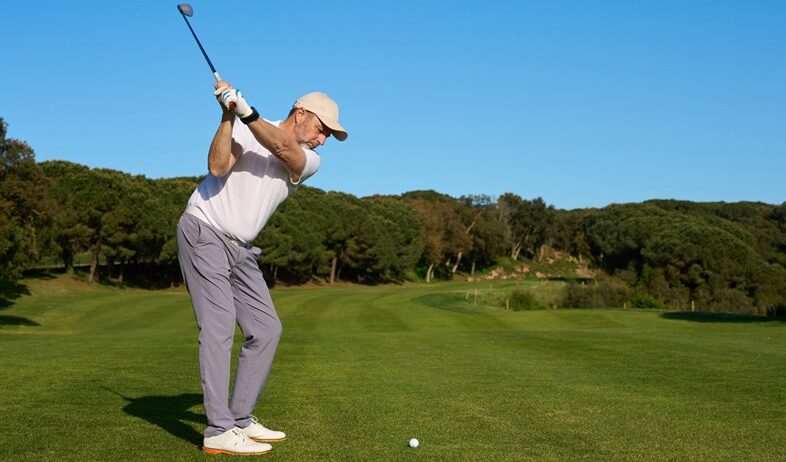
Ready to move on from your beginner irons? These are the models to look at next, from forgiving game-improvement clubs to irons you can stick with even as you continue to improve.
There comes a point in every golfer’s development when their beginner set starts to feel like it’s holding them back.
Maybe you’re striking the ball more consistently. Perhaps you’ve started taking your handicap more seriously. Or maybe you’ve simply reached the stage where those huge, chunky irons you bought when you started playing no longer look or feel quite right.
Whatever the reason, upgrading your irons can be one of the most satisfying purchases you make.
But there’s an obvious question: what should you actually upgrade to?
The temptation is to go straight for the kind of irons you see some of the best players using. That’s understandable, but it’s probably not the smartest move.
Outgrowing a beginner set doesn’t suddenly mean you’re ready for a blade or a demanding players’ iron. In fact, most golfers will benefit from finding something in between.
The best upgrade is an iron that gives you a more traditional shape, better feel, and greater control, while retaining enough forgiveness to help when your swing isn’t perfect.
Looking at the results from Today’s Golfer’s biggest-ever irons test, which saw 81 models put head-to-head, these are the models you should be looking at if you’re ready to move on from a beginner set.

Price: $1,199.99 – $1,399.99
Specs Features
Availability 3-PW, AW, SW Dexterity RH / LH (4-PW Only) Stock Shaft Options True Temper Dynamic Gold Mid 100/115g (R/S/X) Stock Grip Options Golf Pride Tour Velvet 360 i-Forged construction for extremely soft, tour-level feelMainframe technology saves weight to redistribute in key areasTour V.T. Sole redefines turf interaction for smoother feedbackBuilt for seamless integration within the ZXi family for combination sets Srixon ZXi5 – Best overall upgrade
The Srixon ZXi5 is exactly the kind of iron that’s ideal for a golfer moving on from a beginner set.
It’s forgiving enough that you don’t need to be a consistently excellent ball-striker, but it doesn’t look or feel like a traditional game-improvement iron.
That balance is what makes it so appealing.
In our testing, the ZXi5 produced 184.8 yards of carry at a ball speed of 126mph. But the most important number was the consistency of that distance.
The ZXi5 produced just 2.68 yards of carry standard deviation, meaning the shots were tightly grouped in terms of how far they travelled. That’s the sort of consistency that lets you start trusting your yardages and picking targets with more confidence.
It also produced 6.5 yards of left-to-right dispersion, which means the shots stayed reasonably close to the target line.
The 46.4° descent angle is another big positive. As your game improves, you’re going to want to do more than simply hit the green – you’ll want to know that your approach shot has a chance of stopping somewhere close to where it lands. A steeper descent angle generally helps with that, particularly when it’s combined with enough spin.
The ZXi5 produced 5,109rpm of backspin and a 33.4-yard peak height, so you’re getting a useful combination of height, spin, and descent rather than simply chasing extra yards.
And that’s ultimately what makes it such a good move as your game becomes a little more consistent.
You’re getting something that feels like a serious upgrade without making life unnecessarily difficult.
It’s forgiving enough for a golfer who still needs help, but sophisticated enough that you won’t feel the need to upgrade again any time soon.
Pros & Cons Specs Features
Lofts 4-PW / GW Stock Shaft Nippon NS Pro 950 Neo / UST Mamiya Recoil DART ESX Stock Grip Lamkin UT+ Left Handed? Yes CORTECH Contour Ellipse FaceMulti-Material Construction with Tungsten WeightingChromoly 4140MSeamless Cup FaceHarmonic Impact TechnologyWhite Satin Brush Finish Mizuno JPX 925 Hot Metal Pro – Best for a more traditional look
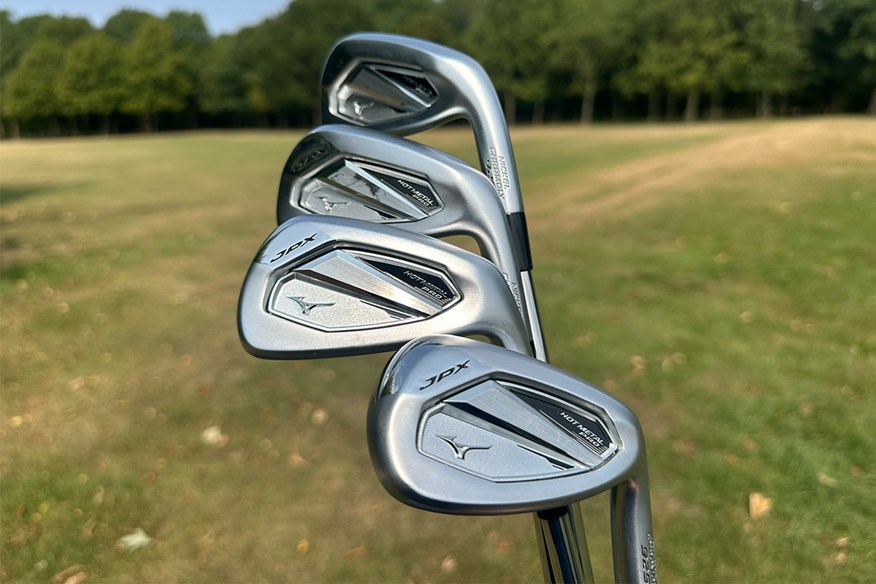
If your main reason for upgrading is that you want something better-looking than your beginner irons, the Mizuno JPX 925 Hot Metal Pro should be very high on your list.
It’s noticeably more compact and traditional in looks, but our testing suggests you don’t have to sacrifice performance to get there.
The Hot Metal Pro carried an average of 189.3 yards, with 127.9mph of ball speed. More importantly, it produced just 1.84 yards of carry standard deviation and 3.3 yards of left-to-right dispersion.
Those are exactly the sort of numbers that should excite an improving golfer.
The 1.84-yard carry standard deviation shows brilliantly consistent distance, while 3.3 yards of dispersion is an excellent indication that shots were staying tightly grouped around the target.
That’s much more valuable than simply knowing it’s a 189-yard iron.
The 45.5° descent angle is also useful. It’s slightly shallower than some of the other irons here, but the combination of a 32.6-yard peak height and 4,925rpm of backspin gives the Hot Metal Pro plenty of stopping power – anything above 45° for a 7-iron will help you stop the ball quickly.
So while the head looks more like the kind of iron you might expect a better golfer to use, the numbers don’t suggest you’re making a huge compromise in forgiveness or consistency.
It’s a great example of why golfers shouldn’t automatically assume that a smaller iron will be harder to hit.
If you want to move away from the oversized look of beginner irons without giving up too much forgiveness or consistency, the Mizuno JPX 925 Hot Metal Pro is a great option.
Specs Features
Availability 4-PW, AW Dexterity RH / LH Stock Shaft Options KBS Tour (R/S/X), KBS Tour Lite (R/S) Stock Grip Options Golf Pride Z-Grip Plus 2 4340M face material provides revolutionary forged feelFace design and SpeedFoam Air provides increased feedback and 24% larger sweet spotFLTD CG brings consistent peak height throughout the setThinner top line and reshaped sole geometry for player appeal TaylorMade P790 – Best if your game is improving quickly
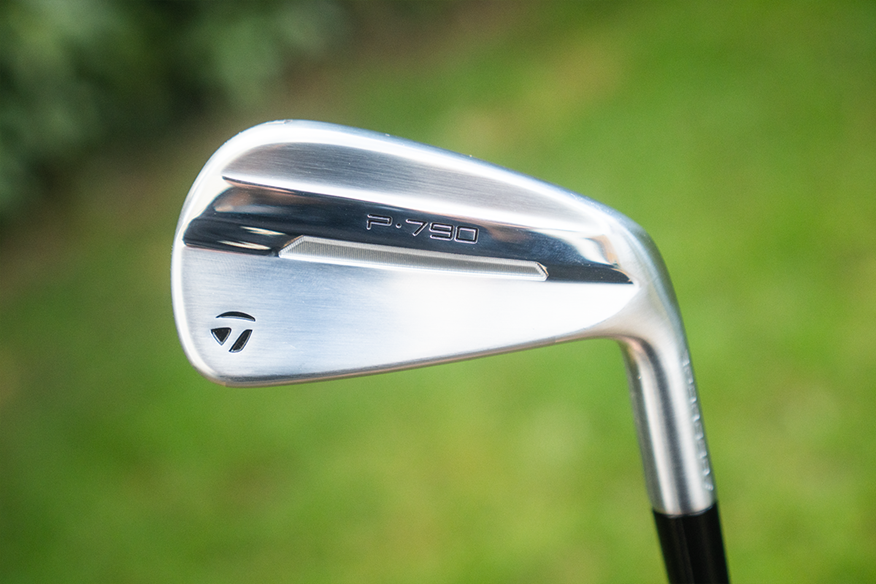
The TaylorMade P790 is the perfect iron if you’ve made significant progress and back yourself to keep improving.
It’s a more ambitious upgrade than a traditional game-improvement model, but it’s still a long way from the kind of unforgiving iron that would punish every imperfect strike.
In our testing, the P790 averaged 185.2 yards of carry and 126.8mph of ball speed, with only 2.65 yards of carry standard deviation.
Again, that consistency is more important than the headline distance. If you’re becoming a better ball-striker, you want to be able to rely on your yardages. A club that gives you the same carry time after time is much easier to score with than one that occasionally produces a monster number but is unpredictable.
Its 3.5-yard left-to-right dispersion was particularly impressive, too. That’s a very tight grouping, giving an improving golfer more confidence to aim at specific targets rather than simply trying to hit the green somewhere.
And then there’s the 47° descent angle, the steepest of all the irons featured here.
That’s a really useful characteristic for an iron like this because strong distance isn’t much use if the ball launches on a shallow trajectory and runs through the green. The P790’s combination of a 34.6-yard peak height, 5,313rpm of backspin, and 47° descent angle gives you the kind of flight that should allow you to attack pins rather than simply chase distance.
There’s also something important about buying an iron like the P790: it gives you room to improve.
If you’re currently playing a beginner set and your handicap is falling quickly, you might not want to buy another set of irons in 18 months because you’ve outgrown the first upgrade.
The P790 gives you a little more headroom. It’s an iron that can genuinely be used by everyone from scratch golfers to high handicappers.
If you want an iron you can stick with as your game improves, the TaylorMade P790 is hard to beat.

Price: £1199 Steel £1299 Graphite
Callaway Apex Ai300 – Best for maximum distance
Not every golfer leaving a beginner set is suddenly hitting the middle of the clubface every time.
If your ball-striking is still inconsistent but you’re ready for something that looks and feels more sophisticated, take a good look at the Callaway Apex Ai300.
It’s a particularly good option for golfers who want to make an upgrade without pretending they’re better ball-strikers than they really are. The Ai 300 gives you that more conventional look while remaining firmly in the game-improvement category.
It’s also a good option if you want to maximize distance. The Ai 300 was one of the faster irons in our testing, producing 127.6mph of ball speed and 190 yards of carry. Its 4.84-yard carry standard deviation and 6.4-yard left-to-right dispersion weren’t as impressive as some of the other irons here, but that’s often the trade-off for more power.
Its 44.6° descent angle was the shallowest of this group, but it is still very close to the 45° magic number, and a 31.6-yard peak height and 4,740rpm of backspin mean you shouldn’t struggle to stop shots on the green.
The important thing is that you don’t have to earn the right to play a more attractive iron by becoming a single-figure golfer first. The Ai 300 gives you a substantial performance upgrade from a beginner set while retaining the kind of game-improvement characteristics that make sense if your strike isn’t yet completely reliable.
If you want a serious-looking iron while still prioritizing forgiveness, the Callaway Apex Ai 300 could be your perfect match.
 Ping G440 – Best for golfers who still need plenty of help
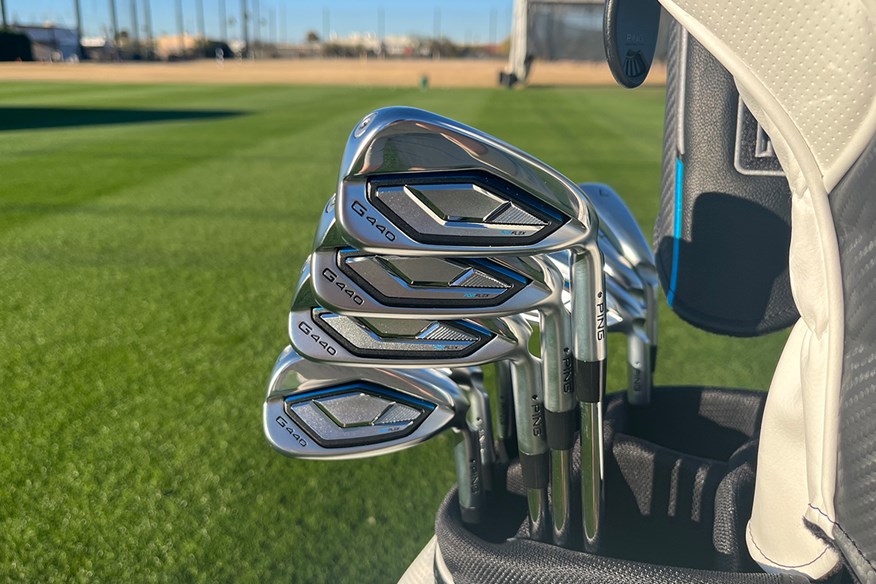
If you’ve outgrown your beginner set but you’re not entirely confident that your swing is going to behave itself every time, the Ping G440 is another excellent option.
It’s still firmly in the game-improvement camp, so you’re not making the same leap into a more compact head that you would with something like the Mizuno JPX 925 Hot Metal Pro or TaylorMade P790.
But there’s nothing wrong with buying a forgiving iron if forgiveness is what your game needs.
The G440 averaged 183.6 yards of carry in our test, with 126.1mph of ball speed and a 4.0-yard carry standard deviation.
That shows good power and repeatability, although it wasn’t as consistent as the very best performers here.
Its 8.2-yard left-to-right dispersion was the widest of this group, but the 46.8° descent angle is a real positive. Combined with 5,376rpm of backspin and a 33.9-yard peak height, the G440 produces a high-flying trajectory that should give you plenty of stopping power.
For a golfer who values help on off-center strikes above all else, it’s a very sensible step up from a beginner set.

Pros & Cons Ratings Specs Features
Looks
Technology
Performance
Overall
Availability 2-P, W Stock shaft True Temper AMT Tour Black steel (R, S) Stock Grip Titleist Universal 360 Left handed Yes, all lofts 7-Iron Loft 30.5 All-Steel Construction Singular DesignConfidence-Inspiring, yet Player-Oriented LooksMax Impact Technology for Increased Ball Speed Across the FaceDual High-Density Tungsten Weighting for Precise Ball Flight ControlProgressive Grooves are Engineered for Spin Control from Rough and Wet Lies Titleist T250 – Best for a premium upgrade
The Titleist T250 is another good choice if you’re looking for something that feels like a genuine step up in class.
It sits in that increasingly popular middle ground between game-improvement and players’ irons, giving you a relatively compact appearance without going all the way to a demanding players’ model.
Our test produced 180.2 yards of carry and 123.2mph of ball speed, with a 4.57-yard carry standard deviation and 5.3 yards of left-to-right dispersion.
That’s a reasonable level of consistency and accuracy, compared with decent power.
Meanwhile, the 45.8° descent angle, combined with 5,074rpm of backspin and a 32.3-yard peak height, gives you plenty of control on approach shots.
If you’re upgrading because you want an iron that feels more refined, looks better behind the ball, and gives you greater control as your game develops, the T250 is well worth considering.
 You don’t need to go straight to a players’ iron
This is probably the most important thing to take from our testing.
There’s a huge difference between outgrowing beginner irons and outgrowing forgiveness.
A golfer can become considerably better while still benefiting from a generous sole, perimeter weighting, and a little extra help on mishits.
There’s no need to jump straight into a blade or compact players’ iron simply because you’ve improved beyond your beginner set.
Instead, look at where your game is right now and where you realistically hope to get in the next couple of years.
If you still miss the center regularly, stick with something forgiving such as the Ping G440 or Callaway Apex Ai300.
If your ball-striking is improving and you want something that looks more like a conventional iron, the Srixon ZXi5 is a fantastic middle ground.
And if you’re becoming a genuinely consistent ball-striker, you can start looking towards models such as the TaylorMade P790 or Mizuno JPX 925 Hot Metal Pro.
 What should you look for when upgrading?
Focus on five things:
Forgiveness: Don’t sacrifice too much help just because you want a smaller head.
Distance consistency: A seven-iron that goes 175 yards one shot and 190 the next isn’t much use to you. As you improve, knowing your numbers becomes increasingly important, so take a repeatable 180-yard carry over a club that occasionally produces 190.
Descent angle: Don’t get sucked into the distance race. An iron that goes five yards further isn’t necessarily better if that extra speed comes with a lower flight and less stopping power. A steeper descent angle means the ball is arriving at the green more vertically, which generally gives you a better chance of stopping it close to where it lands. As you become a better golfer and start aiming at specific targets, that’s far more useful than simply hitting your seven-iron further.
Dispersion: This is arguably more important than raw distance. A slightly shorter iron that keeps the ball closer to your target is much easier to score with.
Looks: If you’re going to spend money on a new set, you should enjoy looking down at them.
Room to improve: Ideally, your next set should be good enough to stay with you for several years rather than something you’ll quickly outgrow again.