

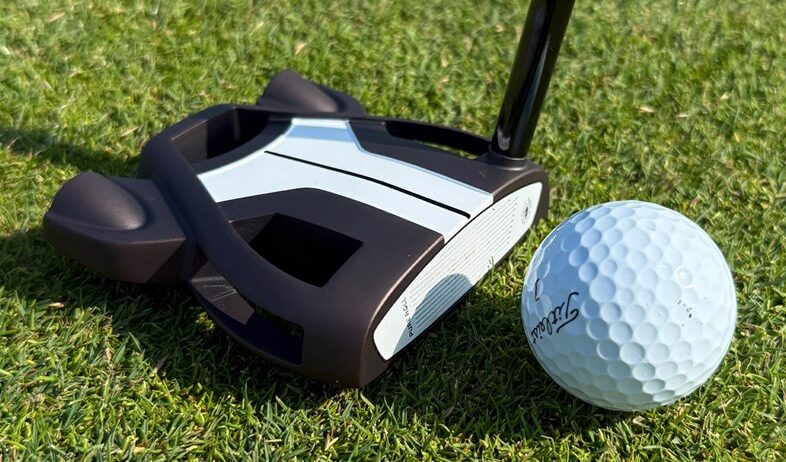
Almost 20 years after the original TaylorMade Spider changed putter design forever, every major brand has had a go at building something better. After testing 110 putters and giving the latest Spider Tour extended on-course time, I’m not convinced anyone has.
Nearly 20 years after the original TaylorMade Spider arrived and changed putter design forever, every major manufacturer has had a crack at building something better.
Some have chased higher MOI. Others have embraced zero torque. A few have produced genuinely outstanding putters.
Yet somehow, the Spider has remained the benchmark. So when TaylorMade released the latest version, there was only one question I wanted to answer: could it still justify that reputation?
Quick Verdict
The TaylorMade Spider Tour proves that sometimes the smartest innovations aren’t innovations at all. While the rest of the putter market has chased ever-higher MOI numbers, zero-torque designs, and increasingly futuristic shapes, TaylorMade have simply refined one of the best putters ever made. The result is a putter that remains incredibly easy to align, exceptionally forgiving, and beautifully balanced. It might not be the sexiest putter on the market, but if performance is your priority, I’m not convinced anything does the job better.


Pros & Cons Ratings Specs Features
Pros Outstanding rollReassuring stabilityGreat alignment Iconic and stylish design Cons Unusual finish won’t be for everyoneNot as compact as the Spider Tour X
Roll
Feedback
Stability
Alignment
Looks
Overall
Loft 3° Lie angle 70° Length 34″ – 35″ True Path Alignment systemTPU Pure Roll insertGrooves angled at 45°Short slant hosel29° Toe hang
Looks, Sound and Feedback: 4.5/5
The Spider Tour has never been a putter you buy purely because of its looks.
When the Spider first launched in 2008, the shape stood out like a sore thumb. It’s still not the best-looking putter you can buy, but nowadays we’re much more accustomed to larger heads and less traditional shapes, so it blends in much more easily.
Personally, I still think the slightly smaller Spider Tour X is the sleeker-looking option of the two, and I’m still not entirely sold on the new ‘PVD Torched’ finish. Depending on the light, it shifts between a dark caramel, brown, and even hints of purple. Some golfers will love that individuality. Personally, I still think brown would be quite far down my list of colors if I were choosing a putter based on aesthetic appeal.
The moment you put it down behind the ball, though, none of that really matters.
For me, the Spider Tour offers the best alignment of any putter on the market. The framing of the ball is exceptional and everything about the head encourages you to aim with confidence rather than second-guess yourself.
The feel is exactly what I want too. It’s solid without feeling overly firm, stable without feeling like you’re detached from the stroke. Some modern putters, particularly those with very soft inserts, can leave me feeling disconnected from the strike. The Spider Tour gives me enough feedback to know exactly what happened without ever becoming harsh or clicky.
Most importantly, it never once makes me think about the putter – it simply lets me focus on the putt.
Technology and Components: 5/5
Sometimes the golf industry mistakes different for better.
Over the last decade we’ve seen putters become bigger, stranger, and more technologically ambitious than ever before. TaylorMade could easily have followed that path. Instead, they have largely refined a design that was already brilliant.
I think that says everything. The Spider Tour isn’t trying to win the technology arms race; it’s simply trying to help you hole more putts.
That starts with the fundamentals. The center of gravity sits 36mm behind the face – the deepest in the Spider family – which goes a long way towards explaining why it feels so solid through impact. It also has the highest MOI in the range, making it the most stable.
The White TPU Pure Roll insert strikes a lovely balance too, producing a pleasant sensation while avoiding the overly soft, muted feel that some insert putters suffer from.
TaylorMade’s True Path alignment continues to shine. Whether you opt for the full True Path system or the simpler sight line, it’s still the best alignment aid I’ve used.
What impresses me most isn’t any individual piece of technology – it’s how naturally everything works together. The Spider Tour feels incredibly stable without ever feeling like it’s trying to steer the stroke for you. You’re still making the putt; the Spider simply gives you a brilliantly balanced platform to do it.
If you’ve been expecting TaylorMade to reinvent the Spider, you’ll probably be disappointed. This isn’t a radical redesign, and nor should it be. If you already own a Spider, the new model offers no reason to change. But if you’re coming from almost anything else, it’s a timely reminder of why this design has remained the benchmark for nearly two decades.
Sometimes refinement beats revolution. The Spider Tour is proof of that.
Distance Control and Roll: 5/5
If looks aren’t what makes people choose the Spider, performance most certainly is, and it’s the reason the Spider Tour has stayed in my bag since its first outing.
The very first putt I hit with the new TaylorMade Spider Tour was a 40-foot eagle putt on the par-5 opening hole at my home club, Royal North Devon.
I hadn’t even rolled a ball with it on the practice green.
The lengthy putt, which I’d have been more than happy to lag close, caught the left edge at dead weight and fell in.
I laughed. You couldn’t make it up.
But perhaps I shouldn’t have been so surprised.
About a decade ago, I borrowed a TaylorMade Spider from a playing partner, and for six glorious months I couldn’t seem to miss. I won competitions, got my handicap down considerably, and even knocked that same friend out of the club matchplay before he eventually, and quite understandably, asked for it back. Looking back, I’m still not sure why I never bought one of my own.
Since then, over the years, I’ve tried several different putters. A Bettinardi blade stayed in the bag for a long time. More recently I’ve tried zero-torque models like the L.A.B. Oz.1 and DF3. I even had a TaylorMade Spider Tour X in the bag for several seasons.
But nothing I tried ever quite matched those six months with that old, red Spider.
So when TaylorMade unveiled the latest Spider Tour, it didn’t feel like I was testing a revolutionary new putter. It felt more like reconnecting with an old friend.
The opening-hole eagle putt made for a memorable introduction, but what impressed me over the following weeks was how consistently good the pace control proved to be.
The feel sits in a sweet spot between too firm and too soft, making it easy to judge longer putts while providing enough feedback to quickly adapt if you get one wrong. Recently I played a course where the practice green was significantly quicker than the greens on the course itself, yet it took very little time to recalibrate.
On the rare occasions I leave one short or run one past, I never blame the putter. I know it was me, and the feedback is good enough to make the adjustment by the next green.
It’s also why I’d still choose the Spider over many zero-torque putters I’ve tested.
If you handed me a four-footer to hole, I’d happily use either the Spider Tour or a L.A.B. DF3.
But if you gave me a 50-footer and told me I had to get down in two, I’d pick the Spider every single time. It gives me complete confidence over long-range pace without sacrificing anything on the shorter ones.
Forgiveness and Stability: 5/5
Perhaps the biggest compliment I can pay the Spider Tour has nothing to do with MOI or forgiveness.
After two years using a claw grip following a bout of the yips, the counterbalanced version has had me experimenting with a conventional grip again. I wouldn’t say I’m putting noticeably better than I was with the claw – which has served me very well – but the putter has made me feel so relaxed standing over the ball that changing back to a ‘normal’ grip doesn’t seem such a crazy idea anymore.
The Spider Tour isn’t technically the highest-MOI putter on the market anymore, but out on the golf course I’ve never found myself wishing it was. That’s probably the biggest compliment I can pay it.
Despite spending plenty of time with zero-torque putters recently, I never found myself missing those characteristics when I switched to the Spider. It feels incredibly stable, but it also feels wonderfully natural. The head resists twisting without ever feeling cumbersome or disconnected from the stroke. It’s like driving a perfectly-balanced car.
Final Verdict: 5/5
The TaylorMade Spider Tour has reminded me why some designs become classics.
Over the years I’ve tested premium milled blades, oversized mallets, and, more recently, several zero-torque putters. I’ve liked plenty of of them, and I still think L.A.B. deserve credit for changing the conversation around putter design. But I don’t actually miss zero torque when I put the Spider back in the bag.
That’s because it already gives me everything I’m looking for: exceptional alignment, outstanding stability, brilliant pace control, and enough feedback to trust every stroke.
The best putters don’t convince you you’re going to make every putt – they make you feel like you’re never going to three-putt. And that’s exactly how the Spider Tour makes me feel.
L.A.B. may have dominated the conversation in recent years, but I’ve also seen plenty of golfers quietly move away from them after the honeymoon period. The Spider Tour doesn’t have quite the same hype. It just quietly goes about its business, year after year, and somehow remains the benchmark.
Is it the coolest-looking putter on the market? Probably not. Would I tweak the finish? Yes.
Would I swap it for anything else right now? No.
That isn’t just my opinion either. In our 2026 Today’s Golfer putter test, where seven golfers tested 110 putters over three days, the Spider Tour finished first overall, with the Spider Tour X close behind in second. It’s rare to see one design dominate a test like that, but I wasn’t remotely surprised by the outcome.
Golf has changed dramatically since the Spider first appeared. Putters have become bigger, stranger, and more technologically ambitious than ever before.
Yet somehow, this design still feels like the benchmark.
It’s the design every other brand is chasing. It’s why PXG have copied it almost like-for-like with the excellent Battle Ready II Torpedo.
Maybe that’s because the best putters don’t always reinvent the wheel. Sometimes they just need remind us why they were so good in the first place.