

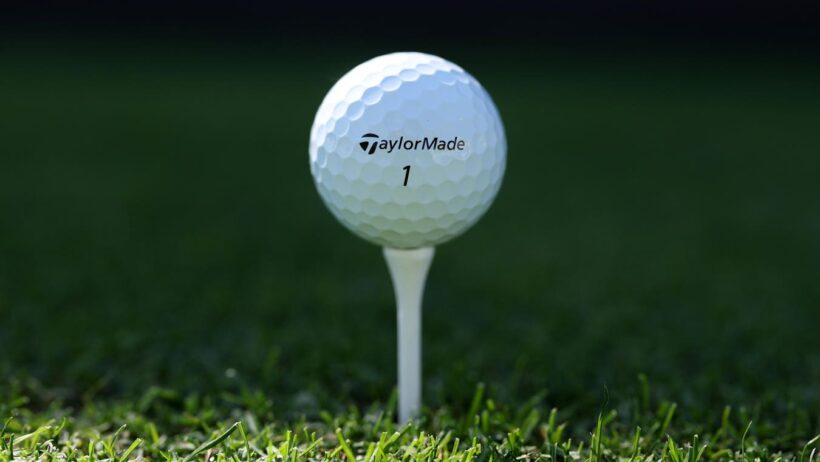

DUBAI, UNITED ARAB EMIRATES – JANUARY 15: A detailed view of a Taylormade TP5 golf ball on a tee prior to the Hero Dubai Desert Classic at Emirates Golf Club on January 15, 2024 in Dubai, United Arab Emirates. (Photo by Richard Heathcote/Getty Images)
Getty Images
In a lawsuit filed in January, TaylorMade is suing Callaway for false advertising, unfair competition, and trade libel, alleging that Callaway has engaged in a “coordinated marketing campaign to mislead consumers and retailers…based on nothing more than how the balls appear under an ultraviolet ‘UV’ light.” The misleading marketing campaign appears to be about the construction of TaylorMade golf balls.
The lawsuit, reported on by Front Office Sports, arose from a video of a Callaway sales agent who allegedly illuminated golf balls from both TaylorMade and Callaway under UV light during a sales pitch. The Callaway sales agent then allegedly claims that dark spots that show up on the TaylorMade ball under UV lighting conditions indicate imperfections in the TaylorMade ball.
In the complaint, TaylorMade alleges that the Callaway sales agent puts a Callaway Chrome Tour golf ball under UV light and suggests that the Chrome Tour ball’s bright reaction to UV light and even coverage in the appearance of the dimples of the golf ball establishes high performance. When TaylorMade’s TP5 golf ball is put under the UV light, the TP5 ball includes a darker spot, which the Callaway sales agent suggests is indicative of a poor-quality golf ball. The complaint states that the Callaway sales agent even goes so far as to suggest that the TP5 ball with the darker spot would behave the same as if the ball had mud caked onto it when hit, commonly referred to by golfers as a “mud ball”.
The Callaway sales agent does not appear to make any qualification as to why the Chrome Tour golf ball might appear differently under UV light besides performance reasons. Factors like whether the golf ball has been used, been exposed to elements like sun or water, or others may affect how a golf ball appears under UV light, factors that TaylorMade notes are not mentioned by the Callaway sales agent. TaylorMade also alleges that Callaway adds UV brighteners as cosmetic additives to their golf balls, which are designed to make the balls appear brighter but have no meaningful relationship to ball flight, distance, playability, or other performance attributes.
Beyond appearing bright under UV light, there does not appear to be any publicly available scientific research on whether UV light can unveil any tangible performance characteristic of a golf ball.
However, the construction of the golf ball itself does matter to the ball’s performance. Characteristics like the number, shape, and dimensions of the dimples, the types of materials used in the inner part of the ball, and the number of layers the ball is made of can all affect the trajectory and behavior of the ball in flight after impact by a golf club.
While it’s unclear what UV light can actually unveil about a golf ball’s performance, TaylorMade is not taking any chances. In a statement to GOLF.com, a TaylorMade representative stated “TaylorMade commenced this lawsuit to safeguard its brand and reputation. We intend to debunk the claims being made about our products and hold Callaway accountable through the courts for not only disparaging our brand and products, but just as importantly, misleading consumers.”
Callaway also provided a statement to GOLF.com, stating “While we do not generally comment on matters in pending litigation, we continue to stand by the relevancy of UV light observations as related to the application of coating materials on golf balls and believe this is relevant information for the marketplace.”
Callaway appears committed to the applicability of UV light observations for determining golf ball performance. Whether there is any legitimacy or truth to this approach for finding defects in golf balls may be further revealed as the lawsuit progresses.
The lawsuit was filed by TaylorMade against Callaway in the United States District Court – Southern District of California San Diego Division. It has been assigned case number 26CV0250.