

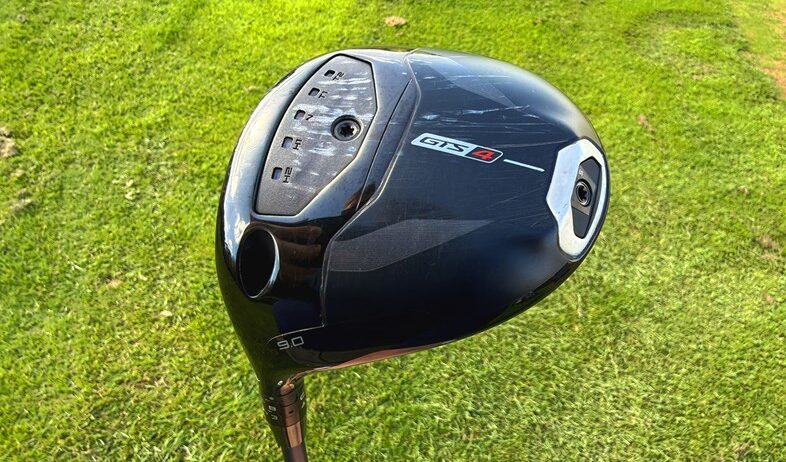
The Titleist GTS4 driver is trying to achieve the impossible: lowest spin performance with stable forgiveness. I didn’t believe it until I started playing it.
Having made the best driver in last year’s testing, there was always going to be excitement for the release of the next generation of drivers. The new Titleist GTS4, as well as the rest of the GTS family, has been built to provide golfers with even deeper performance gains than before, with reengineered body structures and internal mass movement.
The GTS4 stands both with and alone from the rest of the line, with unique designs specifically integrated into this head to suit a niche audience within the market.
Titleist say the new technology is going to provide the best of both worlds, offering the expected ultra-low spin but with a significantly more forgiving cross-face stability.
This combination has long been my holy grail, so I’ve spent the last few months putting the Titleist GTS4 through its paces.
Quick Verdict
Titleist’s GTS4 driver offers nearly everything it promises. While it still isn’t a driver for everybody, there have been significant steps to make this driver far more playable than previous iterations. The changes in head design off enough forgiveness for the target player, while still creating low-spin launch conditions that at times will be too low for the average player. A specialist club that definitely does its job.
The modern low-spin option
Pros & Cons Ratings Specs Features
Pros Forgiveness levels are surprisingly highLives up to the low-spin descriptionLooks are killer; my favorite on the market Cons This is still only for a smaller audience of golfers
Looks/Feel
Technology
Performance
Final Verdict
RRP £629.00 / $699.99 Lofts 8.0º / 9.0º / 10.0° (RH/LH) Weights 8g Track / 5g Aft Head Size 460cc Lie 58.5º Standard Shaft Length 45.5″ Stock Shaft Options Mitsubishi Tensei 1K White / Mitsubishi Tensei 1K Blue / Mitsubishi Tensei 1K Red / Project X TITAN Black Stock Grip Titleist Universal Grip Full-Body PMP Construction allows for massive weight re-allocationSplit Mass Frame improves MOI without a cost to ball speedSpeed Sync face reinforces off-center hits and improves high-face impactHigh Contrast Face improves framing for better, more consistent striking
Looks/Feel: 5/5
From the golfers I know that played the previous generation GT4, there was a certain level of disappointment to hearing how the new model’s head size would be increasing from 440 to 460cc.
For me and the majority of players, however, I think this is a great move to bring the GTS4 platform forward in terms of being justifiably playable enough to add to your bag.
Another reason the new Titleist GTS4 has such an immediate appeal to me is because of how the technology changes have altered the shapes of the other new GTS heads. The raised rear skirts on the GTS2 and GTS3 drivers, created for better aerodynamics, haven’t been carried over into this model, as the intended golfer isn’t in need of additional club head speed, for the most part.
This means that the GTS4’s head is much closer to the GT3 – my favorite driver ever, at least until the updates arrived – and becomes an easy transition for me.
It’s a classic, deep-face driver, with a shorter front-to-back length that focuses your eyes towards the ball, which I absolutely love.
Does that mean it’s going to inspire confidence in players who struggle with consistency in striking center-face?
Probably not, but then again, that isn’t the target market for the 2026 edition, despite the promise of more forgiveness than before.
Beyond that, this is an otherwise all-Titleist golf club. The black gloss finish is almost intoxicating in its appeal, it makes me feel desperate to hit a ball just from the look, with clean framing around the center for quick setup and aiming at address.
Sound and feedback is beautiful, even if there’s a very small background dullness from the carbon fiber body over the old titanium, but it’s nothing I have any desire to reverse.

Technology: 4.5/5
The most immediate addition of technology is also what you’re going to spot first.
Whereas the original GT4 was trapped in a single flippable front-back option, the new model can be dialled in in multiple directions, thanks to introduction of the rearward, or aft, changeable weight alongside the track front weight.
The inclusion of the track is significant in how useable Titleist have made the new GTS4; you can use the pairing of options to directly focus Center of Gravity (CG) where you need it for either overall forgiveness, a specific spot behind the face, or a combination of the two.
These weights also act as semi-support points for the new carbon body to be structured around. The GT models featured a seamless thermoform crown, but it’s been enhanced and advanced in the latest GTS family to also make up the sole plate for a full wraparound carbon body.
It frees up more movement of internal weight through Titleist’s Split Mass technology, which is how the company have been able to make this driver so much more forgiving that before.
Weight is now placed at the rear and front of the head, hence the adjustability that has been added these points, to allow for a personalized and perfect balance for your game.
The final touch is that Speed Sync Face, a reimagined design of the VFT Speed Ring, now creates a far higher smash factor, or the amount of ball speed retained, on off-center hits for longer and straighter drives.
There’s some genuinely great technology on display here, and, as is the brand’s way, Titleist have implemented it incredibly smoothly with a focus on maintaining aesthetics over screaming about the additions.
That being said, most of it is stuff we’ve seen before, so I don’t think I can quite give it full marks for innovation.

Performance: 4.5/5
While each individual technology story isn’t necessarily new, the performance aspect of the Titleist GTS4 driver is certainly a case of ‘greater than the sum of it’s parts.’
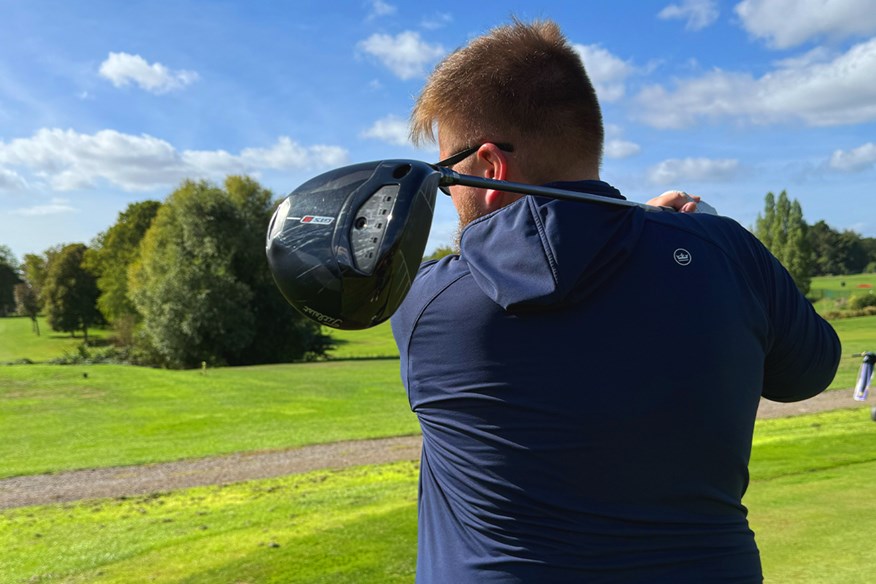
If it wasn’t clear from the image above, I’ve spent plenty of time hitting the GTS4 (no, the colored tee marks won’t come off, no matter what strength of soap I use) and, as any low-spin driver should be, GTS4 is fast.
It looks fast, it feels fast, it is fast, in every way you want to be. With so much of modern design, and a lot of talk of the death of the low-spin model, if feels so refreshing to be given a club that has now qualms about what its intended purpose is.
The normal caveat with any driver that sets up for that focus on power, is that you need to guarantee you’re on your game every time you play. It’s a consequence of a CG-forward design and has been accepted as such since manufacturers first started exploring mass positions in drivers.
What’s most surprising, then, is how much forgiveness is on offer with GTS4 and the freedom it gives you to swing with intent.
Don’t get me wrong, it isn’t a cheat code in the same way that the 10K, ultra-forgiving models are, but the difference between GTS4 and GT4 is literally and metaphorically tangible.
I feared even using the GT4 in my time with it two years ago, but I have every confidence in setting up with the latest edition, knowing that, even when I’m not perfect, I can still play good golf.
My biggest conclusion from my time with the Titleist GTS4 driver is that I still wouldn’t put this into the hands of the vast majority of the market BUT there is a genuine expansion of how many players can now benefit from the lower spin possibilities to their games without adding the expected fear previously obligated.
Final Verdict: 4.7/5
It’s still not for everybody, but Titleist have made incredible concessions to make the GTS4 more playable than any previous model, through their rock-solid technology advancements.
Combine that with the ever-outstanding style and looks, and you’ve got one of the best low-spin options in the driver market.
If you’re looking to bring your flight or spin conditions down, or push your distance to its limits, I’d certainly consider adding Titleist to your list – the only shame is that we’re going to have to wait until 2027 to compare it in our best drivers test.
Similar drivers to consider
The fast and furious

Pros & Cons Ratings Specs Features
Pros Outrageous clubhead speed due to improved aerodynamicsThe best looking driver in the LS categoryLow spin is an understatement! Feels great off the sweetspot Cons Spin fluctuates on mishits horizontallyCould argue that TaylorMade Qi4D core driver makes this somewhat obsolete
Looks
Technology
Performance
Overall
RRP £549.00 / $649.00 Lofts 8º , 9° / 10.5°/° (RH/LH) Head Size 460cc Standard Shaft Length 45.75″ Stock Shaft Options Mitsubishi REAX MR,LR,HR Stock Grip Golf Pride Z-Grip Black/Silver Improved aerodynamicsNew colour aesheticCustom fitting revolutionary shaft procedure 60x carbon face
Unrivalled speed
Pros & Cons Ratings Specs Features
Pros Vastly improved shelf appeal The fastest Callaway driver i’ve ever tested Premium feel across the entire face, a notable improvement Cons Dispersion makes this appropriate to the players who are chasing distance and distance only.
Looks
Tech
Performance
Overall
RRP £649/$699 Lofts 8˚(RH), 9˚ 10.5˚ (RH/LH) Head Size 450cc Standard Length 45.75″ Stock Shafts FUJIKURA VENTUS BLACK60g (S, X), 70g (S, X), TRUE TEMPER DENALI FROST SILVER 50g (S) Tri Force faceAdjustable perimter weighting Ai-optimised faceClean, streamlined shape