


Among the best golf irons are players’ irons, typically aimed at low handicaps to elite-level golfers. Whilst players’ irons aren’t quite as intimidating as blade irons, they’re not far off, but do offer a little more forgiveness. Lots of tour pros, including Major winners Brooks Koepka, Jordan Spieth, and Shane Lowry opt for irons in the players’ category, appreciating the blend of control, workability, and forgiveness.
Jump to:
So what can be the pitfalls in looking for a set of players’ irons? The variations in design are more subtle for this category than any other, so it can be difficult to know where to start, and we often end up going on looks alone. That’s not to say that looks aren’t important, especially how you feel about offset, top line, and the club’s overall profile, which can massively affect your purchasing preference.
Ultimately, the club head is designed to give consistency in the finest detail in this category, so once you’ve narrowed down the club heads that appeal to your eye, you should be trying to identify what provides you with that consistency.
Consistency, in this instance, shouldn’t just be how wide your dispersion is. The clubs in this category should also be offering a predictable ball flight with easy-to-repeat results in apex height, carry distance, spin, feel, and turf interaction. Don’t make the mistake of thinking these irons can cover up bad ball-striking though, these are designed to match the golfer’s skills and demands, not push your numbers further.
If you strike your irons consistently well but want a little more distance, the best players’ distance irons might be a better fit for you, whereas if your consistency from the fairways is lacking, we strongly recommend checking out the excellent options available in our best mid-handicap irons guide.
Best Players’ Irons 2026: At a glance
Let’s take a look at the models of players’ irons we believe are the best of the bunch in 2026.
Best Players’ Irons 2026:  What we say:
The Pro S-3 is where we enter the truly classic-style Mizuno iron offerings. The S – or ‘Signature’ – series is on a delayed cycle compared to the other lines, with four years between updates instead of two.
Mizuno’s argument is that the golfer who’s looking at S-series is looking for a longer-term investment, so bringing new versions out won’t be of as much value, especially as there is minimal technology changes in the heads.
While the M-15 was fantastic for length with a little bit of forgiveness, the Pro S-3 is going to be for golfer’s looking at precision and consistency of performance, and who aren’t in need of as much help.
That being said, the protection that S-3 does have is well-placed, with redistributed mass lower in the head to reinforce strikes caught thin, and the Triple Cut Sole returns to improve turf interaction across every condition you can face.
The Mizuno Pro S-3 is a stellar iron, backed up by even more stellar, extremely consistent performance.
What our tester says:
“The extra bit of forgiveness in the S-3 over the pure muscle S-1 is a great addition. It’s not dramatic, but it’s nice to know that I’m getting those extra couple of yards of carry when I need it.”
Key iron test data:
Ball Speed 121.1 mph | Carry 170.9 yards | Backspin 6223 rpm | Launch Angle 18.7º | Height 35.0 yards | Descent Angle 48.7º | L-R Dispersion 6.7 yards
 What we say:
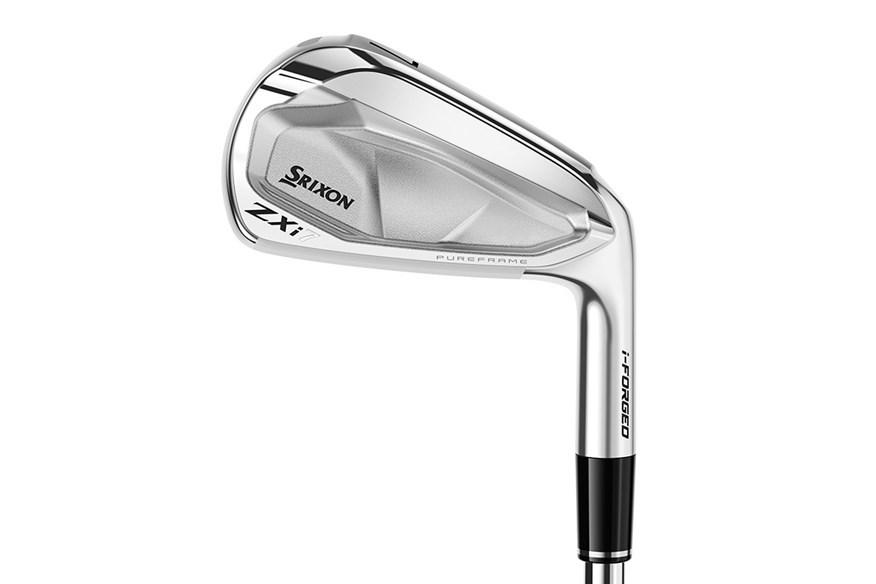
The second Srixon iron to feature in our ‘Best’ list, and it’s no surprise to see it’s the sister model to the ZXi5 from the Player’s Distance category.
The ZXi7 provides a smaller shape and tighter lines for those that feel the ZXi5 is still slightly too chunky for their eye-line. What we love about ZXi7 is that you don’t actually give up much in terms of forgiveness, though, despite the slimmer looks.
You might give up a little distance between the two models, but the Srixon ZXi7 remains a very consistent performer, with its L-R Dispersion (1.8 yards) being particularly impressive.
This is a great iron for a combination, whether with the Srixon Z-Forged muscleback or the ZXi5 (or both for a triple mix set!), but it more than stands up on its own too.
What our tester says:
“The Srixon ZXi7 performs with far more forgiveness than I expected, but there’s nothing given up in looks and feedback at the same time. This is one of my favorite irons from testing and it feels like it could work for more golfers than you’d expect – especially when used as a combination!”
Key iron test data:
Ball Speed 123.3 mph | Carry 177.5 yards | Backspin 5628 rpm | Launch Angle 17.2º | Height 33.3 yards | Descent Angle 47.0º | L-R Dispersion 1.8 yards
 What we say:
Muscleback irons are one of the most subjective categories we test, with minimal technology implementated to separate them. The data points we use are chosen around controlled flight and consistency of performance, which is what an MB user is after.
It’s unsurprising, then, to find our 2025 winner and runner-up have performed in the same manner this year, with the only change being a switch of places for 2026.
Cobra’s player-centric irons have been some of the most underrated of the last few generations, so seeing them take the top spot here is more than well-deserved.
We would have liked to include the 3D printed MB irons in data testing, if not for availability at time of testing, but it goes to show that Cobra still know how to make a traditionally-built iron with the best of them.
What our tester says:
“I’m going to say the same thing that I did last year – these blades look great, but I don’t know how I feel about playing the lower-lofted irons in the Cobra MB set! The feel is slightly firmer than some other musclebacks, but it’s a more old-school feedback that tells you exactly where you’ve struck it over just being soft.”
Key iron test data:
Ball Speed 119.5 mph | Carry 168.0 yards | Backspin 6327 rpm | Launch Angle 18.0º | Height 32.8 yards | Descent Angle 47.5º | L-R Dispersion 2.9 yards
 What we say:
Ben Hogan’s Icon was so close to doing the double in the MB category, but sadly the company that bears the famous Texan’s name will have to settle for a second-place in 2026.
There’s a unique shape to the Icon that helps maintain a classic, timeless look that will appeal to the traditionalists among us, but it’s backed up by the tightest L-R Dispersion (1.6 yards) in the category, as well as good standard deviation for Ball Speed (1.15) and Carry (1.33) performance.
Like with the Takomo 301 CB, it’s worth pointing out that the Hogan Icon is another direct-to-consumer model, with a price point that few can compete with (especially in this category).
What our tester says:
“Feedback from the Icon is great when you find the middle, but it does feel a little harsher to mishit than some of the more well-known brands. That being said, I’ve struggled to make it move off-line, even with a [relatively] poor strike.”
Key iron test data:
Ball Speed 121.3 mph | Carry 172.1 yards | Backspin 6044 rpm | Launch Angle 17.5º | Height 32.9 yards | Descent Angle 47.3º | L-R Dispersion 1.6 yards
 What we say:
While Takomo have updated their 101, 201, and 201T irons to the new Mkii editions, the 301 CB and MB are continuing on for 2026 – this is much a case of ‘if it ain’t broke, don’t fix it’ as anything else.
The 301 CB is a Player’s Cavity iron best described as ‘average’ but we don’t mean that it lacks in quality: it wouldn’t have made our ‘Best’ list if it wasn’t worth recommending. Takomo’s offering in the category offers solid performance in each data point, neither coming out top nor sitting at the bottom of the pile.
The best point we can make with the 301 CB is that you’re getting reliable and repeatable quality for half the cost of other irons listed here, and while we don’t focus on price in data-testing, it’s hard to ignore how good the value-for-money is with Takomo.
What our tester says:
“If you didn’t tell me that this was a Direct-to-consumer product, I’d never be able to tell. It feels great, and I love the way it sets up behind the ball, and I’d pick the 301 CB over a few of the big name irons in the category.”
Key iron test data:
Ball Speed 120.4 mph | Carry 169.9 yards | Backspin 6261 rpm | Launch Angle 17.6º | Height 32.6 yards | Descent Angle 47.3º | L-R Dispersion 5.9 yards
 What we say:
Titleist’s T-series has been the most popular collection of irons across virtually every major tour for several generations now, and the 2026 update is no exception.
Played by the likes of Ludvig Åberg and Jordan Spieth, the T100 is one of the best mixes of quality feel, solid forgiveness, and killer looks that you’ll find in the Player’s Cavity category.
If you want ‘player’ style looks without a sacrifice in performance, this is where you need to be looking.
What our tester says:
“If you don’t care about those few extra yards from the T150, the T100 gives a player everything they could need in an iron. There’s not really any flaw here, just reliable quality.”
Key iron test data:
Ball Speed 122.9 mph | Carry 174.8 yards | Backspin 5,996 rpm | Launch Angle 17.5º | Height 33.9 yards | Descent Angle 47.9º | L-R Dispersion 8.7 yards
 What we say:
The amount of Ping Ambassadors that have chosen to play the Blueprint T model says all you need to know about the quality of these irons, but let’s give you a little more than just that.
As with most things that bear the company’s logo, the Blueprint T offers incredible stability and predictability, even within the muscleback category. The T head, in 2026 testing, has produced the tightest front-to-back dispersion (Carry standard deviation of 0.82 yards) of anything we hit, regardless of the category.
All this to say, if you want a set of irons that you know are going to land on the same spot, every time (assuming the strike is right), then Ping are still the best guarantee of that consistency, regardless of the category you’re looking at.
What our tester says:
“Ping’s eye for detail is great. This is a really polished iron design, with the right shape and lines from every angle. I love the way it feels, and it’s just so reliable, even if it is a bladed model.”
Key iron test data:
Ball Speed 120.7 mph | Carry 171.4 yards | Backspin 6028 rpm | Launch Angle 17.2º | Height 32.0 yards | Descent Angle 46.7º | L-R Dispersion 4.9 yards
Best Players’ Irons: The data
Below is the data from our independent testing of the best golf players’ irons available in 2026. You can read about all the other models that didn’t make our shortlist above in our golf club review pages or category-specific irons pages.
ModelClubhead SpeedBall SpeedStd Dev Ball SpeedCarry DistanceStd Dev CarryLaunch AngleBackspinPeak HeightDescent AngleL-R DispersionMizuno Pro S-391.2 mph121.1 mph0.99170.9 yds2.3318.7º6223 rpm35.0 yds48.7º6.7 ydsSrixon ZXi791.0 mph123.3 mph1.24177.5 yds2.2517.2º5628 rpm33.3 yds47.0º1.8 ydsCobra King MB90.7 mph119.5 mph0.36168.0 yds1.0418.0º6327 rpm32.8 yds47.5º2.9 ydsBen Hogan Icon91.2 mph121.3 mph1.15172.1 yds1.3317.5º6044 rpm32.9 yds47.3º1.6 ydsTakomo 301 CB90.2 mph120.4 mph1.34169.9 yds2.3817.6º6261 rpm32.6 yds47.3º5.9 ydsTitleist T10091.2 mph122.9 mph1.03174.8 yds2.4517.5º5996 rpm33.9 yds47.9º8.7 ydsPing Blueprint T90.2 mph120.7 mph0.65171.4 yds0.8217.2º6028 rpm32.0 yds46.7º4.9 ydsBest Players’ Irons: Buying guide
Choosing a new set of irons is a decision not to be rushed, irrespective of your handicap. It’s critical for all clubs, but particularly as a new set of irons will likely be the biggest investment you make in your game and shouldn’t need upgrading for several years. Here are the key things to prioritise when it comes to selecting a new set of players’ irons.
Ability
As the name suggests, players’ irons are aimed at high-level golfers who strike the ball consistently well from the fairway and off the tee. With smaller head profiles and weaker lofts than many models aimed at the mid-handicap market, players’ irons are less confidence-inspiring and will do little to support those chasing added distance. Ensure you have sufficient swing speed and confidence in your ball-striking ability before committing to purchasing a traditional players’ iron.
Feel
The feel of a golf shot is integral, allowing you to learn from the interaction experienced between the ball and the club at impact. Feel is determined by the vibrations travelling up the shaft of the club, as well as the sound of the impact. Every iron will have its own unique ‘feel’, and it’s therefore imperative to make sure you select a model that encourages this feedback to best control ball flights and ultimately help you to shoot lower scores.
Workability
The ability to draw and fade a ball into awkward pins is a key skill for better players, and players’ irons are designed to enhance this shot-shaping ability. Consider your natural ball flight, and which shot shape you struggle with most, before heading to the range with a few different options to see which model provides you with the workability you desire.
Distance
Players’ irons are designed with workability and control in mind as opposed to distance, as high-level players are typically able to generate sufficient levels of ball speeds to hit their ideal yardages with each club. For those who feel they have the ball-striking ability to benefit from this type of iron, yet lack a touch of ball speed, we suggest checking out our guide to the best players’ distance irons, which pack in a bit more distance-boosting technology.
Custom fitting
Often overlooked, but dialling in your optimal set-up through a custom fitting session will likely be of more benefit than the slight performance edge you hope to achieve by selecting one set of irons over another. If you’re not sure where to start, we suggest nipping down to your club Pro or nearest golf retailer to explore the shaft, flex, lie angle, and a whole host of other variables that will help you extract the most value from your chosen model.
Budget
As with most things in the golf world, prices for irons can vary considerably. Value for money is subjective and, therefore, you should spend however much you feel comfortable with, be it a premium set or one with a more competitive price point.
If you’re ready to upgrade in 2026 but can’t justify the dizzying price tags of the games’ powerhouse brands, check out our pick of the best players’ irons from 2026. Many of these recently replaced models are now available at reduced prices and still deliver a modern and competitive performance package.
Best Players’ Irons: FAQs
Who are players’ irons for?
Golfers who strike their irons consistently well and don’t need much help with distance or forgiveness should look to the players’ irons category. For those golfers wanting ultimate workability and control, then blade irons could also be worth considering. Both players’ irons and blade irons are considerably less forgiving than models aimed at mid and high-handicap golfers.
What is the difference between players’ irons and players’ distance irons?
Players’ distance irons will typically create more speed and distance than blades or players’ irons, and while they may not generate quite as much spin, the high launch helps with stopping power on the greens. TaylorMade P790 irons are one of the best players’ distance irons and have set the standard in this category for a number of years.
What irons do Tiger Woods and Rory McIlroy use?
Both Tiger and Rory game TaylorMade irons. Tiger uses TaylorMade P7TW irons (4-PW) with True Temper Dynamic Golf Tour Issue X100 shafts, whereas Rory opts for the brands’ P760 4-iron and P730 Rors Proto irons (5-9) with Project X Rifle 7.0 shafts. Bear in mind, however, that these are two of the best ball strikers of all time, and you should consider which TaylorMade iron is best for you before splashing the cash on your idol’s exact model.