

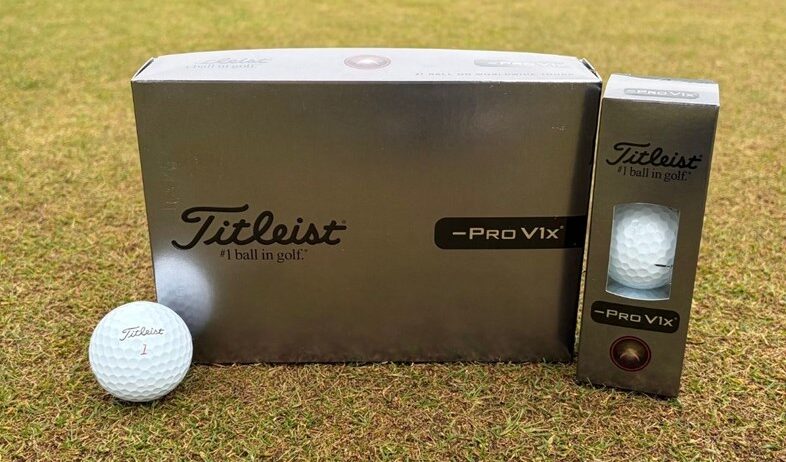
The story behind the Titleist Pro V1x Left Dash is that it’s faster and longer. But, writes golf ball expert James Hogg, it’s in another area where Titleist have boosted this model’s appeal…
Titleist are constantly working to innovate their golf balls to find marked improvements from generation to generation, and it’s only when they see clear developments that they then bring a new golf ball to market. This is one of many reasons why, in my people’s minds, they produce the best golf balls on the market.
Every golf ball introduced by Titleist has to go through the same rigorous testing process, where it’s scrutinized at every stage. For the 2026 Pro V1x Left Dash, Titleist hit a bump in the road in April 2023, and they were forced back to the drawing board to reimagine Left Dash, based on what they call its North Star.
Was it the right decision? Based on feedback from Tour players, and the fact Titleist have now brought a Left Dash to market in 2026, I would say so, and I’m sure Titleist would agree.

Left Dash began life as a Custom Performance Option (CPO) in 2018. Fast forward eight years, and the Left Dash is now a fully fledged member of the Pro V1 family alongside the extremely popular Titleist Pro V1 and Pro V1x. All three Pro V1 models make up Titleist’s premium golf ball range – along with the Left Dot in America.
In previous years, I would have classed the Left Dash as a very niche golf ball. The best way to describe it is the Pro V1 with high flight and less spin. For some amateur golfers, that will sound enticing, but if it does to you, you’re probably in the minority. Based on that summary of the Left Dash, it doesn’t appeal to me, but I think there’s a lot more to the 2026 model than there was with the previous generation Left Dash.
The prior model was the first Left Dash Titleist officially brought to market, as an option for amateur golfers. Titleist says, based on the figures from their golf ball fitting app, the Left Dash is the primary recommendation for only six to eight percent of golfers. I don’t necessarily think this number will change drastically on their database, but if you hit the Left Dash on course, I think it could be a potential golf ball for more than that percentage.


Pros & Cons Ratings Specs Features
Pros Better short game spin and control than previous generationGreat distance for fast swing speed playersLikely to appeal to more golfers than previous modelsExtremely responsive Cons Firm feeling isn’t going to please everyone
Durability
Versatility
Tee to Green Performance
Feel and Response
Construction 4-piece Cover Urethane Dimples 348 Feel Firm Flight High-mid Long game spin Mid-low Short game spin High-mid Color options White Faster high gradient dual core formulationThicker, high-flex casing layerThinner cast urethane coverSpherically-tiled 348 tetrahedral dimple design
At the end of 2024, I began testing the 2025 Pro V1 and Pro V1x, and I was shocked to discover I preferred the Pro V1 over the Pro V1x. Despite not really being a fan of the Left Dash, I was open to trying it, because who knows, maybe I’ll prefer this to the Pro V1…
Tee to green performance: 4.5/5
I’ll be honest with you, I don’t prefer the Left Dash to the Pro V1, but I liked it a lot more than I thought I would. I doubt I’ll be the only one with that opinion, and for anyone who currently plays Left Dash or has used them on occasion, I think you’re going to really enjoy the 2026 model.
Based on my on-course findings and the results from our 2025 golf ball robot test, there was no disputing that the previous generation Left Dash was one of the longest golf balls, especially for golfers with fast swing speeds. But, somehow, Titleist have been able to find even more distance and speed.
I tested the Left Dash, and so did one of my regular playing partners, who uses Left Dash practically every round they play, and we were both in agreement that it’s longer than the previous model. Whether it’s thanks to the faster high gradient dual core formulation, thicker, high-flex casing layer, or both, what I do know is we (he for definite) didn’t scoff at the extra yards off the tee – and I don’t think any golfer would.
A faster and longer golf ball is always going to appeal to golfers. We’re all the same – even if we’re not actively chasing distance, it’s always appreciated. However, the area that impressed me most with the Pro V1x Left Dash was its short-game performance. I began testing the Left Dash at the practice area at Cleveland Golf Club, and I was immediately taken aback by how spinny it felt. Considering it’s lower-spinning than the Pro V1 and Pro V1x, the Left Dash felt surprisingly spinny, and it was generating enough spin to stop much quicker than the previous model, which I was hitting at the same time as a comparison.

Titleist have introduced a new, thinner cast urethane cover in the 2026 Left Dash to help generate more greenside spin and control, and, from what I’ve seen, it delivers. Moving through the bag, even into mid-irons, the Left Dash was stopping quickly. When approaching greens with an iron in hand, it wasn’t stopping as quickly as I would expect a Pro V1 or Pro V1x to, but it wasn’t rolling out anywhere near as much as the previous generation. Personally, I see this as a big win for the Left Dash because it makes it more playable for more golfers.
The flight is very similar to the previous generation. It is difficult to launch if you have a slower or even average swing speed, but for golfers with fast swing speeds, this won’t be an issue, and you will still see that high, penetrating ball flight you’ll have become accustomed to with Left Dash.
Overall, the Left Dash really impressed me with its tee to green performance. The changes Titleist have made to the core, mantle, and cover have all enhanced this golf ball’s performance, and ultimately, its appeal.
The Left Dash no longer strikes me as a daunting golf ball, but one that more players should be encouraged to try.
Versatility: 4/5
Building on from my previous point, the Left Dash has, at least in my eyes, improved in its versatility, based on the changes made by Titleist, and the on-course performance I saw. The Left Dash isn’t as versatile as the Pro V1 or Pro V1x because it’s a golf ball that’s been designed to work for golfers who aren’t getting the most out of the Pro V1 or Pro V1x.
However, I’ve definitely seen enough from the 2026 Left Dash to say it’s more versatile than the previous generation. Not only because it’s higher-spinning around the green, but it also feels easier to hit, easier to launch (if you have the swing speed), and easier to control.
The Pro V1 is quite possibly the most versatile ball in the game, and the Pro V1x isn’t far behind if you require more spin and a higher ball flight. If you asked me last year how the Left Dash compares, I would have said it was a long way back, but honestly, if you asked me that question now, I would say it’s much closer.

Feel and Response: 4/5
I’ve restrained myself from mentioning anything about feel and response until now. Over the past couple of months, my preferred feeling has changed because I’m listening to the ball a lot more. I’m now not in the soft camp, but I’m not in the firm camp as much as I was previously. Given that’s the case, I didn’t think I was going to like how the Left Dash feels because it is a firm golf ball, that has been made firmer in 2026.
However, I actually enjoyed the feel and response because although it is firm, because it’s not as clicky as other firm golf balls. I listen to a golf ball most when I’m putting, and it is very firm off the putter face, but it sounds more like a Pro V1x than the previous Left Dash.
The main reason why I typically enjoy firm golf balls is because of how responsive they are. I always think you can learn a lot more from a firm golf ball than a soft golf ball, and I would say that’s the case with the Left Dash, but more because of the fact, it is still quite an unforgiving golf ball. It’s definitely improved in that area, but with a mishit, you will know instantly it’s not a good shot through feel, and then it will be confirmed by the end result.
I would say if you like the Pro V1x for its feel, then the Left Dash should also be up your street. But if you do want something softer, then stick with Pro V1.
Durability: 4/5
I saw marked improvement with durability in the 2025 Pro V1 and Pro V1x, but that wasn’t the case with the 2026 Pro V1x Left Dash. At the short game area, I didn’t see any damage to the cover after a number of chips and pitch shots, and when I took the Left Dash out on course, there was very little sign of wear.
In earnest, durability is very similar to the previous generation. The odd scuff did begin to appear towards the end of my round, but I had been in a couple of bunkers, and I had found some long grass on a couple of holes. Given that it’s a thinner cover, I did expect durability to decline, if anything, but I’m happy to report it’s more or less at the same level.
I would have been happy to play another few holes at least with the one Left Dash I used during my round, but another 18 probably would have been a stretch for me. However, I think some golfers could easily get two rounds or so out of one Left Dash and be satisfied with how it holds up and its performance.

Final verdict: 16.5/20
The Pro V1x Left Dash is definitely a golf ball on my radar for 2026. It’s probably not a ball I’d reach for every round I play, but I could happily use one and find success, which is something I don’t think I could have said about the previous generation.
The 2026 Left Dash is faster and longer, but I think the main takeaway is that it’s easier to control and it performs more optimally when hitting into greens, which I think is only going to help this ball appeal to more golfers.
If you’re in two minds as to whether or not you should try the Left Dash – don’t let me put you off. But it’s worth bearing in mind that it isn’t as versatile as the Pro V1 or Pro V1x.
Having said that, I can see it being the right golf ball for more golfers in 2026 than it had been in its previous seven years in the game.