

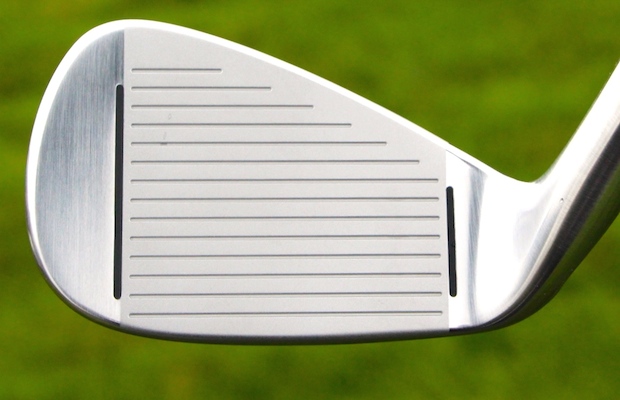
Yes, I’m a teaching professional, but I don’t hesitate to use all the technology that equipment manufacturers are building into their new clubs. Like you, my job keeps me from playing and practicing as much as I’d like, so I want all the help I can get from my equipment. That’s why I was excited when I heard about TaylorMade’s RSi irons, which have new technology that promises to improve performance on off-center hits.
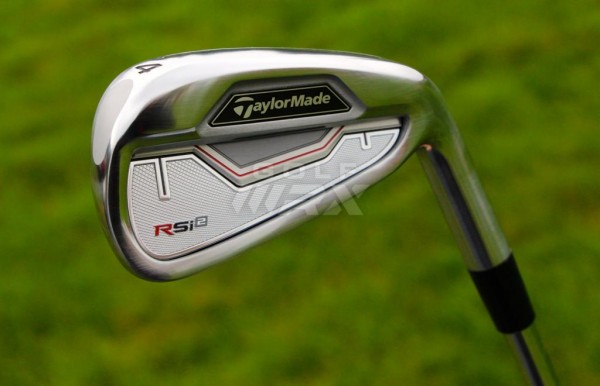
The RSi irons have slots cut through their faces that are said to help mishits — especially those on the heel and toe — fly more like shots hit on the sweet spot. They work together with the slot on the bottom of the sole (TaylorMade calls it a “Speed Pocket”) to help iron shots launch higher, faster and more consistently.

It wasn’t until Doppler Radar Launch Monitors like FlightScope and Trackman came out that I became clear on how big of a difference equipment plays in changing ball flight. By changing club heads and shafts, golfers can totally shift the launch, spin, height and landing angle of their shots, which affects their carry distance, roll and dispersion.

I used to order the same set makeup every year, which wasn’t too different than what I used during my formative golf years, but now I’ve switched to multiple fairway woods and different types of modern iron constructions (hotter, more forgiving long irons and blade-like short irons) that help me play my best. I found this to be my ideal set makeup through testing on my Trackman, and when I got TaylorMade’s new RSi 2 irons in the mail I could wait to see if they worked better for me.
The RSi 2 has a size that between the TaylorMade’s RSi 1 irons (a larger, game-improvement model) and its RSi TP (a smaller moder for better players).

Full disclosure: I am a TaylorMade staff professional, but I approached this testing in the same non-biased way that I approach my instruction articles with GolfWRX. Don’t take my word that these irons are good or bad — look at my numbers, or better yet go get fit for the and see the results for yourself.
The testing below took place the week after a (non-golf) vacation, so I really got to see how good they RSi’s were at helping me on mishits.
7 iron, RSi 2: Solid shots with centered impact
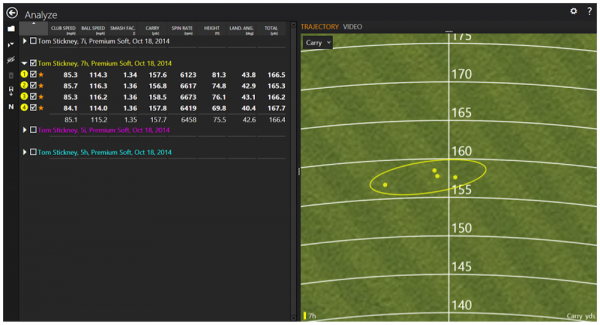
Click the images to enlarge it.
I separated my best stock shots with my 7 iron.
Clubhead Speed: 85.1 mph
Ball Speed: 115.2 mph
Smash Factor: 1.35
Carry: 157.7 yards
Height: 75 feet
Spin Rate: 6458 rpm
RSi2, 7 iron: Random unsolid impacts
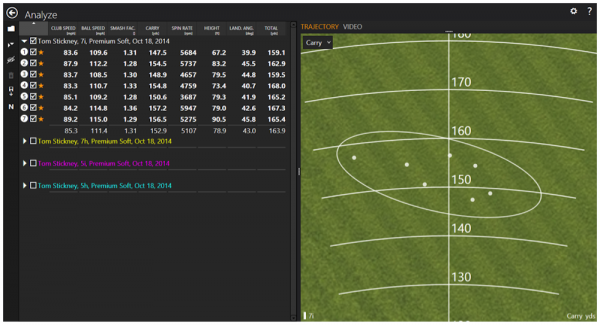
Click the images to enlarge it.
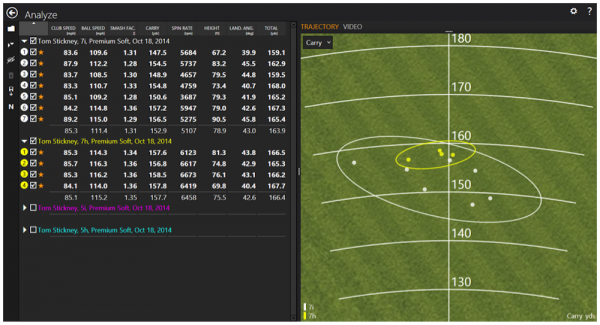
I separated my mishits with my 7 iron, throwing out the grossly mis-hit shots that are not typical of my on-course play. My averages are below. You can see they they’re different than my best hits, but they’re much closer than what I expected.
Clubhead Speed: 85.3 mph (from 83.3 to 89.2 mph)
Ball Speed: 111.4 mph (from 108.5 mph to 115 mph)
Smash Factor: 1.31 (from 1.28 to 1.36)
Carry: 152.9 yards (from 148.9 yards to 154.8 yards)
Height: 78.9 feet (from 67.2 feet to 90.5 feet)
Spin Rate: 5107 rpm (from 3687 rpm to 5947 rpm)
Let’s compare the 7 iron data together
Click the image to enlarge it.
Both impact conditions have the same clubhead speed that averages around 85 mph. The ball speed of the solid shots averaged 115 mph vs. 111.4 mph on the unsolid ones. That’s a Smash Factor difference of only 0.04, which is miniscule.
What is interesting to see is that the carry distances are under control on the solid shots — no hot spots from the slots, which was a concern with TaylorMade’s original RocketBladez and RocketBladez Tour irons. Even better was the consistency on off-center hits in terms of carry distance. I missed the ball all over the face and got an average carry distances that was only 4.8 yards shorter than my best strikes.
——————–
Now, what about a longer iron? That’s where there’s a much greater potential for mishits and those mishits are often amplified. With the RSi 2, TaylorMade added tungsten weights to the soles of the 2, 3, 4 and 5 irons to add more MOI to the clubs for even better ball speed retention on mishits.
Here’s how the same test went with a 5 iron. I followed the same protocol as above.
5 iron, RSi2: Solid shots with centered impact
Click the image to enlarge it.
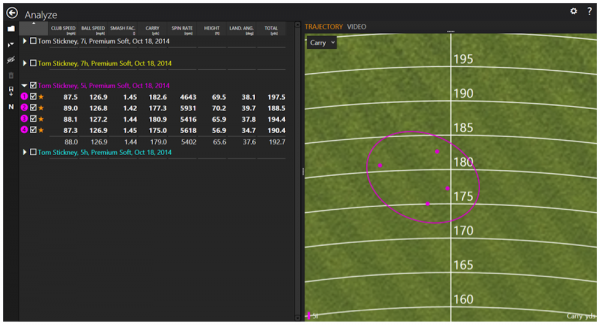
Clubhead Speed: 88 mph
Ball Speed: 126.9 mph
Smash Factor: 1.44
Carry: 179 yards
Spin Rate: 5402 rpm
Height of 65.6 feet
Landing Angle: 37.6 degrees
5 iron, RSi2: Random unsolid shots
Click the image to enlarge it.
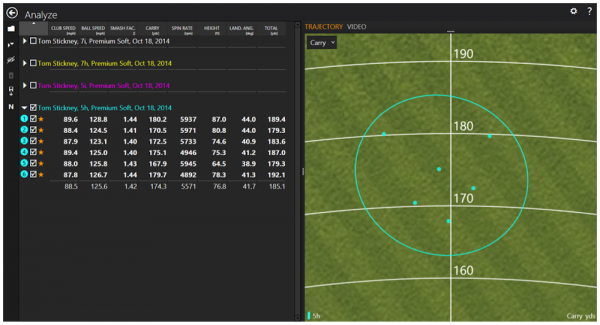
Clubhead Speed: 88.5 mph (from 87.8 mph to 89.6 mph)
Ball Speed: 125.6 mph (from 123 mph to 128.8 mph)
Smash Factor: 1.42 (from 1.4 to 1.44)
Carry: 174.3 yards (from 167.9 yards to 180.2 yards)
Spin Rate: 5571 rpm (from 4892 rpm to 5971 rpm)
Landing Angle: 41.7 degrees (from 38.9 degrees to 44 degrees)
Let’s compare the 5 iron data together
Click the image to enlarge it.
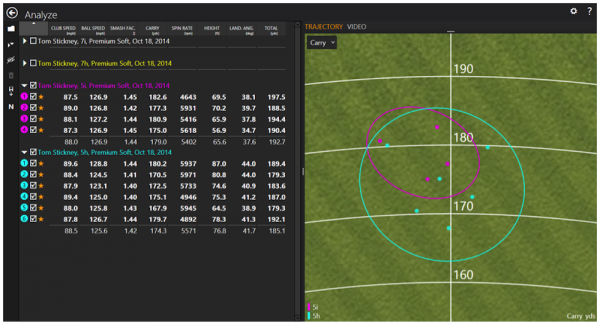
The clubhead speeds on both series of shots was constant at about 88 mph. Amazingly, average ball speed was only separated by 1.3 mph from the “solid” to “unsolid” group. Smash factors between the two showed a very consistent energy transfer on the unsolid shots as well — just a 0.02 of a difference
The carry average on the solid shots was 179 yards, and the average of the mishit group was less than 5 yards shorter — 174.3 yards. Only one mishit that fell outside of a 10-yard gap. It flew 167.9 yards, which was a nice surprise based on the contact (awful).
The Takeaway

To me, this test showed that TaylorMade’s new RSi 2 irons are the company’s most consistent irons in their category to date. The improved Speed Pocket and Face Slots do make a difference. Just how much of a difference will depend on your swing speed, average contact point and mechanics, but they will be more consistent.
Are they worth the upgrade? I’ll be making the switch because I know they’re better for me. The numbers proved it. If you’re interested in a new set of irons, get to a qualified custom fitter and see which model works for you — the RSi 1, RSi 2 or RSi TP — and if they’re better than what you’re playing.