

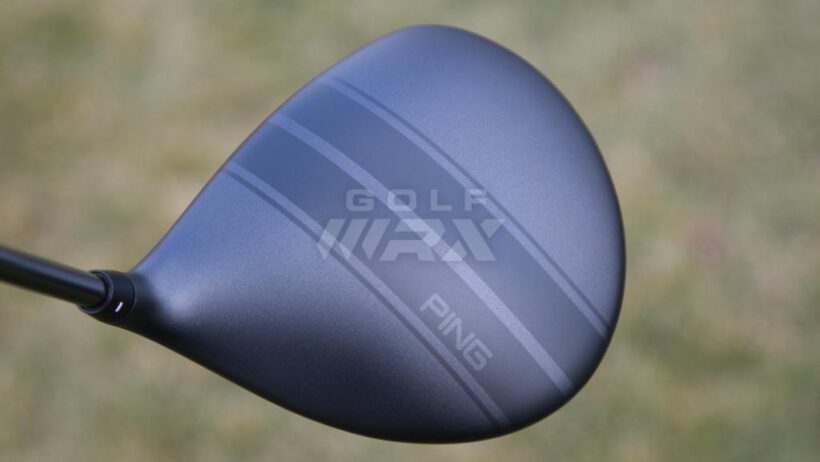

i25 Driver
Ping’s new i25 driver has a center of gravity that is more forward than the company’s G25 driver to help golfers reduce spin on their tee shots. But discussion about the i25’s engineering feats will likely take a backseat to a more obvious change to the new club: black racing stripes that run from the top of the driver’s face to the back of its crown to help golfers set up square to their target line.
Click here to see what GolfWRX members are saying about the i25 lineup in the forums.
Marty Jertson, director of product development for Ping, said it took the company three years to perfect the racing stripes because of the difficulty of placing straight lines on a club’s curved crown surface.

According to Jertson, average golfers use a driver with a lie angle of about 58 degrees. But when they place their drivers in the address position behind the ball, their lie angle measures about 45 degrees. That’s why if you look at the racing stripes in most orientations other than the setup position, they don’t look straight. But they look perfectly straight at address thanks to the special tooling Ping created to stamp the stripe on the head and verify its proper placement.
[youtube id=”cR1beX34Yak” width=”620″ height=”360″]
The i25 driver is not as forgiving as the company’s G25—its heel-to-toe moment of inertia is about 4700 g-cm2, while the G25 has an MOI of about 5500— mostly because of the i25’s shorter profile from front to back. But engineers were able to make a significant improvement in the top-to-bottom MOI of the i25; it’s 8 percent higher than its predecessor, the i20 driver. That creates more consistent spin rates on shots struck both above and below the sweet spot, leading to longer drives. The i25 also has 15 grams of tungsten weighting positioned on the rear portion of its sole, helping boost heel-to-toe MOI by 1 percent over the i20.

Like Ping’s G25 and Anser drivers, the i25 is equipped with Ping’s Trajectory Tuning technology, the company’s slim, lightweight adjustable hosel that allows golfers to raise or lower a driver’s stock loft by 0.5 degrees. The driver is available in lofts of 8.5, 9.5 and 10.5, each with a 460-cubic-centimeter head that weighs 207 grams.
The stock shaft is Ping’s new PWR (performance, weighting, responsiveness) family, which is available in three different weights: 55, 65 and 75 grams. Each shaft has a specific balance point that keeps the swing weight of the club the same regardless of what shaft weight golfers choose. For example, an i25 driver built with a PWR 55-gram shaft will have a lighter total weight than one built with a PWR 65-gram shaft. But the lower balance point of the PWR 55-gram shaft allows both clubs to have the same swing weight.

The stock shafts include: PWR 55 (R and S flexes), PWR 65 (R, S, Tour S and Tour XS) and PWR 75 (S, Tour S, Tour XS). The stock shaft length is 45.25 inches.
i25 Fairway Woods

Like the i25 driver, the i25 fairway woods have a center of gravity that is more forward than the G25 models. That decreases the amount of spin the fairway woods produce, leading to a lower launch and flatter overall trajectory.
While the i25 fairway woods are made from the same 17-4 stainless steel as their predecessors, they offer faster ball speeds thanks their thinner and slightly taller faces. The saved weight from their faces, as well as their bodies, also gives the i25 fairway woods a 7 percent improvement in MOI over the i20 fairway woods.
[youtube id=”kKNzb_MaCyw” width=”620″ height=”360″]
Like the i25 driver, the fairway woods have Ping’s patented racing stripes on their crowns, tungsten weighting on the rear portion of the soles and adjustable hosels. They’re available in three different lofts, S3W (14 degrees), 3W (15 degrees) and 5W (18 degrees), and offer the same PWR shaft options as the i25 driver.
i25 Hybrids

The i25 hybrids are designed to be the most versatile hybrids the company has ever created thanks to their more compact overall shape and reduced bulge and roll.
According to Jertson, reducing the bulge and roll, or the curvature of the faces of the hybrids, gives golfers more control over their trajectory. For example, on a knockdown shot, Jertson said the 20-inch roll on the i25 hybrid will deliver less loft at impact than the 14-inch roll on the G25 hybrid, resulting in the desired lower-launching shot.
Like the i20 hybrids, the new models are cast from 17-4 stainless steel. But they have a more-forward hosel axis, adding offset to the clubs that will help golfers create a higher launch angle. For that reason, the lofts of the hybrids were strengthened one degree from their predecessors to 17, 19 and 22 degrees. A 26-degree hybrid has also been added to the lineup, and both it and the 22-degree model have a center of gravity that is positioned closer to their faces to help flatten their trajectories.

While the hybrids do not feature the racing stripe that is on the crown of the i25 driver and fairway woods, they have a straighter leading edge and a more squared off toe that will help golfers with their alignment.
The stock shafts for the i25 hybrids include a PWR 80 (R, S and Tour S) and PWR 90 (S, Tour S and Tour XS), which are designed to create the same swingweight regardless of what weight or flex is chosen.
Ping’s i25 driver ($399), fairway woods ($249) and hybrids ($219) are currently available for pre-order, and will hit stores in mid-February.
Click here to see what GolfWRX members are saying about the i25 lineup in the forums.