

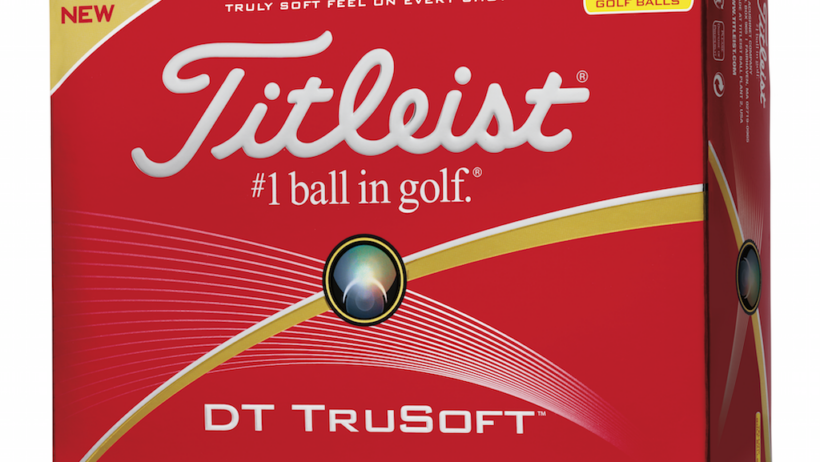
Titleist’s DT golf balls have had a following with golfers for decades, going back to the 1940s when DT stood for “Dynamite Thread.” There’s no thread in modern golf balls, of course, but in recent years Titleist’s DT Solo has resonated with golfers wanting a soft-feeling golf ball with well-rounded performance at an affordable price.
Titleist’s new DT golf ball, the DT TruSoft, replaces the DT Solo in the company’s line. It sells for $21.99 (MAP), and is available in white and optic yellow. The DT TruSoft aims to give golfers a significantly softer feel than they enjoyed from the DT Solo, without compromising the performance of its predecessor.

Related: Our review of Titleist’s DT Solo and Velocity golf balls
On Titleist’s compression measuring devices, the DT TruSoft is 15 points softer than DT Solo, which was already the softest golf ball in Titleist’s line. That puts its compression in the mid 50s, according to Michael Mahoney, director of golf ball marketing for Titleist.
The move toward a softer compression was prompted by increased demand for softer golf balls, Mahoney said, which the company saw the impact of when it released its significantly softer NXT Tour S golf ball in 2014.
[quote_box_center]“It was a very incremental product, and we saw huge growth,” he said.[/quote_box_center]

Related: Our review of Titleist’s NXT Tour and NXT Tour S golf balls
Focusing on a single factor isn’t Titleist’s style when it comes to golf balls, however, particularly when that factor is compression. The company wanted to create a softer-feeling DT without affecting performance, particularly short game spin. Its engineers found the means to do so by blending a fast, low-compression core and a Pure Ionomer cover — both of which are the softest Titleist has ever used in a golf ball.
[quote_box_center]“When you lower compression in a golf ball, it’s going to get slower and it’s going to generate lower spin,” Mahoney said. “That’s going to be across all shots. There can be benefits to that in the long game, but also detriments to that in the short game. We can bring compression down and we can leverage [low] spin characteristics in the long game, but then we continue with spin technology and cover technology that helps us deliver more spin in the short game.”[/quote_box_center]
Remember that the DT TruSoft is still an affordable golf ball, which means there are better-performing golf balls in the Titleist line. So if you’re looking for more short-game performance from the Titleist brand, you’ll want to try the NXT Tour and NXT Tour S golf balls (both $33.99), which are “in a different category when it comes to short-game performance,” Mahoney said. And of course, all golfers will get the best performance with a Titleist golf ball from either the Pro V1 or Pro V1X (both $47.99).
For that reason, it’s best to compare the DT TruSoft to Titleist’s Velocity ($26.99).
According to Mahoney, the DT TruSoft is a lower-flying golf ball than Velocity, so it will create more distance through roll. But when it comes to which ball has a softer feel, the DT TruSoft is true to its name.
[wrx_retail_links productid=”15″]