
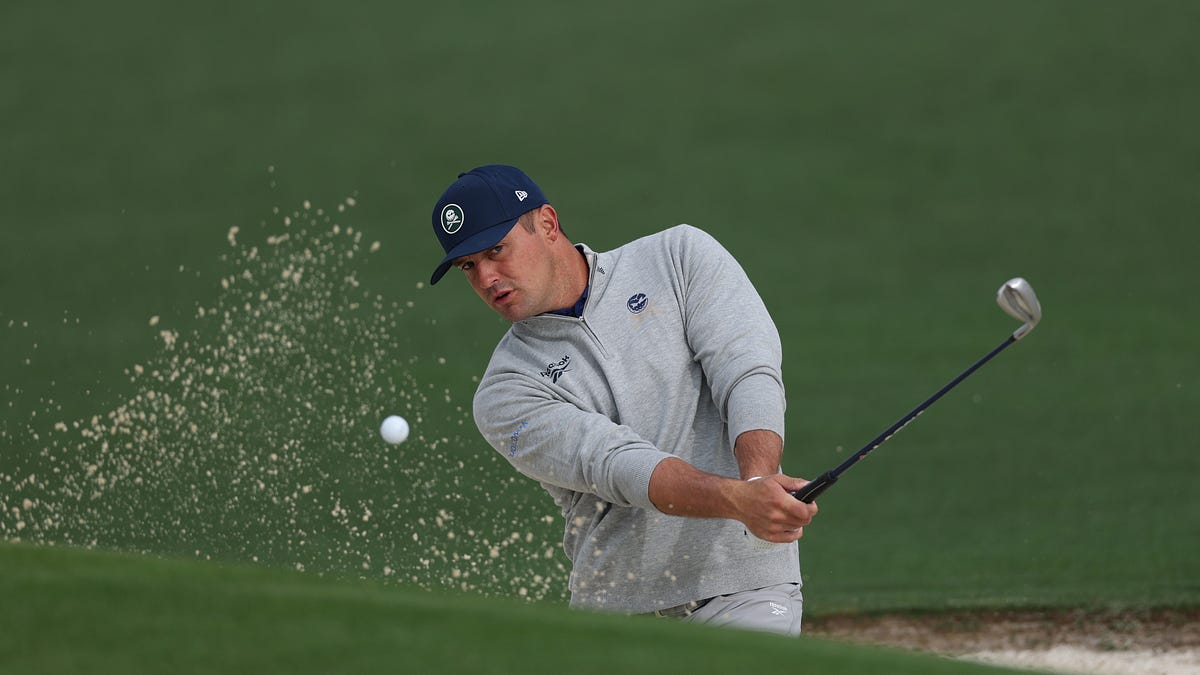
 Bryson DeChambeau hits out of a greenside bunker on the second hole during a practice round prior to the 2026 Masters Tournament on April 07, 2026. (Maddie Meyer/Getty Images)
One of the first stories I ever wrote at FiveThirtyEight — at the request of Mike Wilson, our original Managing Editor — was about golf. Specifically, it examined which skills tended to shine at the Masters: I found that Augusta rewards power far more than precision, with long hitters consistently outperforming expectations while players who rely on accuracy off the tee, putting and short-game prowess don’t see their games translate as reliably amid the towering Georgia pines.
 At Augusta, Hitting Short Drives and Losing Is a Tradition Unlike Any Other
A few years later, one of the first stories I ever edited from top to bottom was also about golf (and also about The Masters). In it, Todd Schneider argued that, despite Augusta’s reputation as a putting test, the data shows the opposite — the Masters is won tee-to-green, with elite ball-striking (off the tee and on approach) correlating far more with success than putting or short-game skill.
Both stories pointed toward similar conclusions: That the long game is traditionally what wins at the Masters, with iron accuracy also playing a key role, while short hitters and those otherwise reliant on their skills on and around the putting green tend to suffer.
And just based on recent results, it’s hard to argue to the contrary. Rory McIlroy, last year’s Green Jacket recipient, ranked No. 2 among all PGA Tour players in driving distance, averaging 323 yards per drive, and he was joined by fellow long hitters Jon Rahm (No. 11 in 2023), Scottie Scheffler (No. 19 in 2022) and Dustin Johnson (No. 10 in 2020) among winners this decade.
But there is some evidence that the story at Augusta has gained a few twists since our original research roughly a decade ago.