
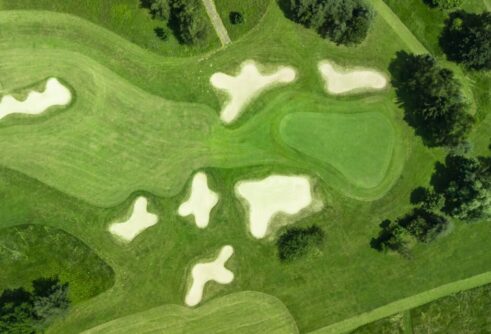
The Town of Oyster Bay has reached a settlement with Peninsula Golf Club that permanently prohibits development on the 50-acre, nine-hole course in East Massapequa, ending a nearly six-year legal battle over the property’s future.
The agreement, approved unanimously by the Town Board on Tuesday, March 24, requires the site to remain a golf course and rezones the land from residential to recreational use. The club has 60 days to execute the terms. Under the deal, the town retains the right to pursue eminent domain if the restrictions are violated and holds the right of first refusal if the property is ever offered for sale.
“This is great news for our community as we are permanently protecting this open space from development while saving the millions it would cost to acquire it,” Oyster Bay Supervisor Joseph Saladino said.
The dispute dates back to 2021, when it was rumored that P.G.C. Holding Corp., the course’s parent company, had received an offer from a Florida-based developer to be subdivided into 150 single-family homes.
According to a statement posted by the Nassau Shores Civic Association, shareholders had voted to approve a sale of the property that included a provision awarding them an additional $60 million if the land were later developed.
The town offered to match the $4.4 million purchase price, but the deal’s structure made it effectively impossible to compete, the association said. The town then pushed to rezone the land from residential to recreational use to block development without a purchase, but the owners declined to rezone the property.
In 2024, Oyster Bay filed a petition in Nassau County court to seize the property through eminent domain.
The Nassau Shores Civic Association became involved early in the process, mobilizing residents and advocating for the land to be preserved.
“The No. 1 goal was to maintain the golf course as open land and to prevent development,” said John Guerriero, president of the association.
Residents feared the scale of potential development would overwhelm the surrounding neighborhood.
“With the infrastructure issues in Nassau Shores, it just wouldn’t be able to support another 150 homes,” Guerriero said. “It’s a jewel of the neighborhood and also serves as an important flood buffer.”
Nassau County sold the land in 1946 with restrictions requiring it to remain a golf course, though those protections were not guaranteed to hold. The settlement strengthens those restrictions through new deed agreements tied to the property.
Environmental concerns drove much of the community’s opposition. The course sits in a low-lying coastal area that experienced significant flooding during Superstorm Sandy in 2012, and residents say its open land helps absorb water that would otherwise reach surrounding homes.
While the settlement resolves the immediate threat of development, some residents say attention will now shift to the condition of the property itself, pointing to longstanding concerns about safety and maintenance, such as fencing and surrounding foliage.
“They fought hard to keep it, now they need to put the work into it,” Guerriero said. “It is my hope that the owners of the course can now move forward and focus on making necessary safety and cosmetic improvements to outdated features of the course.”
The Peninsula settlement reflects Oyster Bay’s effort to limit housing development on the property, bringing an end to years of uncertainty for residents who had opposed its potential redevelopment.
“It comes down to preserving the integrity and the character of your neighborhood,” Guerriero said.