
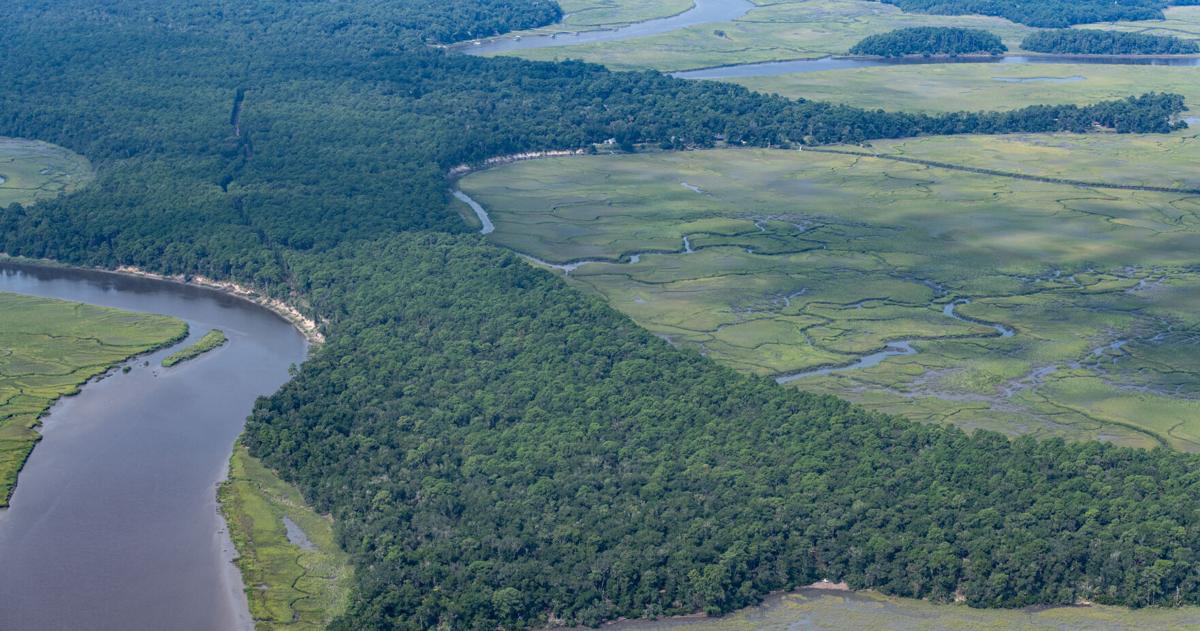
BEAUFORT — The efforts by would-be developers to build a golf resort on a St. Helena Island property known as Pine Island have taken any number of twists and turns in the three plus years since the plan came into public view.
In the latest gyration, Judge Richard Gergel dismissed a lawsuit pending before the U.S. District Court for the District of South Carolina. The suit, filed by Charleston attorney Ellis Lesemann on behalf of the property owners, Pine Island Property Holdings LLC and Pine Island GC LLC, was one of a pair of lawsuits filed in 2023 after county officials denied applications for three six-hole golf course on the 502-acre property.
The denial was based on a zoning amendment, referred to as the St. Helena Island Cultural Protection Overlay, which prohibits golf courses, resorts and gated communities in the overlay zone. Most of St. Helena Island is within zone boundaries, including the Pine Island property. The plaintiffs purchased the property with that understanding as stated by Gergel in his Feb. 20 order.
“It is regrettable that taxpayers and community members were required to devote substantial time and resources to defending straightforward, long-standing land use protections,” said South Carolina Environmental Law Project senior attorney Jessie White.
SCELP represented the Gullah/Geechee Sea Island Coalition, which was recognized as intervener in the federal case on behalf of the defendant, Beaufort County.
“The fact that we received this announcement during Black History Month means that much more to us since historically our ancestors didn’t see their culture honored or protected by others,” said Marquetta Goodwine, also known as Queen Quet, founder of the Gullah/Geechee Sea Island Coalition.
The first of the two suits appealed the decision by the Beaufort County Planning Commission denying the application. It was heard in the Court of Common Pleas. The second suit broadly alleged that the property owners’ rights were violated by the decision, and that case was moved to the federal level.
While the cases were argued in different courts, they remained inextricably linked in a way that would ultimately prove important.
The state case worked its way through the court system, albeit slowly. An attempt at mediation failed when Beaufort County Council voted in September 2024 to reject a settlement offer made by the plaintiffs and opted to proceed to court. Council debated that decision behind closed doors in executive session, and the substance of the settlement offer was never made public. The case never made it to court.
In December 2025, Lesemann suddenly withdrew the appeal in a move that baffled some who followed the case closely. Amy Armstrong, SCELP executive director, referred to the move as sudden and inexplicable.
Beaufort County Attorney Brian Hulbert noted that the issues raised by the appellants in the state case were also raised in the federal case, which may have motivated the decision to end the state case.
“They didn’t stand that good a chance to win in the state court. It’s tough to win on an appeal from the planning commission in state court,” Hulbert told The Post and Courier last year.
In the federal case, Lesemann made a number of claims, including that the denial of the golf courses was a violation of due process and a violation of his client’s equal protection.
“Plaintiffs seek to invalidate the (cultural protection overlay) and have this Court declare that ‘the intended development plan’ is permissible under applicable law,” Gergel wrote.
Activity on the case began to pick up in December 2025 after Gergel lifted a stay on the case. He ruled on several motions made by both the plaintiffs and defendants. Notably, a motion to dismiss the case filed by the county was dismissed, as was a motion by the plaintiffs to disallow participation in the case by the Gullah/Geechee Sea Island Coalition.

Marquetta Goodwine, also known as Queen Quet, performs a libation ceremony at Coosaw Sea Island Cotton Heritage Preserve on Coosaw Island, April 22, 2025. Founder of the Gullah/Geechee Sea Island Coalition, she participated in a federal lawsuit, opposing an attempt to build a golf resort on St. Helena Island’s Pine Island.
File/Tony Kukulich/Staff
In his Feb. 20 order dismissing the case, Gergel said that a party invoking the federal court must have suffered an injury, the injury must be traced to the defendant and the injury can be favorably redressed by the court. The withdrawal of the state case eliminated any claim of injury on the plaintiff’s behalf.
“The Court finds that there is no longer of case or controversy before it, and that this action must be dismissed,” Gergel wrote.
Unsurprisingly, reactions from the plaintiffs and defendants varied considerably.
In a press release, the Coastal Conservation League called the ruling a “significant victory for St. Helena Island and community-led zoning.
“This decision affirms what has been clear all along – the St. Helena community-driven Cultural Protection Overlay is a lawful and enforceable exercise of Beaufort County’s zoning authority. We appreciate the Court’s careful attention to the record in bringing this litigation to a close,” White said.
Lesemann, in an email to The Post and Courier, opined that the decision was not based on the merits of the case.
He wrote, “Judge Gergel’s order was based on a technical issue that we are already in the process of correcting. The case will be refiled shortly.”