
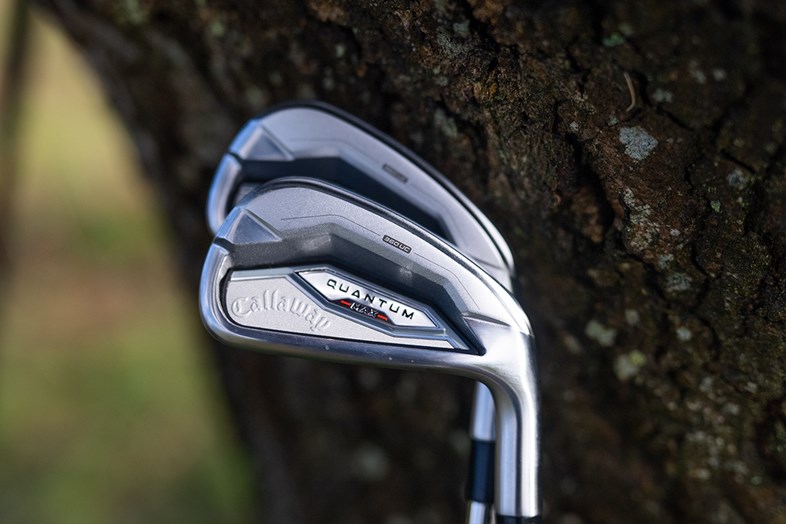
Callaway’s Quantum Max are a front-runner for the best ever game improvement irons. But with two steps forward comes one step back, as Alex Lodge found out…
The Callaway Quantum Max irons join the Callway Quantum metalwoods in an incredibly exciting release for 2026, with myself and other TG gear experts keen to see how they all perform in the best irons and best drivers test.
The Callaway Quantum irons come in a Max and Max OS offering, with clear distinctions between them for the high-handicap golfer. These irons have big shoes to fill, with the Callaway Elyte irons performing well in our best game-improvement irons test. The Elyte irons were the epitomy of what Callaway have been doing right, and wrong, over the last decade with their iron releases.
Releasing an iron every year is a difficult task, especially in the game-improvement category. We’ve seen TaylorMade shy away from this release schedule in recent years, with more brands following suit to lengthen the time they release irons in any category. Callaway have held firm – but the iron styles year-on-year have changed drastically. The Callaway Rogue ST irons were a players distance iron – a fantastic but confusing iron release. The Callaway Elyte irons were some of the best irons of 2025, but their performance crept a touch too close to their Apex family, with the Ai300 the more expensive, premium offering feeling the heat. Callaway have chopped and changed the style of their iron releases every year – a sign of experimentation, and perhaps a sign of not knowing what the consumer wants.
I do still believe Callaway have far too many irons out in 2026, but with the Callaway Quantum Max irons, there is a clear message for who they are targeting, going back to their roots with a clear game-improvement iron that is all about forgiveness.
Callaway Quantum Max irons

Price: £167/$164 per iron
Pros & Cons Ratings Specs Features
Pros Clean, fresh aesthetic which stands out in a traditional manner. Remnants of old Callaway X-family in DNA Superb launch windows on mishits Cons Feel is relatively poor across the face.Iron lineup in general from Callaway feels oversaturated.
Looks
Tech
Performance
Overall
RRP £167/$164 per iron Availability 4-SW Stock Shafts KBS Max 90, True Temper Denali Frost Silver, Mitsubishi Chemical Vanquish, Mitsubishi Chemical Eldio Stock Grip Golf Pride Tour Velvet 360 Modern 360 degree undercutProgressive Tri Sole AI Optimised Face Design
Looks – 4/5
Callaway, alongside other OEMs, have a difficult task with game-improvement irons – especially with a yearly release. A game-improvement iron has to be large by nature, to allow maximum forgiveness on mishits and increase the MOI of the clubhead.
You can paint a game-improvement iron however you want it, they’re usually ugly either way.
The models that usually aren’t as hard on the eye are continuations of a player irons family. The Srixon ZXiR, Mizuno’s JPX family, Callaway’s Ai300 are all very good looking irons that are based off the design of a blade or muscleback.
It seems when brands go back to the drawing board and create the DNA of the iron rather than adapting it off something that has worked for lower handicap players, the looks aren’t as appealing.
I’m on the fence whether that applies to the Callaway Quantum, because I can sense the DNA of a very popular iron from years past.

There isn’t a whole lot going on with the Callaway Quantum irons. We can see some tech on the sole (which is admittedly large) but the topline isn’t going into the realms of being repulsive. There’s a healthy amount of offset (which I welcome), and overall, it’s quite a traditional iron for the game-improvement iron category, with a splash of modernity in the etching and color scheme to allow the head to appeal to anyone’s eyes.

This iron reminds me of a Callaway X in shaping, there or thereabouts. If we take a trip down memory lane to the X-family in the 2000s, Callaway had the game-improvement category in a relative chokehold year after year. The irons were synonymous with each other in identity, and it felt as if consumers were excited to put these irons in the bag. The similarity between the Callaway Quantum Max and this family is a real positive, although what the future holds for Callaway game-improvement irons does have me scratching my head. Is Quantum here to stay for the next five years? We’ll see.
Tech – 4.5/5
Technology of a game-improvement iron is usually quite linear, in that it involves the forgiveness of the iron based on the golfer who is purchasing the product.
With the Callaway Quantum Max irons, we do have refinements alongside a pivotal piece of innovation aimed at helping the golfer shoot lower scores.
This new piece of tech is an industry-first modern 360 degree undercut delivering extreme sole flexion to maximize ball speeds and optimal launch windows across the face.
Traditionally, with most cast game-improvement irons, the face is welded onto a cast body and hosel. With the Quantum irons, Callaway have flipped this construction. The hosel and face are now a single piece of material, with the weld line moved much further back around the sole.
This creates a full 360-degree undercut near the bottom of the face, freeing up the sole to flex far more at impact – particularly low on the face, where amateur golfers tend to strike the ball most often. More flexion means a more active face, better energy transfer, and more consistent ball speed across a much larger hitting area.
With this technology in place, mishits should retain significantly more ball speed and launch more optimally. Rather than a thin 7-iron coming up a club or two short, the Quantum irons aim to keep misses within roughly half a club of your intended carry, while maintaining playable spin and descent angles.
The keen golfers will see the sole has a new geometry design, labelled Tri-Sole. This isn’t a new concept, Tri-Sole was one of the standout features of the Elyte irons in 2025 – so it’s no surprise that Callaway have doubled down on this concept for Quantum – but with meaningful refinements based on tour and amateur feedback. This piece of tech will aid turf interaction for any type of golfer.
So, this iron should push the realms of forgiveness whilst maintaining tour level control and turf interaction.
Performance – 4/5
With the tech introducing some new innovation, I was quite eager to try these to find out if they were truly different to other game-improvement irons I’ve tested over the last few years.
I tested this iron out primarily on-course, but did have a data-gathering session at SwingZone Golf to compare it to other irons in my 2026 game-improvement lineup.
What stood out to me, as it does with practically every game-improvement iron, is the feel and sound suffering. It has a high, loud impact noise, with this not really changing across the entire face. That is in the DNA of the construction of the iron, which brands can’t really get around, despite their attempts. It’s not a negative feel, but irons such as the Srixon ZXiR do feel more premium.
What impressed me with the Callaway Quantum Max on-course was the launch windows I was seeing on mishits. I have a tendency to have a high-toe mishit creep into my game during the later stages of 18 holes.
The high-toe mishit usually comes with right-to-left curvature from gear effect and decreased spin. This is a combo that spells out a missed green. The result I found with the Callaway Quantum Max was far less severe than expected. On several occasions, I found the green when the impact location warranted anything but.
To put some numbers to this claim, I put these irons on a simulator and intentionally hit out of the toe and heel. The spin varied upwards and downwards by approximately 1,000rpm on mishits – a notable amount from a data perceptive, but when factoring in that this was with mishits, it didn’t hinder the end result.
I imagine this positive element is due to the new Modern 360 Undercut, coupled up with the Optimized Face Design. This feels like the modern upgrade to the Callaway X-20, while keeping the DNA that worked so well in irons of old. The technology is exactly what is needed for game-improvement irons – consistency, as opposed to outlandish distance.
Final Verdict – 4/5
This is the exactly what the modern game-improvement iron should be. The focus is on performance and getting the high-handicap golfer from A to B in the easiest way possible.
If was off 24, I’d be very overwhelmed by the myriad of high-handicap irons being pushed towards me saying they’ll improve my game. In truth, all irons are of a real high quality in 2026, so you can’t really go wrong.
That being said, for the consistency that this iron produces with launch windows and spin off mishits, this iron is a front runner for the game-improvement category, going back to the Callaway of old.
It’s such a shame that the feel and sound of the Quantum Max irons can’t be improved. But this is an industry problem, not a Callaway problem. And, in truth, it’s a worthy sacrifice for the performance.