
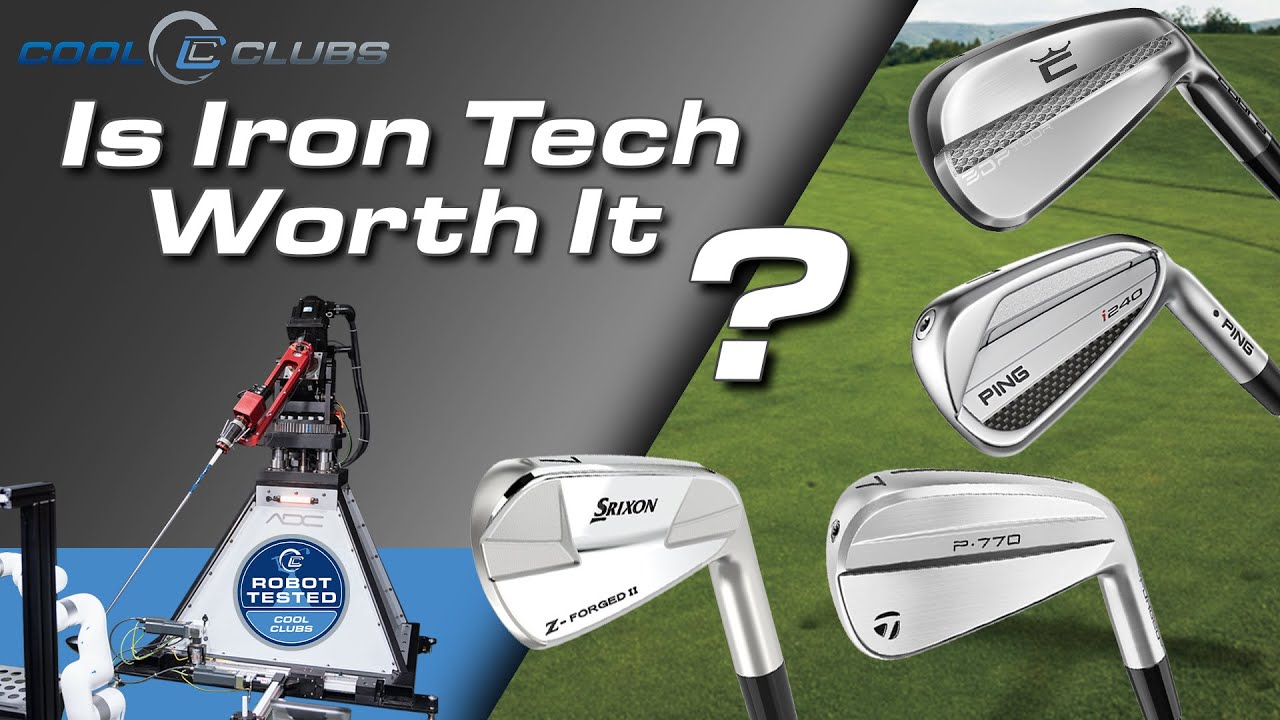
Is modern iron technology actually worth it—or is it all just marketing?
We put it to the test.
Using our Cool Clubs Verified Robot Test, we ran an extensive side-by-side comparison of four standout models:
Cobra 3DP, Srixon Z-Forged II, Ping i240, and TaylorMade P770.
Each iron was tested at 90 MPH and 80 MPH swing speeds, including center-strike data, dispersion patterns, and 3D scan insights to uncover what really changes with modern design—and what doesn’t.
From a forged blade to hollow body, we dig into every measurable performance difference to finally answer the question:
Is Iron Tech truly worth it?
Every shot. Verified data. Real results.
If you care about numbers, precision, and truth in performance, this is the iron test you don’t want to miss.
Like if you love seeing real robot data in action
Comment on which iron surprised you the most
Share this with a golfer who’s chasing consistency
Subscribe for more verified testing, fitting insights, and data you can trust
Chapters:
0:00 Intro
1:58 Cobra 3DP 90mph Robot Test
2:32 Srixon Z Forged-II 90mph Robot Test
4:49 Ping i240 90mph Robot Test
5:34 Taylormade P770 25′ 90mph Robot Test
6:49 Comparing the 90mph robot test key numbers
7:30 3D Scan Data for 3DP, Z Forged-II, i240, P770
9:30 80mph Verified Robot Test – Center Strike Data Comparison
11:27 80mph dispersion graphs compared
12:46 Answering the question: Is Iron Tech worth it?
BOOK A FITTING: https://coolclubs.com/book-fitting/
SIGN UP FOR EXCLUSIVE CONTENT: https://coolclubs.com/newsletter/
🌐 Website
📷 Cool Clubs Instagram
https://www.instagram.com/coolclubsgolf/
👀 Cool Clubs Facebook
https://www.facebook.com/CoolClubs/
What is Cool Clubs?
Cool Clubs is the largest independent club-fitting and custom-building organization in the world. We have club-fitting locations around the planet and are part of the Worldwide Golf family.
Cool Clubs is not affiliated with any club manufacturer, this means we only fit our clients with equipment that performs the best for them.
Research. Fit. Build. Performance.
Trust Your Fit. Trust Your Build. Love Your Game.
Welcome back to the channel. If you read the thumbnail of this video, it’s based around is tech worth it in irons? Because I didn’t pick these four irons how we’ve done it traditionally. It’s like, all right, do the fitters have them in the bay? People requested them. This is basically the last few irons in our tests that we’ve running, right? Just kind of finishing off the last couple and this is what ended up being. And uh yeah, it kind of makes sense. You got a little tech versus uh not tech, right? Right. Well, the the irons that showed up is kind of a lot of people that requesting. So, we got the 3D printed Cobra. We got the Shrixen Z Forge. And you look at those two together and think they shouldn’t be in the same group, but they may not. Like, let’s check that out with some data. And then we got Ping I240 and P770. So, ironically, all of these, the Shrixon, the Tailor Made, and the Ping, all at 33°. Yep. And then the Cobra sat at 31, right? Quite a bit stronger, right? You’d think. Yeah. So, we’re thinking longer distance, lower spin, lower launch. But we’re going to get into the nitty-gritty data. We’re going to hit these one time on the robot at 90 mph just for fun so you guys can see what happens. Then we’re going to dive into the 80 mph test. Then we got 3D scan data and after this video we’re going to probably move into drivers again and eventually we’ll get down through those hybrids and we’ve never seen those tested on the robot. No fairs hybrids I haven’t done in you know I’ve done you know 20 years ago or so did a lot of them but uh no we haven’t actually done a lot of hybrids in fairwood. So be really interesting to see what happens there. Yeah. So stick around for that. Hit that like. Hit that subscribe, jump in the comments. Last three videos have blown up. We love your support. We’re going to keep moving the needle, so stick with us. So, first things first, let’s hit the Cobra at 90 mph. And you’ve got you played three of these four. Yeah, I played three of these four. Uh well, I haven’t played the new Ping. I played the, you know, the pre predecessor to the 230. Yep. Which I liked a lot. Um and playing the Cobras right now. And I have the 770s as well. So, I’m pretty familiar with these. Well, let’s dial them in and see which one theoretically is right for you. Maybe you can tell us which you think is right. I think I got the right ones. Okay, good. Okay, let’s start with the Cobra at 90 mph on the robot. All right. Interesting. Yeah. 123 ball speed. So, like we’ll see that. We’d think at 31° we’re going to transfer the most energy, right? Yeah, we think so. So, maybe we’re going to see drop off. There’s a lot going on in the Cobra, though. So, Right. Yeah. Look, we talked about off camera. It’s 3D printed, right? For the most part. Yep. But they whack tungsten low. Got 100 g of tungsten in it, right? This is a lot. That’s a lot. Yeah. So, we’ll we’ll check out what that means for the others. Obviously, the ZForged is a is a truly forged piece. Yeah. So, let’s move on to that next and see what we get. All right. 122.5. So, with that 6.7 mph of ball speed of the the Cobra. Yeah, it’s not that far off, is it? Okay. And especially we got two degrees loft change there, right? Let’s see what the other final numbers were there. We got 18 1/2° of launch. And we’d expect this to spin pretty good because it’s let’s call it muscle. It’s as close as they get to blade almost. It’s basically a blade. 5600. Okay. Only two yards in carry distance. Yeah. Isn’t that strange? That’s so something’s going on either right with the stricks going long or the Cobra going short. We’ll figure that out. Okay. Next up, we’ve got the Ping i240. I’ve been a big fan like before we get into this 230 was like it’s a really good golf club. Matter of fact, a couple years ago when we did, you know, a lot of robot testing actually, that was actually the tightest circle of any club we tested for a while. So, it’s a really good golf club and really consistent. And I find it hard. I had a guy reach out to me yesterday actually. He said, hey, I’m playing the Mizunos. He’s like, I want to try something new. What else? And I kind of said, oh, what have you tried? Right. And and then he’s like, I want to play as distance iron. And then I kind of asked the question to those people like, what how much weight are you placing on on the distance? And because you know obviously there’s distance and there’s a few that come in this category where it doesn’t really go that far. So even though this is 33° which you kind of think is strong for this shaped golf club it’s really a more controlled iron for me. I feel like this is aimed at good golfers like players in terms of how control Yeah. how much control it has. Yeah, absolutely. I mean you know the struggle often the blades and stuff like that by a little bit obviously but not not a ton but yeah it is that’s I mean there’s plenty of tour players playing the game. I think this is a lovely one for you out there. If you’re in like that that handicap range and you’re kind of coming out of the teens into single figures, I think this offers like a lot of protection in terms of shape, which we’ll get into in the 3D test and sole design, but you get that control of the the next level down almost. Yeah. And the Ping, it doesn’t look tiny either. I mean, we we actually put these down on the ground and started looking at them and stuff, and the Ping is noticeably bigger and friendlier looking, right? So, yeah, it’s a good transition club, but but it also could be for a really good player, really good golfer, right? Let’s see what it does. So again, 33 degrees here. So we’re going to see that ball speed hopefully in a similar place. 122. Okay. So slightly slow, only like half mile hour slower. 5,800 RPMs. Great spin, great launch, plenty of spin. And we saw the distance drop off. So now we saw that 5 yards between the Cobra and the uh Ping, right? But only like two yards between the Cobra, sorry, the Shrix on the Ping. Yeah. So the blade does a really good job for a blade. for a blade is pretty long blade. Yeah. Absolutely. Yeah. All right. Last on the list, 770. Now, we, you know, this year we’ve seen a lot of this. We did a video on it and earlier with the old test, which by the way, we’ve changed the test. Everything from the the XForge video is the same test. You can compare them all, but it was so tight, right? Uh, so this is the new test with this iron and we’re interested to see what the dispersion is. Hang around for the 80 mph chart on that. Right. Okay. Slowest ball speed, but most spin, least distance, great land angle, 48 degree land angle. Yeah, plenty there. Solid. So, from top to tail of all of these, we got like seven yards. Nothing, right? But, uh, you actually, you think you see more than that, right? You got two degrees difference in loft. You know, you’re talking, you know, that’s that’s almost a full club. I mean, it’s a half a club at least. Half a club, right? Right. So, you think you see more like five or six or seven even. Yeah. Now, it’s it’s interesting there that Cobra does give the longest, which is great. We we should should see that, but you would think that the Shrixon would give the shortest, and it doesn’t, right? So, the other two are sitting in a great category. These are actually really good to compare. We can just give you a chance to have a look at that that chart. This is the 90 mph single shot test just for fun. We actually have a tour test coming, which is going to be 95 mph. So, aimed really around the the tour player speed. And it won’t we won’t test every club with that. just be the clock that fit in those caps. Probably some most of these probably will be tested like that cuz they’re good. But, you know, the bigger higher handicap ones. No, we’re actually going to probably look at doing like a 70 mph test for, you know, some of the big bulky things are really designed for lower club speeds. Yeah. And we’ll do that verified by Dr. Tom Mace just as these 80 mph data is. But you can see here the advantage of the 770 and the 240 is they launch a little higher. The Cobra, although it launches the lowest with that low loft, it’s still in a great spot relative to its loft, if that makes sense. Yeah. Yeah. Relative loft, it launches pretty high. Yeah. Uh and again, 770 a big standout for spin. Uh I240 big stand out for spin. And if you’re looking at how they hit the deck, we’re talking two degrees in terms of descent angle across the board. That’s a fair amount. But tailor made wins I240 next. And the other two are right in line with each other. Yeah. Okay, let’s jump into the 80 mph um test. Well, actually, let’s start with a 3D scan data. We talked about it a little bit with the ping, right? What are your call outs here in terms of key numbers? You think, all right, you know, you know, looking down at them stuff, obviously they look pretty similar that the ping looks a little bigger, obviously. You can tell that by the, you know, the top line’s a little thicker. Um, you know, it’s it’s probably, you know, the biggest footprint of the bunch. Um, you know, but the lowest bounce, but the lowest bounce. So, they blend that. They understand that. So, the back of the ping is actually uh this one here. This one here. You know, they actually do bevel it off a little bit. So, it’s not as wide as it looks, but it’s got a, you know, pretty good size. And it’s it’s funny cuz we put these next to each other and we look at blade lengths, and they’re all pretty close. Nothing crazy. The Tailor Made and the uh 3DP are a little longer, but it wasn’t blade length that stood out. What makes the Ping look bigger is either ground and that top line. Yep. Kind of top line’s a little thicker and it’s definitely higher, right? Um so, it looks a little like there’s more behind it, right? All right. So, it looks a little easier to hit for sure. Um, I think that’s the biggest difference. Right. Well, I think that’s interesting for people when And offset. You can tell the offset. Oh, true. Offset is is a little more. You can see that in the numbers there when people are looking down at a club or you’re in a hitting base. Like, what are you really seeing? I think some people maybe see blade length if you go from an extreme of both ends. Yeah. But those offset in that top line really stood out as and the depth of this one too. It just looks like it’s more face, which it is actually. Um, I don’t think we put it in this number, but I know uh we do actually measure face area. Yeah. Score area, right? Someone asked about that on the channel the other day and I said we we got it. We keep some things under our sleeve. We’re building some software in the background that’s pretty powerful. But yeah, we measure the scoring area of each club which is kind of available and this would be a little quite a bit bigger I’m guessing. Yeah, for sure. Uh and while we’re here, let’s just touch on that Shrixon again in terms of that that that V soul design with the notch out in the heel. It’s one of the lower bounces out of this but not by a lot. But it it’s it’s again that aggressive short thin but really steep and then nothing off the back. So that means that the footprint becomes small compared to everything else cuz not much is going to interact. It actually has more showing more bounce by a bunch, but it definitely has, you know, that leading edge is definitely steeper. Steep, right? Y. Okay. Next on the list, let’s take a look at the center hit data from 80 mph. Does it line up with that 90 mph data? Yes. Basically, the curve does a little lower, but look at those spin numbers. Ping and tailor, mate. Real standouts for spin. Yeah, definitely higher spin pumps. Um, and I think we I think this might be the closest that we get to 6,000 outside of of blades. That’s true. At 80 mph, you know, typically we look at, you know, for for better tour players of 90 mph, you know, 7 iron, you’re looking around 7,000 something, right? And 8 iron, 8,000. You know, as you drop down in speed, obviously that goes down a little bit, but, you know, even 80 mph, these are, you know, 7 iron, so they’re almost 6,000 RPMs, which is pretty good. What I really want to call out here is that the Shrix is powerful in its own right. If you’re looking for a strong flighted muscle blade with great sole design. Yeah, it’s it’s pretty decent. Yeah. And then you look at the Cobra and you’re like, “All right, I’m looking for a little more love and getting the ball in the air with a strong loss. You’re going to get distance, but you know, forgiveness.” And interesting thing on the Cobra, um, so, you know, we obviously test these in the center. And then we test, you know, down a little bit and down a little bit more. So, 6 millm down and 12. Um, the Cobra actually is hotter down lower because of that 100 g of tungsten. So, it’s definitely got a lower CG than the rest of these clubs. 100 grams of tungsten definitely going to drop it down. So, that 18°, you know, number, you know, as I was saying, everything’s kind of relative, right? You got 100 g of tungsten below it, you know, it’s still launching similar to the other ones. Um, not spinning quite as much. Um, all scamp because of the low CG, you know, high launch, low spin kind of thing. Um, but, you know, it definitely gets it up in the air. And it was four yards. We looked at it off camera and you know, this a couple yards longer, right? Just center shots. Everything was actually the real center. When you looked at the other clubs, it was pretty close to where we hit center, but the Cobra’s center is definitely down. Definitely down, which is why I like that club so much. I hit a lot of thin shots, right? And I hit quite a few on the toe, but you know, a lot of good shots I hit down a little bit. And and the Cobra’s really good for that. So, okay. Well, let’s prove it. And this is the one I think I know a lot of people love the most is the dispersion chart. 80 mph. So, we we talked about earlier in the year. Kudos to Tailor Made for the 770. That thing. Yeah. that tiny little circle, isn’t it? It’s a really good golf club. I played with this actually a couple days ago and you know, they’re just really easy to hit. I do notice they are to me a little shorter than the Cobras, even though the lofts are the same. Well, here’s the thing. Shorter for the Cobras for you. You thin you thin the tailor made, which is the red circle. We’re talking not fully thin, but it’s not bad. And we’re talking 152, let’s call it. You thin the Cobra 162 m hour. So, that’s exactly it. Right. Huge gains for your specific impact location. And I think that’s we talked about this. I sent you an email about this is like when we’re doing our software, it’s like how powerful is it to say, all right, this is the club’s overall area. This is what the area is in the toe. And you’re like, and this is the distance in the toe. We can start dialing it in before you hit too many shots. Yeah. Uh and people do have a, you know, a pattern. I mean, I like I said, I never touch the toe the heel. I never hit never never hit it in the heel. You know, I hit on the toe and I hit it thin. So I I’ll look at those two shots and I probably look at thin is almost as important especially you know just a little bit thin right down you know 6 mm on the cobra is actually probably the sweet spot it might be down like five you know it’s probably right around there but it’s definitely longer down there so it’s a good thing going back to the thumbnail of the video is is tech worth it right I think this video really shows that the benefits now and how good we’ve got tailor made with that foam filled club ping that have got even the carbon sticker on the back to dampen it with that. They got the weights on the heel and the toe too. They got, you know, weight ports under the hoszle and they’ve got it on the toe. So, you’re actually spreading the weight apart more there and making it more forgiving. Cobra pump. Yeah. 200 grams of tungsten. So, basically, you know, you know, almost 40% of the club is tungsten weighted into the weight anyway. So, that’s a lot. A lot. And then we look at the purity of the Shrix. Beautiful looking club, awesome sole design, but you do get a trade-off in the toe and it’s not so great. Right. Right. Yep. So yeah, the tech’s worth it. The fitting’s worth it. Show the center all time. Right. Well, okay. That would be nice one, but I’ve never seen the center of the golf club. Someone draw me a map. I don’t know where it is. Um, so we hope you enjoyed this iron series. We’ve got more like the We still got the Wilson’s in there to test. We might come out with another video on that and we’ll definitely circle back when we start getting that tour test underway. But we’re going to go through the drivers. We got Fairways Hybrids um driving irons and we’ll do some fun stuff with wedges. Yeah, I think that’d be kind of interesting to do wedges, you know, couple different ways. A, let’s, you know, let’s hit them all the same, right, on shorter shots and see if if you know, one of these groove configurations actually does spin more than another. That’ll be interesting to see. Um, you know, I definitely want to kind of experiment a bit with uh I think it was Titus was telling me they actually use toilet paper to put in front of the ball, just hang down. So, that kind of acts like grass cuz it gets in the groove and stuff. That’d be interesting to see what happens, right? Uh, and then actually moving around the face a little bit will be kind of interesting. You know, what does the wedge do when you hit it towards the toe or the heel or down thin? You know, that’s kind of also We have so much runway. We got so much cool stuff to show you. So, stick with us, tell your friends, subscribe to the channel, comment, like, all that good stuff. We look forward to seeing you next time. We’ve actually got some different content on the channel. We want to hear you talk about that. We’re doing some fittings. Um, so let us know how we do. All right. Great. Oh yeah. [Music]
12 Comments
Why dont you show the key data and dispersion graphs for 90mph? You always show a 90mph test then show 80mph data.
If you do a wedge test, are you able to see how steep you can hit the ball before it starts to slip on the face?
If we are truly checking if technology is making a difference shouldn’t you test 20 years ago iron vs 15 years ago, vs 10, vs 5 vs current? All set to similar swing weight for the test?!
Love the 3D scan data with offset, top line, blade length, and sole footprint. Wish this was standard in spec sheets for these various clubs. Keep up the good work 👍🏻.
Srixon loves to make irons that just spin a little less, regardless of iron type. I have a set of ZX7's & Z-Forged (original) and spin rates are basically identical. Also, i wonder how Cobra is going to adjust the 3DP to raise the sweet spot just a little bit or if the upcoming 3DP MB is going to fix it? EDIT: Wedges – never heard about the TP that's interesting, you could also do a wet wedge test by spraying the ball. There are distinct wedges out there that just perform way better in the wet than others.
I tried the 3dp irons. They were a bit strong for my liking ( I currently play the Cobra MB/CB combo and appreciate the more traditional lofts) – but i was shocked how they performed compared to the feel. They performed like a forged tec/p790 kind of thing, felt almost as good as my MB/CB and looked somewhere in between at address (and are gorgeous in the bag).
Not sure that they aren't still a hard sell for the price they command at the moment (hoping scale of economy will bring pricing down on 3dp clubs soon) but they're a hell of a club – unique and kind of something to everyone.
What accounts for the 1 mph difference in club head speed from the 90mph robot swing? Is it just variation of the robot or the launch monitor? Or maybe club weight or offset makes one swing “faster” than the other?
Great content especially for a free youtube video. Its so nice to know hey i miss low so Cobra is good, or I need more height and you say TM. It would narrow the fitting to only a couple clubs if you diagnose yourself.
now I remember who Mark looks like, it's Jeffrey Snover who designed powershell for Microsoft
Top notch again guys. Your content is so informative.
Would you be interested in investigating cavity back wedges?
Great job.