
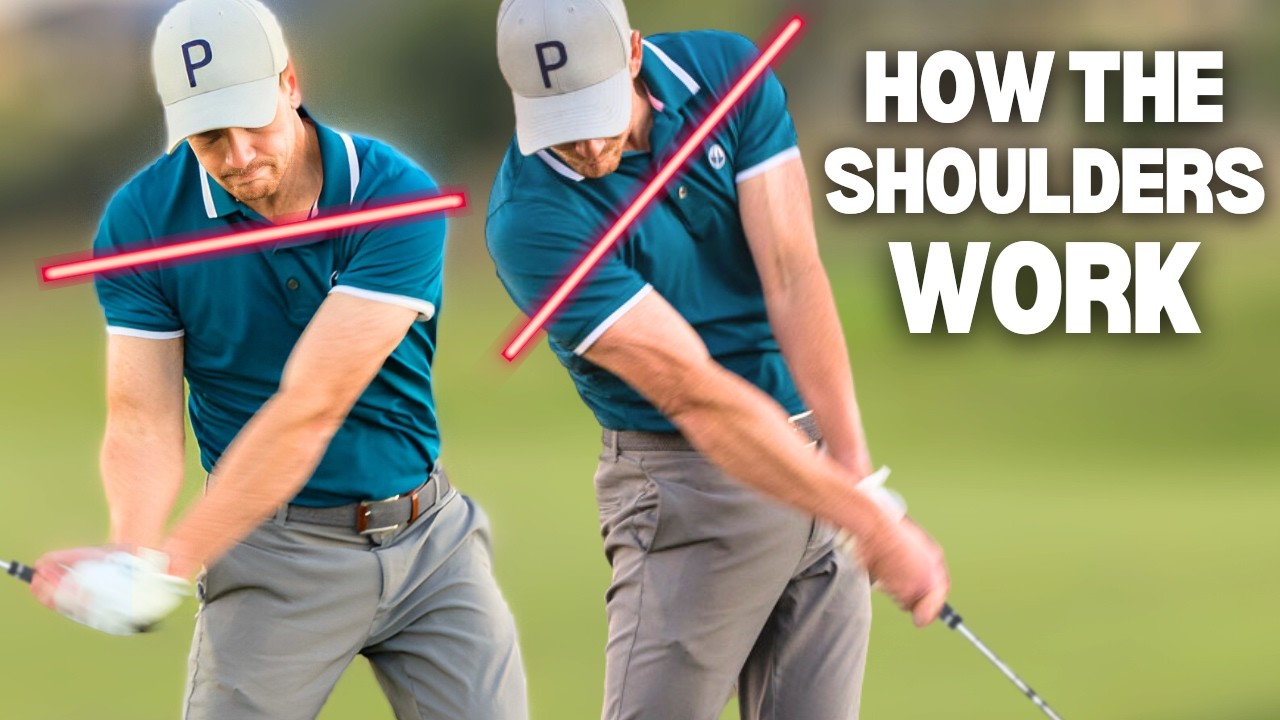
Most amateur golfers turn their shoulders too flat in the backswing, causing them to lose posture and struggle with inconsistent contact.
In this video, PGA coach Kerrod Gray and @LincolnLylesGolf explain how to properly use your shoulders to stay in posture, rotate efficiently, and deliver the club on plane.
Subscribe for Daily Golf Content! 🔔
FREE SWING REVIEW
▀▀▀▀▀▀▀▀▀▀▀▀▀▀▀▀▀▀▀▀▀▀▀▀▀▀
Post your swing in my community and I’ll give you a video response on what to improve – https://www.perform.golf/offers/Fxgk9REy
MY ONLINE COURSES
▀▀▀▀▀▀▀▀▀▀▀▀▀▀▀▀▀▀▀▀▀▀▀▀▀▀
5-Step Masterclass – https://www.perform.golf/5-step-maste…
Transform your swing in just 90 minutes. Designed for all skill levels, this course covers the essential aspects of the swing.
Driver Masterclass – https://www.perform.golf/dominate-you…
Learn the best way to optimally distribute your weight. The secrets of generating maximum clubhead speed.
Bunker Masterclass – https://www.perform.golf/bunker-play
Learn to get out of the bunker first try, every time. Techniques to master spin, power and distance control.
CHAPTERS
▀▀▀▀▀▀▀▀▀▀▀▀▀▀▀▀▀▀▀▀▀▀▀▀▀▀
0:00 – How The Shoulders Move In The Golf Swing
0:36 – Fix Flat Shoulder Turn In The Backswing
2:42 – How To Maintain Posture In Golf Swing
3:03 – Shoulder Tilt In The Golf Swing
4:30 – Drill To Improve Rotation And Pressure Shift
5:16 – How To Sync Upper And Lower Body
7:00 – Improve Low Point Control And Consistency
7:45 – Video Takeaway
SOCIAL MEDIA
▀▀▀▀▀▀▀▀▀▀▀▀▀▀▀▀▀▀▀▀▀▀▀▀▀▀
Website: https://kggolf.com
Instagram: https://www.instagram.com/kerrodgraygolf/
Facebook: https://www.facebook.com/kerrodgraygolf
TikTok: https://www.tiktok.com/@kerrodgraygolf/
Twitter: https://x.com/kerrodgraygolf
COACH KERROD
▀▀▀▀▀▀▀▀▀▀▀▀▀▀▀▀▀▀▀▀▀▀▀▀▀▀
Hi! I’m Kerrod, an award-winning PGA golf coach and Pro Golfer. Join me on a journey around the world as I collaborate with the brightest minds in the game to discover evidence-based strategies and tools that can help you improve your golf game.
#golflesson #golfswing #golftips #golfdrills #swingtips #golfinstruction #golfcoaching #golf #golfdrill
Now, what I want everyone to look at here is the angle of Lincoln’s shoulders as he swings back. So, Lincoln, swing very slowly back for me. Now, what you’ll notice is this left shoulder here is going down to the ground and his right shoulder is actually higher at the top of the swing. Now, as he starts to then transition into the down swing, we’re going to see them begin to get back to that point of where they would be level of where they started and then through the golf ball, Lincoln, as you then move through impact, we’re going to see that the right shoulder would be lower than the left. Now, what we do see, however, is quite a big difference with a lot of recreational golfers that would struggle with their ball striking. So why don’t you run us through some of the common issues that we see with amateur planes? Okay. So uh lovely demonstration as far as like left shoulder lower, right shoulder lower at times players tend to get both shoulders a little bit too high in my experience. So the left shoulder will work a little bit too high in the back swing for players. Y and their shoulders return really really flat to the ground. It kind of does two things. is it kind of takes you up out of your posture and also moves the hands and club too far in and around you and leads to all sorts of transitional issues as well. And if you set up once more for me, I’m just going to put a line on Lincoln’s head here. And from that face on camera, you’re going to see as he swings back and he gets his shoulders turning too flat. You can see his head moves off the ball. Now, from that position there, assuming you finish your swing, Lincoln, what would generally happen in the down swing in regards to contact and strike and everything? I mean, I think a lot of times the transition would start to move outward. Yeah. Trying to steepen that shoulder. The hands would kick out, club would kick out. And by the time that happens, when the golf club kind of gets outside the golf ball, it’s all compensation. At that point, there’s going to be a lot of stand up, a lot of stall out, a lot of um just inconsistency to your strike, heel strikes maybe, uh thin, uh overly downward on the ball at times, too. Yeah. And we we know a lot of players are trying to fix their early extension or their duff shots, their chunk shots. But as we see with a lot of cases in the golf swing, if you fix some earlier pieces, meaning how you’re moving away in the first few feet of the golf swing, it can actually greatly influence your impact position. Correct. Right. Because you’re standing up out of your own coordination. Yeah. Because if you didn’t stand up and you stayed in your posture, at that point you’d miss the golf ball. Right. So you’re doing you’re not really extending for no reason. You’re doing that to hit the golf ball. Uh, and as you said, the better that you can get your shoulder tilt on the way back, as we’re speaking now, the better chance you have to stay in your posture uh, as you come into the golf ball, create more of kind of a symmetrical circle rather than things kind of moving wobbly rather than shifting too much. So, okay. Well, let’s assume I am a player and I do have a bit of this flat shoulder turn in the back swing and then in the follow through. Doesn’t really look like what we saw from yourself earlier on when you flushed it down the center of the range. What’s a great drill that you have for players really, no matter what they’re doing with their shoulders, even just to stand up at the computer and like practice something to give them a feel of the correct movement? Yeah, and I use this for for golfers of all skill levels, just in the sense of creating um an easy go-to feeling. And it also helps train the body to move the way we want to, being able to turn posture and keep our our tilts correct. So, when when I go into my golf posture, I’m set up in a forward bend. So, our whole goal is to make a back swing and stay in more of a leftward bend. So, I always like to to think of it as airplane wings. So, if I just hold my arms out in front of me, okay, the whole goal as I make a back swing is to never let these airplane plane wings get closer to each other. And I want my left wing to be lower than my right on the way back. And you can notice my hips make a good tilt and turn, my shoulders make a good tilt and turn, and I’m just thinking something stupid and simple like airplane wings to make that happen. Right. Now, the big thing that’s really visual and cool for this is as you come into the golf ball, if my left wing starts to go too high in this instance, the golf club drops too far behind us. Or if my left wing starts to move too low and around, the golf club kicks out in front of us. So, as there’s a great coordination that comes from this of of how to get the golf club to the ball, as you’ll see, my left shoulder kind of move up and around the corner here, which brings the right shoulder into the golf ball. And now you can see my hips have opened, which is a really cool thing. My pressure’s kind of shifted to my left side. But more importantly, I’m more lean to the right as I’m getting to the golf ball. And you can feel your body moving in a circle. And I would imagine if you’re looking at me from face on, my head hasn’t moved too much laterally. Yeah. Yeah. So, I’m actually going to jump in here and kind of face this camera. And I just thought of a a great thing or addition we can add to that is actually just gripping down on the golf ball, maybe about halfway. And what you’re going to do is you’re going to use this simulation of the club face kind of matching um where your palm would be. Right? So if I’m in this airplane mode that Lincoln was just talking about there and I make a rotation in the back swing, you’ll see that my wings, they’re not getting closer together. They’re staying the same distance apart. So as I rotate back now, we’re into this like really functional top of swing position. My head stayed nice and centered. I feel some left side bend, which is important to stay in our posture and make contact with the golf ball. But then as I come down, if I’m trying to then match that club face up, yeah, at the moment of impact, now I have a great visual of what it’s like to shift my pressure forward sequence, the lower and upper body, we get that club face square as well. And that’s what I’ve found with people, too, is is it simplifies the pressure shift and the hip turning, too, because you’re not really thinking about it. You’re just thinking about getting this club to the ball through your through your turn and all of a sudden these this this pressure shifts and your hips move well because if I was going to go to the ball, let me hop out hop in there for you. If I was to go into the ball and I’m not allowing this wing to get closer, well, this stuff’s got to start getting out of the way to bring that in. So then my my hip stuff starts working well, too. As much as this is an upper body feel, I think it trains the lower body, the weight, the weight shift or pressure shift, excuse me, and the hips moving well, too. Now, let’s say you’re a player at home. I’m going to grab that club off you. Get into your aeroplane stance. Right now, get the left wing pointing down in the back swing. Perfect. Now, rehears in the follow through. Perfect. Okay. Now, club back in the hands. What I would recommend is players do is then set up on the inside of the golf ball. Have a practice swing for me, Link, and just recreate the feel, that feeling of the crunch in the left in the back swing and in the follow through. Get that left shoulder feeling down there. Now in the follow through for me. Right shoulder feeling down as well. Now step into the ball and hit a little pitch shot down there. Maybe like 50 yards or something like that. Last swing down. Right. Okay. Perfect. And you know what? With that sort of shot, such a smooth, easy going, we can’t even see the end of the ball flight because it was such a frozen rope. Now we add a little bit of speed behind that link. Let’s have a look at what happens when we do that. Okay. Now, we recommend that every amateur golfer would still just rehearse that same feeling again between the shots. Don’t slack on the rehearsals because just cuz you did it once doesn’t mean that you have ownership over the skill you need to do. And I don’t think any golfer can get too good at that drill or at that speed. Like it just does so many good things to create your swing being symmetrical, low point things, um, and just keeping you in posture. I mean, how how how important is that, right? Oh my god. For everything. Yeah. Okay. So, one more rehearsal for me. Okay. So, we’re going good on the back swing. Perfect. Coming down in the down swing. Look at those shoulders stay tilted throughout the motion. Then two hands back on the club mate. Full speed. Let’s tie a bowl on it. And that right there has started directly on the same line and the ball play. It’s pretty much exactly the same, just higher and more powerful. So look, if you’re wondering how the shoulders need to work in the golf swing, let’s say that you’re struggling with your contact, you’re shifting off the ball, the shoulders are working too flat, you can use this aeroplane drill that we’re giving you today, and it can really level up your ball striking. Thanks for watching this video. YouTube thinks that you would benefit from watching this one next. So click that card, and it could be the tip that you need to take your game to the next level. I’ll see you next time.
3 Comments
Post your swing in my community and I’ll review it for FREE ➡ https://www.perform.golf/offers/SgoYYtTp
Great video. I hope you post more content with this instructor. The previous ground force videos were too technical for most of us amateurs in my opinion.
Hi. Great videoAt what point do you flatten the left arm and wrist during takee away.