
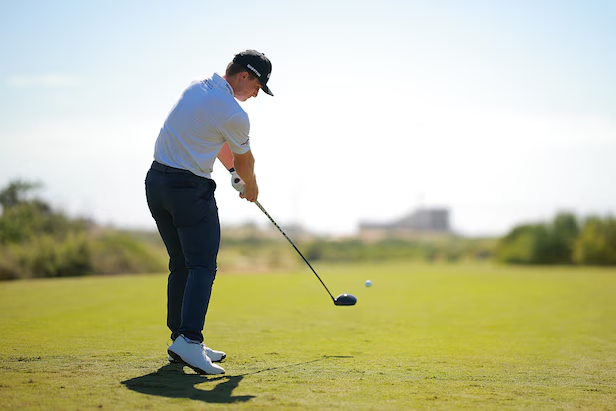
Blades Brown looks destined for the absolute top of the game. The 19 year-old opted against going to college and instead turn pro right away—and as awared with his first victory at the World Wide Technology Championship in 2026. His golf swing, under the tuteldge of Golf Digest Top 50 Coach Justin Parsons, is unique, powerful, and repeatable. Get used to it.
Brown’s lead hand grip is slightly weaker than most—meaning his left thumb runs more down the middle of the grip. Parsons and Brown have worked hard on his right hand grip, extending his trail hand further down the grip to help round out his swing.
A textbook takeaway with his arms stretched wide away from him.
As his left arm reaches parallel to the ground, you can see the minimal wrist set. There’s a wide angle between his club and forearms—the start of the signature trait in his swing.
The minimal wrist hinge remains up to the top. He doesn’t use lag or wrist hinge to generate most of his power, instead he does it by creating a big, powerful turn on both sides of the ball, as you can see here.
Blades’ upper body is stacked almost exactly on top of his lower body at this point, with minimal side bend. This is a classic fader move—draw players tend to tilt their upper body more away from the target by this point.
Brown likes to visualize the golf swing as a straight line, but that comfortable feel can cause high strikes. Parsons have Brown have worked on rounding out his swing slightly, which improves his delivery position.
Left arm is slightly bent and off his body, with the clubface, back of his left hand and his left elbow all pointing in the same general direction. It’s a relationship a lot of top ball-strikers with weak lead hand grips, like Moe Norman, Bryson DeChambeau and Lee Trevino, have.
A Spieth-like left arm action prevents the clubface from rolling over
Brown grew up playing baseball and practicing taekwondo, which help build Brown’s athleticism that and powerful, explosive rotation through the ball.
Loading swing sequence frame