

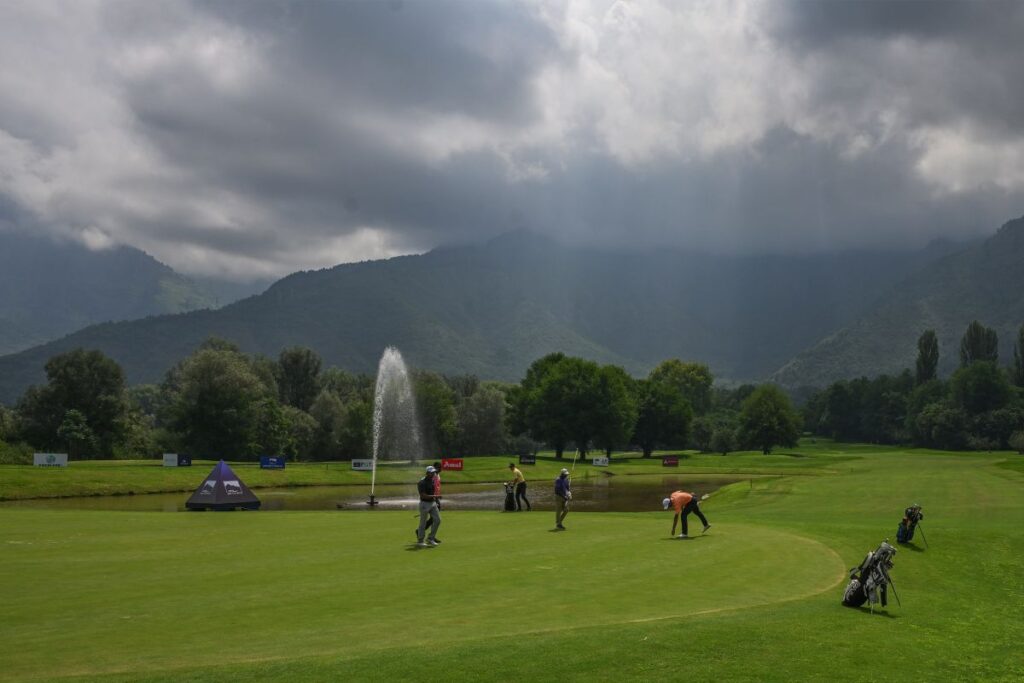
 Royal Springs Golf Course – KO photo by Abid Bhat
By Shereen Naman
My father walks to the golf course before the day begins, and the walk has become so fixed a part of his mornings that I grew up wondering about a game I never saw him play.
What was golf, and why did a stretch of cut grass draw a grown man back to it so faithfully?
I kept those questions to myself for years. When I finally visited Royal Springs as an adult, I found that the course had far more stories to tell than I had imagined.
I knew nothing of handicaps or swings. A golf cart took me along winding paths through green framed by trees and the Zabarwan hills, and the city fell away behind the slopes. It looked like a film set.
Within an hour, I had stopped asking about the sport and started asking who had imagined this landscape, how a pastime bound to British colonial leisure found its way into Kashmir, and how Kashmiris became part of its story.
The usual answer is the view.
Royal Springs, with its groomed fairways, landscaped greens and mountain backdrop, sits among the valley’s most striking golfing landscapes, and golf tourism here is promoted through scenery, climate and setting.
The scenery is real. It is also the thinnest layer of the place.
The older layer begins with the heat of the Indian plains. British officials and travellers escaping it found temperate summers and open ground in the valley, and golf came with their recreational habits.
Historical accounts place the origins of the Kashmir Golf Club in Srinagar in the late nineteenth century. Memberships, clubs and social networks organised the sport, and they mirrored the hierarchies of the society around them. Golf here was never only a pastime.
Kashmiris were part of golf’s early history too, as players and professionals. Their role complicates the idea that golf was simply a British game brought to the valley. Local people maintained the courses and taught others to play, but their contribution rarely finds a place in the popular history of the sport.
Royal Springs itself is a modern course, inaugurated in 2001, and belongs to a different chapter from the historic club, so the two histories should be kept apart.
The course lies beside a forest, and wildlife occasionally wanders onto the greens. A meticulously kept sporting ground becomes, for a moment, a clearing in a living landscape that has its own calendar.
The golfers play inside the mountains, and the mountains had no part in the arrangement.
Along the route, stone markers bear the names of walnut and cherry, the trees and fruit of the valley’s orchards. A sport rooted in another cultural tradition speaks, in these inscriptions, in a Kashmiri vocabulary.
Who chose those names, and for what purpose, remains to be investigated. The cultural history of a landscape sometimes survives in its smallest inscriptions rather than its grand monuments.
Less conspicuous than the markers, an Aastaan-e-Sayyidaen stands within the course’s interior, a shrine locally associated with one of Kashmir’s thirteen prominent Sayyid lineages.
An astaan is a place of reverence and inherited memory, joining the physical landscape to faith and belonging. The land that hosts a modern sporting institution also holds ground whose meaning reaches well beyond recreation, and a casual visitor may never register it. Its precise history and its link to the lineage await documentation through local knowledge and historical records.
Here the tourism argument turns sharper.
Golf tourism joins sporting infrastructure, hospitality, destination marketing and cultural identity, and in Kashmir it cannot be separated from the mountains, the nearness of Dal Lake and the valley’s singular natural environment.
The opportunity lies in presenting golf as part of a fuller account of the place, a pastime attached to its setting instead of floating free of it.
A visitor who learned the history, the ecology and the local culture would understand the destination more deeply than one who saw only a green against a ridge.
That fuller account holds obligations. Tourism has to grow in step with environmental protection, responsible land use and the preservation of heritage, because a landscape’s worth exceeds the number of visitors it draws.
A course promoted on its scenery alone invites the very visitors least likely to ask what lies under the grass, and the land has more to say than the brochure allows.
The questions worth asking are the ones that call for patient research. Who were the earliest Kashmiri players and professionals? Who tended the greens and introduced others to the game? What lies in the clubs’ archives, and what memories survive among the people who have lived and worked around them?
Such records exist in fragments, if they exist at all, and fragments fade with the people who hold them.
Royal Springs is more than a place to play golf. Its greens rest within a larger Kashmiri world formed by colonial encounters, natural abundance, cultural memory and spiritual inheritance, and Srinagar’s history here cannot be reduced to a single game or a single era.
I went looking for the meaning of my father’s morning habit and found a landscape that keeps absorbing new meanings while holding the traces of earlier ones.
His walk now looks to me like a daily passage through layers that nobody has finished recording.
The author is a cultural activist by passion and scribe by profession. She can be reached at [email protected].