
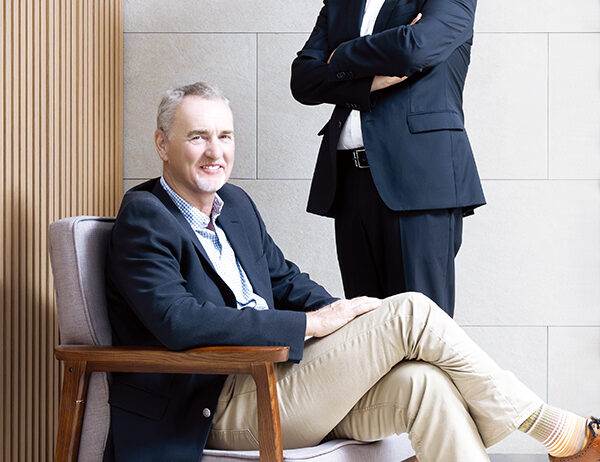
Interview with Vice Chairman Kim Kang-ho of Gunsan CC
Working as a doctor, participating in Gunsan CC management from 2021
Plans to transform the largest golf course in Korea created on the abandoned salt field
Designers challenge the ‘destination’ deliberately visited by world golfers in the style of Scottish Links
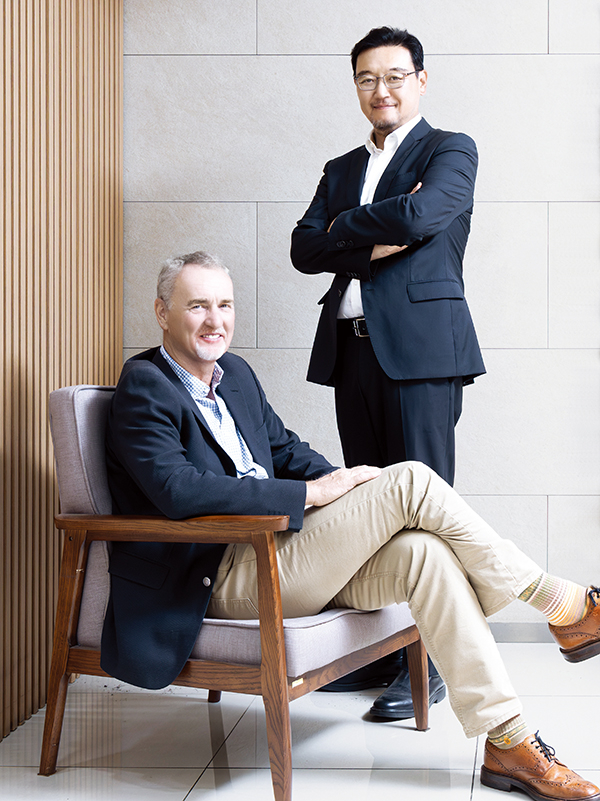 사진 확대
Salt was no longer money.
The area around Ok-gu, Gunsan, Jeollabuk-do, was once the home of sea salt. In the 1980s, there were more than 20 salt fields. However, as cheap Chinese salt flooded in and Saemangeum reclamation began, the salt fields were closed one by one. Plans to build an international auto racecourse in the empty salt farm also fell through during the foreign exchange crisis. It was the land where only the sea breeze remained.
In 2003, a golf course of 1.3 million pyeong began to be built on the land. A waterway was dug in salt-bearing land to create a course with the soil. No soil was brought from the outside, nor was a vinyl barrier placed on the ground. Eco-friendly construction was a groundbreaking idea at the time. The 27th hole was first opened in November 2005. In May 2007, all 81 holes opened, making Gunsan CC the largest golf course in Korea. So far, it’s the story of the ‘biggest golf course’.
The real narrative of Gunsan CC has just begun.
David McLay Kid (DMK), a world-renowned golf course designer, participated in Gunsan CC’s project. The plan is to implement a Scottish Links-style golf course in Gunsan CC.
Vice Chairman Kim Kang-ho of Gunsan CC first met him in September 2024 at Pinehurst, where USGA headquarters are located, to work with DMK on Gunsan projects. Between 2024 and 2025, he visited golf courses designed by the DMK, including Vanden Dunes, Washington, USA, Tribute, Central Idaho, Sand Valley, Wisconsin, Mammoth Dunes, and Stream Song, Florida.
“Looking at DMK’s course in person, I became convinced of his golf course design philosophy,” Vice Chairman Kim said. With these efforts, DMK signed a contract to design a new course at Gunsan CC’s Jeonju Iksan Course in August 2025. DMK is the first Asian to design his course in Gunsan CC.
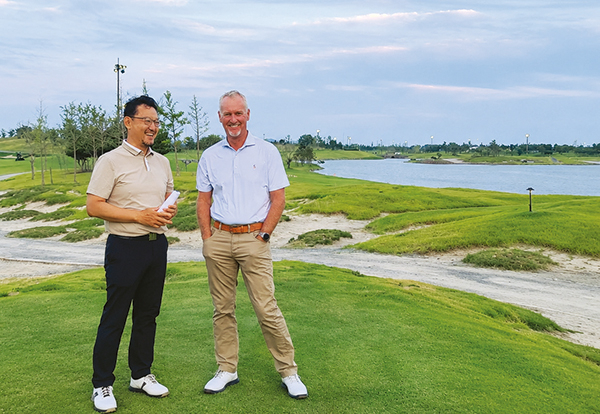 사진 확대
“The Green Inside Bunker” by a physician
Vice Chairman Kim Kang-ho’s original job is as an internal medicine doctor. It operates the Seoul Medical Care Health Examination Center in Mapo-gu, Seoul. The son of Chairman Kim Chun-dong, founder of Gunsan CC, has been participating in Gunsan CC management since 2021. Vice Chairman Kim completed the current tournament course through renovation over two years from 2022.
At first, I thought I just needed to fix the existing course a little bit.
“I tried to change it to some extent through renovation, but I didn’t want to do that. So I started thinking about changing the course altogether.”
The goal was to have the most fun for the first part of the tour. The purpose was to increase discrimination so that athletes who are good at distance, iron accuracy, short games, and putting can win, and to allow amateurs to enjoy the experience together.
Vice Chairman Kim placed the contour lines of the 18 hole green drawn by the designer side by side on A4 paper and discussed with golf course staff, saying, “It should not be made the same.” The hole that was born in that way is the 12th hole that became a hot topic as a bunker in the middle of the green. His nickname is “Those Bunkers.” Bunkers have been built in the green, following the water, fairways, and around the green. Most holes are targeted with short iron, but the calculation method has changed for each pin location due to the bunker in the green.
“If the pin is in front of you, you have to set it well so that it doesn’t go into the bunker behind you, and if the pin is behind or next to the bunker, you have to calculate the distance and direction well and stick it to the pin. I wanted to make the golfers think a little more.” From this experience he gained a principle.
“It’s about creating a course to give golfers fun.” Confidence has gained. Eyes turned to the rest of the course. From that moment on, Vice Chairman Kim became a “golf course student” before he was a golf course manager.
A name that’s been sucked in like a ‘black hole’, DMK
Vice Chairman Kim visited the world’s best courses and played golf himself, and dug into who designed the course. Starting with the “legendary” pit die of golf course design, his disciples and the works of designers named in the world’s top 100 courses were compared one by one. The person I met at the end is DMK.
“I didn’t pick up the DMK, I experienced it while playing golf, so I fell into a black hole called DMK.”
DMK designed the first course of its golf resort, Bandon Dunes, off the Pacific coast of Oregon. Vanden Dunes is considered the most successful recreation of Scottish Links Golf in the United States. If pit die used artificial obstacles and psychological pressure in its design, Vanden Dunes is a prime example of minimalist design that maximizes natural terrain. Now, it has become a “holy place for U.S. golf” that is difficult to make a reservation even a year ago.
DMK’s father was the general manager of course management for the glen Eagles, Scotland, where the Ryder Cup was held. DMK grew up as a designer by learning to manage and build golf courses from an early age.
He also designed the seventh course of St Andrews. It is a castle course on a hill overlooking the city. However, what Vice Chairman Kim paid attention to was philosophy rather than DMK’s history.
“He’s not just an aesthetic artist who catches beautiful sculptures. He is learning how golf can be fun. It’s an architect who can capture the fun of the ball rolling out of the shape of the course.”
The DMK also gave Kim a high evaluation. Regarding Vice Chairman Kim, he said, “The golf IQ is very high.”
“Vice Chairman Kim has experienced all the golf courses I designed with time and effort, and he is passionate enough to look back on world-famous courses. If there is a Ph.D. in golf course construction, Vice Chairman Kim will pass it easily.”
‘Rolling Golf’ Experimented in Gunsan
Vice Chairman Kim explained his golf experience in Scotland like this.
“Even after the ball falls to the ground, it rolls for a long time and then stops. You can stop the ball by giving it a lot of spin on the green, but it doesn’t even get set up if you don’t have skills. Whether it’s floating, rolling, or stopping, it’s all golf. So you can play a lot of different things and you get creative games.”
The DMK said the same direction. He described U.S. golf as “a form that just falls while flying in the air.”
“At Gunsan CC, we try to follow the tradition of Scottish Links golf rather than the United States. I would like to prepare a golf course and an environment where the ball rolls.”
Links is a golf course on the sandy soil of the coast that “connects” the sea and inland, and golf is the first place where it was born. The sea breeze passes directly over the treeless land and the ball rolls far from the hard fairway. The same hole becomes a different hole every day depending on the wind. This is why creative shots that roll the ball low and read the wind are needed instead of American-style golf, which floats the ball high.
Mysteries Experienced in T-Box
Most golf courses in Korea are located in mountainous terrain. The fairway is narrow and OB burdens are high. Instead, when you stand in the teeing area, you can see the fairways, greens, and bunkers at a glance, and the target is set immediately.
DMK went around the Gunsan CC tournament course where the KPGA tournament was held on the morning of the interview and the day before. The evaluation was like this. “It seemed like there were enough elements to take on the adventure. But there didn’t seem to be anything mysterious or something mysterious.”
When I stand on the T-box, “I can see the puzzle right there.”
“More than that, I want to add a more advanced mystery to Gunsan CC,” he said.
“The Gunsan CC course has a straight tee box and green, and bunkers are placed on the left and right sides in it. But I put the tee box and the green diagonally, not straight, and I can’t see all the bunkers at a glance. There must be a diagonal line somewhere, and that’s for the golfer to decide.”
The hazard of a golf course does not necessarily have to be a pond, bunker, or valley. DMK said, “Even a small mound (shape) and a hollow (alone) can roll in a direction that the ball does not predict,” adding, “I want to create an environment where I can play aggressively.” In fact, it is said that there are holes in the course designed by DMK that do not even see green or fairway from the tee.
“When you go to most golf courses and stand on the tee box, you can see that you have to do this. What I’m saying is that when I stand in the T-box, I want to make something like, ‘What should I do about this?’ and scratch my head.
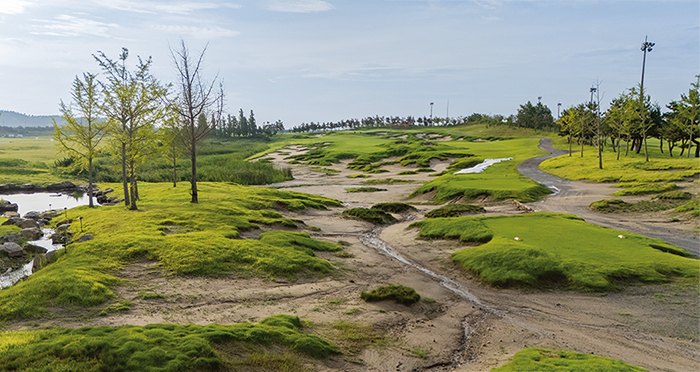 사진 확대
Where the future of DMK and Gunsan CC meets
I don’t mean to give a golfer a hard time. DMK said, “It’s just doubling the fun of putting this puzzle together one by one, not hiding it somewhere so you can never find it.”
Find the target route that was not seen in the first round in the second round. One stands on this fairway and the other over there, saying, “You can’t see it from there, but I think you can hit it this way.” It is a team play that unlocks secrets with companions and caddies.
“Letting kids play like they’re playing with puzzles, and using nature’s topography to make the ball roll is our key.”
The DMK emphasized that this was ‘real golf’ originally played in Scotland. As you walk and explore the terrain, the course begins to be read as if numbers were pouring down in the movie “The Matrix.” He described it as “four-dimensional golf.”
Vice Chairman Kim is also said to have experienced the mystery. “In Korea, the designer’s intention is analyzed to some extent even if it is a good golf course. But you can’t predict the Scottish style or the Dunes style if you don’t actually go and play it.”
This is the point where the owner, who tested “Golf that Makes You Think” with a bunker in the 12th hole green, meets the designer who tries to scratch the golfer’s head at the tee box.
a destination you should visit at least once
Gunsan CC’s new course already has the word “Olympics.” If North Jeolla Province is selected as a candidate for South Korea’s bid for the 2036 Summer Olympics, and South Korea hosts the Olympics, golf will be held at Gunsan CC. Vice Chairman Kim said, “We plan to create a new course so that we can play golf when the Olympics are held in Korea.” However, there is no change in the belief that the competition will come if you make a good course, not make a course for the competition. DMK is on the same page.
“Thirty years ago, when we designed Vanden Deuce, we didn’t design it with the idea that a big competition would be held here. But in the end, the U.S. Amateur was held in Vanden Dunes. That doesn’t mean it’s just a tournament, but Vandendence is a course where regular golfers come and play golf every day.”
Vice Chairman Kim summarized the direction of Gunsan CC with the word “Destination.” This means that it is not a golf course that determines the distance or green blood, but a place that golfers should visit on purpose. He picked five directions. A golf course that will go down in history, a golf course that opens a record-making competition, a golf course that creates a culture that connects the tradition of golf, a golf course that contributes to the community and the sports world, and a destination that all golfers should visit at least once.
His models include Vanden Dunes, Sand Valley, Stream Song, St Andrews, Trump Turnberry, Van Boogle Dunes, and Taraiti. Gunsan CC is also planning a long-term stay-type destination with hotel-type condominiums, sports facilities, perimeter walking paths, and cycle paths. However, the order is clear.
“The first thing we need to do is to create a unique golf course that we don’t have in our country. When a good course is created, there will be conditions for the creation of a hotel, and the course will become an anchor, raising the level of other courses within Gunsan CC Resort.”
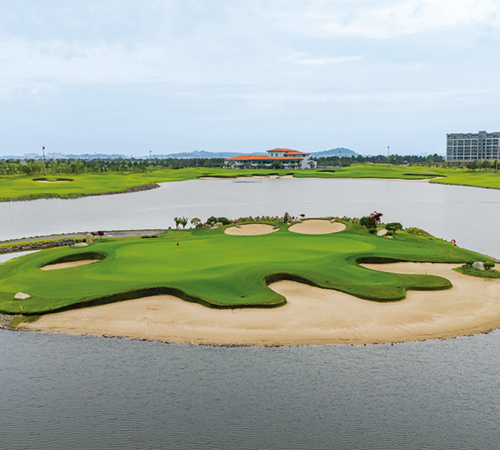 사진 확대
The ‘land of opportunity’ that the players remember
Gunsan CC has played numerous tournaments for about 20 years, from junior tournaments to aspiring tournaments, second-division tours, and KPGA regular tours. The KPGA Gunsan CC Open, which marks its 17th anniversary this year, has become a mid-sized tournament of the tour.
Since three years ago, Pro-Am and profits from admission, food, and souvenir sales have all been added to the prize money. It’s an idea from the way the Masters tournament is awarded.
“A lot of prize money will make the players excited and the competition will go up.” If the main sponsor was a company, it would have planned a pro-am competition centered on its affiliates and partners. But Gunsan CC’s clients are golfers and players.”
Therefore, Gunsan CC sold the Pro-Am participation ticket to general customers and placed free round vouchers and accommodation vouchers in kind. The prize money was increased in return for the payment.
This year’s total prize money is 1.11 billion won. The winner is given a three-year seed. I left the door open to amateurs as well. The Gunsan CC Open has continued Monday qualifying as a tradition, although it is rare to hold a qualifying tournament due to the cost burden. In addition, the No. 1 player in the national team and the No. 1 player in the amateur rankings will be eligible to participate in the finals immediately without qualifying.
Lee Soo-min and Jang Yoo-bin rose to the top as amateur players for the national team. Kim set the record for his first career win and youngest win in the competition.
Kim Min-kyu, who won the seed through the Monday preliminary round, is also a “Gunsan Kids” selected by Vice Chairman Kim. “Gunsan CC has been a land of opportunity for all golfers, both in the past and in the present.
And I also want to continue to leave that history for our golf dreamers in the future.”
[Reporter Kim Ki-jung]