
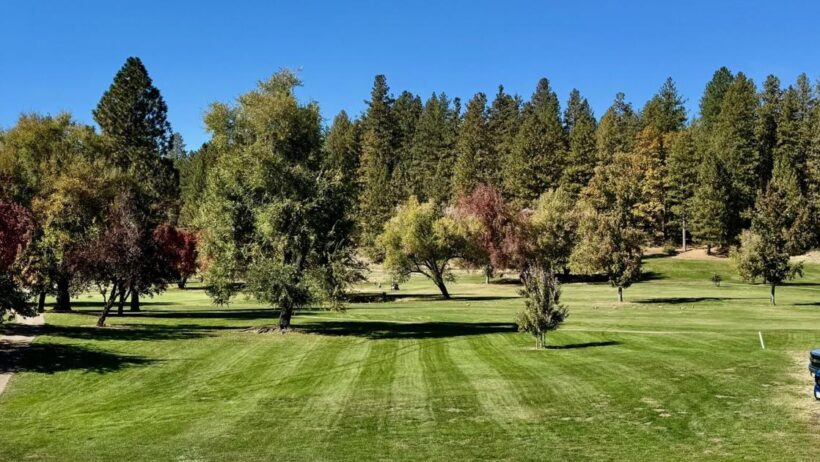
I invited a friend to play a round of golf at the Nevada County Golf Course. As usual, he outdrove me on every hole and was six strokes ahead by the 7th tee. His name is Grayson, but most people call him “Grayman.” The Grayman is a fun-loving, prankster-type, golfer who might occasionally use his cart to run over your ball and bury it in the fairway, then declare, “Oh, I didn’t see it” (but you know he did). You know the type, it’s all in fun and I love golf with this guy.
At the 8th tee, I happened to count the clubs in his bag — there were 16. I called out, “Grayman, you just lost the game.” “What? Carville, are you crazy! I’m kicking your butt. What are you talking about?” I replied, “You may be kicking my butt, but you broke the 14-club rule, so you lost. Pay up, my friend — lunch is on you.”
Grayman: “I don’t need no stinking 14-club rule. Where did that come from?”
32 Clubs
Well, Grayman, 100 years ago, there was no limit to the number of clubs a golfer could carry. Albert Campbell won all his matches in the 1936 Walker Cup (famous competition between the best male amateur golfers: United States vs. Great Britain/Ireland). This tournament was named the Walker Cup after George Herbert Walker (grandfather of President George Herbert Walker Bush) who donated the winner’s trophy.
Anyway, in the 1936 Walker Cup at Pine Valley, New Jersey, Albert won every match while carrying 32 clubs. His oversized bag included seven 9-irons and several left-handed clubs for shots obstructing a right-handed swing. The United States team won 9 – 0, the first and only shutout in the history of the Cup.
14-Club Rule
While watching that event, Bobby Jones (most famous American amateur golfer at that time) and Tony Torrance (famous Scottish amateur) got to talking about Albert’s 32 clubs. Bobby carried 16 clubs and Tony carried 12. They split the difference and agreed on 14, and that eventually became the world standard.
The United States Golf Association (USGA) adopted the 14-club rule in 1938, and the Royal and Ancient Golf Club (St. Andrews) did so in 1939. The penalty for violating the 14-club rule is ‘loss of match.’ “So, there Grayman, that is why you are buying lunch.”
Sand trapped
On the 10th hole the Grayman landed his second shot on the green, but the ball rolled into the sand trap behind the hole. Grayman asked, “Carville you gonna say something about sand traps too?” I replied, “Yeah, because it’s an interesting story.”
A sand trap — officially called a bunker — was not always a part of a golf course. The origin is an accidental feature of early Scottish golf. In those days (16th – 18th centuries) golf was played on windswept Scottish links where sheep burrowed in shallow pits to escape the harsh weather, exposing the sand underneath. Over time, the wind blew more sand into these pits, forming the first bunkers. Later, golf course designers evolved these sheep shelters in strategic hazards. The story goes that the famous golf course designer Old Tom Morris (1821 – 1908) was the first to intentionally incorporate bunkers to define the character of holes.
Some bunkers have earned iconic and affectionate names: ‘Road Hole’ and ‘Hell Bunker’ at St. Andrews, ‘Church Pews’ at Oakmont, ‘Coffin’ at Royal St. George. However, some insanely difficult bunkers have legendary crude names which reflect the extreme difficulty of getting out of the bunker. Civility precludes divulging those names in a public forum — deliciously entertaining, but not appropriate here. Enough said!
Anyway, after splashing sand all over, the Grayman got out of the bunker (he may have eventually used his foot to kick the ball out). Then, in an act of frustration and defiance, he loudly gave the bunker a wonderfully crude name.
We finished the round, laughed, and complimented each other on our respective golf talents. Then to top off the day, we retired to the clubhouse and had great lunch prepared by Melissa, the club’s wonderful cook. Pretty nice day!