
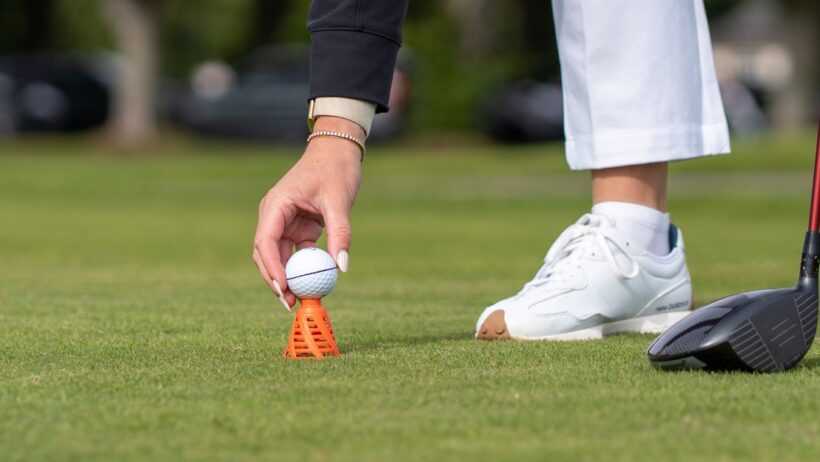
SCIENTISTS are to put a “revolutionary” golf tee to the test to see whether it performs as well as the traditional version used by players for generations.
Researchers at the University of Stirling will analyse a Canadian-designed tee which sits on top of the ground instead of being pushed into it.
The reusable BirTee Pro Speed+ was originally developed to make golf easier for players with mobility problems and can also be used on frozen ground or indoors.
The product has been approved by the R&A and is already used by golfers in simulator facilities and during winter practice.
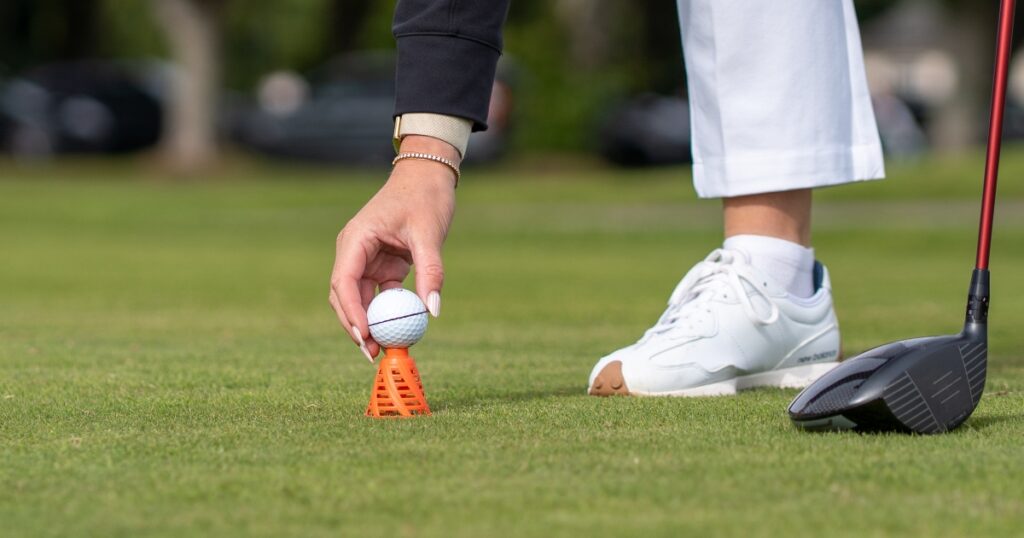 The tee allows for different heights. Image: University of Stirling
But academics will now carry out an independent study to establish whether drives struck from the unusual tee are as reliable and consistent as those using a conventional tee.
Seven University of Stirling golf scholars and seven recreational players will take part in testing at the university’s Golf Studio.
Players will hit drives using two different sizes of BirTee as well as a traditional tee, with the tests repeated around a week later.
Researchers will measure clubhead speed, ball speed, launch angle, spin rate, carry distance and total distance, among other factors.
The study will also look at how much performance varies between individual shots and between separate testing sessions.
Dr Lewis Macgregor, Lecturer in Physiology and Nutrition at the university, is leading the research.
He said: “BirTee Pro Speed+ tees are an interesting innovation, yet there is currently very little independent research examining its performance characteristics.
“This partnership gives us an opportunity to generate robust scientific evidence on the reliability and consistency of the product under controlled conditions.
“Our study will compare key performance outcomes across a range of golfers and tee types, helping us better understand whether the new tees influence driving performance and variability.”
The tee allows golfers to select different ball heights without having to force anything into the ground.
Dean Robertson, the university’s Head of Golf, said the design could be particularly useful for older players or golfers struggling with hard winter surfaces.
Robertson, who recently captained Great Britain and Ireland to victory in the Walker Cup, said: “For older golfers in particular, the simplicity of being able to tee the ball up and have it securely balanced without having to push a conventional tee into hard or frozen ground could make the game more accessible and enjoyable.
“Sometimes the simplest ideas are the most effective.”
University golf scholar Abby Nisbet already uses the tees during practice.
She said: “They allow me to keep developing my skills regardless of the environment or weather, which is vital as an elite athlete.”
BirTee Golf International founder Mario Caya, from Perth, Ontario, said the partnership followed a visit to Stirling’s golf facilities.
He said the research would provide “valuable insight into the consistency and performance” of the product.
The university said the results could help golfers, coaches and equipment manufacturers better understand how alternative tee designs affect performance.

Iona Craig has an NCTJ from Glasgow Clyde, PhD in English Research from University of Strathclyde and a Masters Distinction in History from the University of Stirling. Currently working as a Journalist intern at Deadline News.
Related