


Deja Vu
Over six years ago, I got to preview the half-finished first course at Sand Valley [full story HERE]. I still remember turning off a little-used road, through a wall of trees, and the landscape opening up into an amazing golf property.

Driving up to a fledgling Rodeo Dunes, I got much the same feeling. On a hazy day, the landscape looked flat and brown. The Rocky Mountains were far away and mostly obscured. It looked like cattle country – which it is – not America’s next great golf destination – which is what this is likely to become.

First Impressions
My first impression of Rodeo Dunes was largely what I expected, based on my experiences watching Sand Valley grow. The infrastructure is light and temporary. A trailer – albeit a very nice one – serves as the pro shop, and a limited menu of food and drinks is served from another trailer next door.
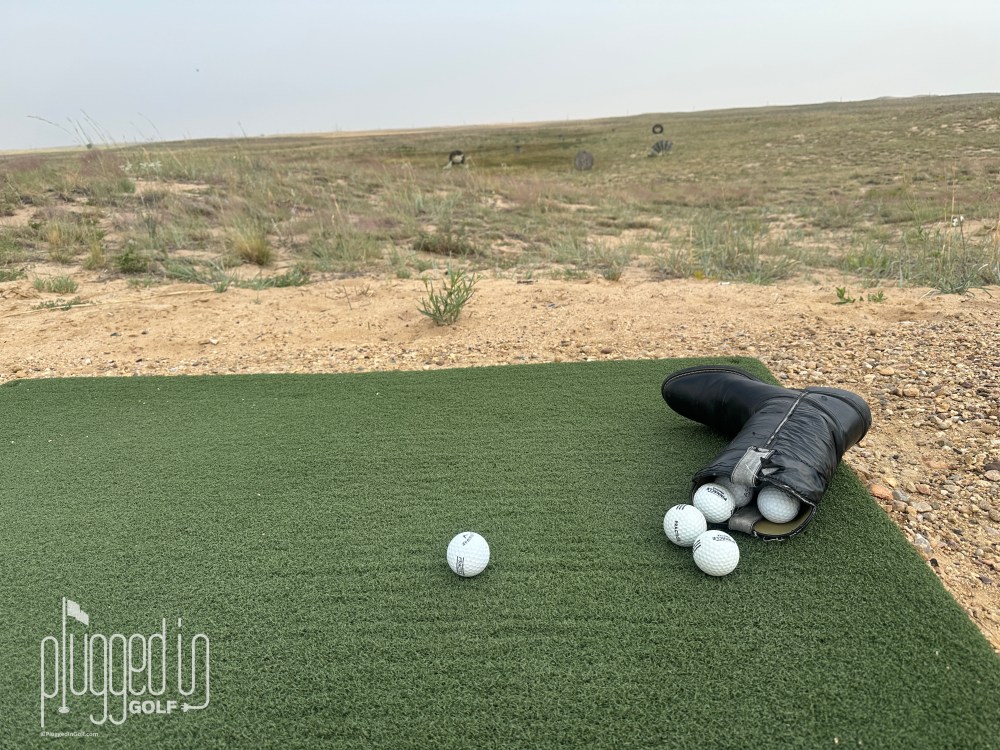
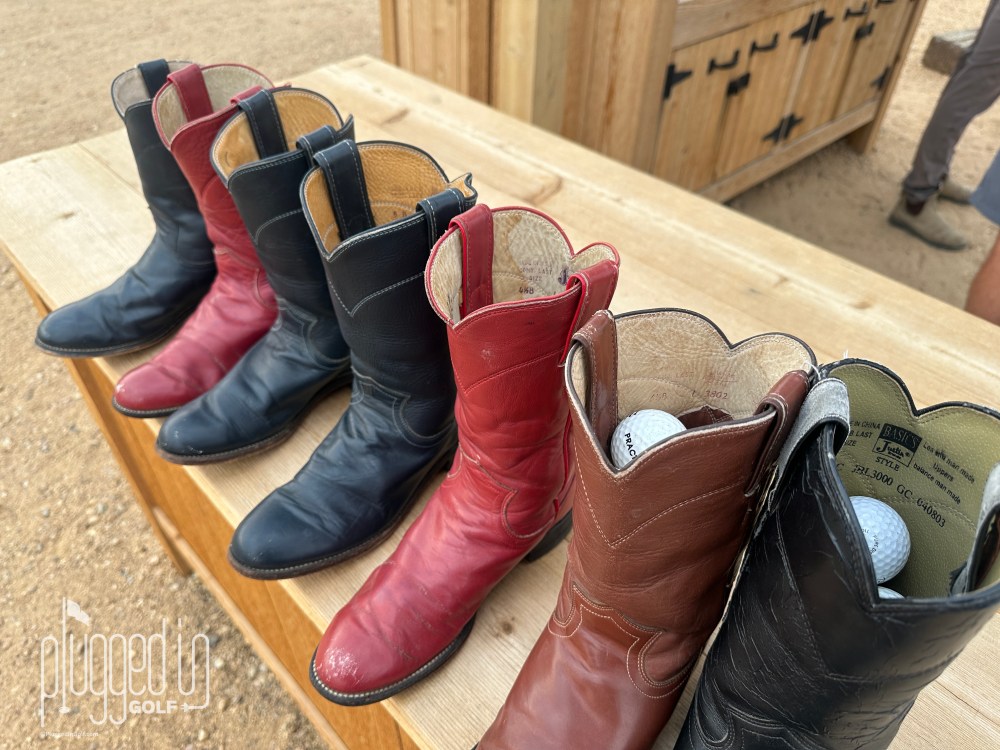
Rodeo Dunes leans heavily into the western vibe, packing their range balls into old cowboy boots. The practice facility, such as it is, consists of three mats aimed at a few barrels placed out in the sand. In the pro shop, you’ll find denim and flannel headcovers bearing the Rodeo Dunes logo. [Learn More / Plan Trip]

Rodeo Dunes Golf Course
I love Coore Crenshaw golf courses. Sheep Ranch might be my favorite course at Bandon. I love Sand Valley, Kapalua, and Ozarks National [review HERE]. While this could be new course enthusiasm talking, I think Rodeo Dunes is my favorite Coore Crenshaw.

The feeling I always get on a Coore Crenshaw is that the course is tough but enjoyable. Nine times out of ten, they get the difficulty dialed in perfectly where you feel like you have chances to score, the course doesn’t seem unfair, but you know you have to play your best. That’s the case throughout the round at Rodeo Dunes.

One of the signature features at Rodeo Dunes is the “compression and release” off the tee. Looking at the hole, you feel like you’re constricted, that there’s nowhere to hit the ball. As you start to walk after your tee shot, you realize that there’s ample room. This isn’t totally unique to Rodeo Dunes or Coore Crenshaw, but what I like about this course is that local knowledge is not required. If you take a careful look, most holes show you where the space is and what areas to avoid. There are a few blind shots, and those are the ones where the caddies earn their keep.

The native areas are another defining feature of the course. There is ample fairway, and if you stray from it you’re taking your chances. You might spot your ball easily, you might need to step on it to find it. You can draw a favorable lie, you might need to take an unplayable.

Among the standout holes were the par 3 second hole where the green is tucked around a corner behind a mound. Hole four has tons of character: a split fairway with a massive centerline bunker and a green that’s largely obscured by a mound. The front nine closes with a par three whose long green sits at angle, creating numerous yardages and demanding precision. My early favorite on the back nine is #16 with its visually difficult, downhill tee shot and uphill approach to a diamond-shaped green.

Overall, this is a course that doesn’t have a clear signature hole, but it doesn’t have any weak stretches either. There’s a bit of quirkiness with the back-to-back par 3s at #13 and #14, but it’s primarily strong, interesting, challenging golf from the first tee shot to the final putt.

More Coming Soon
In addition to playing Rodeo Dunes, we got a tour of “Course 2” (the “Future Course” shown above) with its architect, Jim Craig. Though it’s still fairly early in its development, there’s little doubt that it’s going to be outstanding. Course 2 will start and finish alongside the original course. From what we were able to see, it’s going to be a great match play course with a ton of optionality.

More than anything specific to the routing, I came away really impressed with how enthusiastic the design team is about the course. They were giddy about every detail, every decision that was still left to be made. I think golfers are going to feel the same way when they’re playing, and I can’t wait to be one of them. [Learn More / Plan Trip]

Is Rodeo Dunes the Next Bandon Dunes?
Yes, no, and maybe.
The things that fill the “Yes” column are obvious. This project is being developed by the Keiser family, the same family behind Bandon Dunes and Sand Valley. Additionally, Bill Coore and Ben Crenshaw designed the first course at Rodeo Dunes, just as they did at Sand Valley [review HERE]. They also have Bandon Trails [review HERE] and Sheep Ranch [review HERE] to their credit. Rodeo Dunes, just like Bandon Dunes, will be golf-centric and likely walking-only.

Filling the “No” column are two items, one obvious, one less so. The one “No” is that the landscape is dramatically different. There is no ocean, there are no cliffs. I’m not saying that makes Rodeo Dunes inherently better or worse; but it’s a significant difference.
The less obvious “No” is that Rodeo Dunes is being developed with better knowledge about what’s to come. Twenty years on, we take it for granted that Bandon Dunes was always going to be a success. That’s simply not true (read Dream Golf if you have any feelings about Bandon, it’s fantastic). With Rodeo Dunes, they know this is going to work, and they’re planning accordingly. There was open talk of at least five courses throughout our visit.
The “Maybe” is the part that’s most interesting to me. Anyone who has been to Bandon Dunes knows that it’s a full day of travel from most of the US. Sand Valley is three hours from Chicago. In contrast, Rodeo Dunes is an easy forty minute drive from Denver International Airport.
Easier accessibility seems like an obvious, universal good, but I’m not sure that’s true. Part of the appeal of Bandon is that it’s summer camp for golf sickos. The vibes are tremendous because anyone who would go through the trouble of getting there is likely to be similarly obsessed with this crazy game. People who live in Denver can treat Rodeo Dunes like their muni (I know that’s not true because of demand, but you understand my point) which does not seem like it would create the same environment. Time will tell.
Perhaps the better question is, “Does Rodeo Dunes want to be the next Bandon Dunes?” Given the quality of the first course, it’s on the board that this could be even better. [Learn More / Plan Trip]
Rodeo Dunes
LINKS GOLF ON THE RUGGED PLAINS OF EASTERN COLORADO. Long before golf arrived, the wind had already done much of the work.

Help support our mission. We earn a commission if you make a purchase, at no additional cost to you.

Editor In Chief at Plugged In Golf
Matt has worked in nearly every job in the golf industry from club fitting to instruction to writing and speaking.
He founded Plugged In Golf in 2013 with the goal of helping all golfers play better and enjoy the game more.
Matt lives in the northwest suburbs of Chicago with his wife and two daughters.
Latest posts by Matt Saternus (see all)