


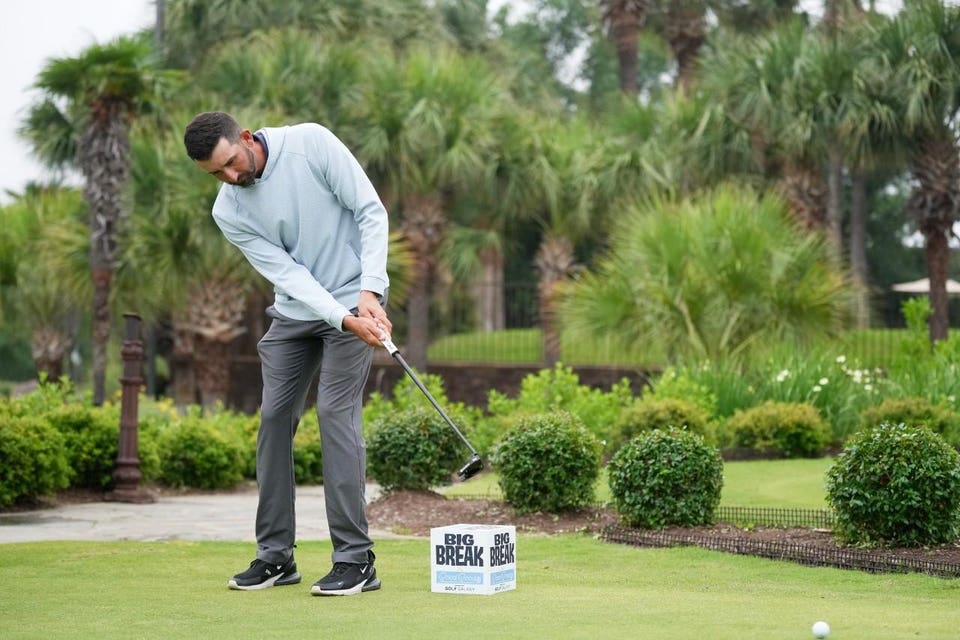
Horseshoe Bay hosts the latest season of the popular TV show
Big Break /Cy Cyr @ Versant Media
Big Break, the longstanding reality golf competition TV Show, returns to Golf Channel late this month. This season – which is No. 24, by the way – is called Big Break x Good Good. And the Texas Hill Country’s rolling hills provided a picturesque backdrop for this high-stakes collision of television history and modern digital media earlier this spring. Production for the latest iteration of the iconic Big Break franchise ran from late April through early May, bringing an infectious surge of energy to Horseshoe Bay Resort near Austin, Texas.
For Anthony Holder, director of golf operations at the resort, the unique collaboration felt like a natural evolution for the sport. “As someone who grew up watching the original series and loving the competitive gamesmanship and skill-testing challenges, bringing that legacy together with the Good Good brand at a facility as diverse as ours felt like a perfect match,” says Holder.
A major catalyst for the production’s fresh momentum is its partnership with Good Good, a collective of young social media influencers known for creating engaging, accessible golf content on platforms like YouTube and Instagram. In this new season, two members of the Good Good crew competed directly as contestants, while others stepped into roles as hosts and emcees.
Holder believes that the profound impact the group has on younger demographics helps connect the game – and possibly his resort – with the next generation of players. “I believe their influence and ability to engage junior players has done more to expand the game’s reach than almost any other recent initiative,” says Holder. “They bring a fresh, vibrant element of fun to the sport.” This digital-first approach aligns with broader shifts in the golf industry. Even the PGA Tour has recognized the power of these creators, frequently hosting media events with influencers to build momentum before major tournament kick-offs.
Logistically, hosting a multi-week television production required immense coordination. Horseshoe Bay proved to be an ideal canvas, utilizing all four of its distinct championship layouts to stage a wide variety of skill-testing challenges, a rare feat for a single resort property.
The resort features three legendary layouts designed by the acclaimed Robert Trent Jones Sr., starting with Slick Rock, the resort’s flagship 1971 course famous for its winding residential fairways and the iconic 14th “Million Dollar Hole” where players must drive past a cascading 35-foot waterfall. Next is Ram Rock, known for its rugged, demanding layout featuring dramatic elevation changes, narrow fairways, and strategic water hazards that test even the lowest handicaps. Apple Rock rounds out the trio with sweeping panoramic views of Lake LBJ, elevated tee boxes, and immaculate conditioning that highlights the natural Texas landscape. Then there’s Summit Rock, a private, members-only Jack Nicklaus Signature course that adds an exclusive layer of architectural brilliance to the resort, blending lower oak-lined holes with rugged upper terrain overlooking the lake.
Balancing a major television production across these diverse properties while serving nearly 1,900 club members and resort guests was a logistic challenge. By strategically utilizing standard course closure days and limiting filming to a few holes at a time, the resort minimized disruption while allowing maintenance teams to keep the grounds in pristine condition. “Our members really embraced the project; they are proud of the property and excited to see it on a national stage, even if they want to keep this place a quiet little secret,” says Holder. Beyond the greens, the production captured the unexpected topography of the region. Holder expressed particular excitement for viewers to experience the stunning aerial footage of the area, noting that outsiders are often surprised by the breathtaking vistas, rolling hills, and lake views unique to the Texas Hill Country.
With experience working on past seasons of Big Break – including the Indian Wells installment, where he was the head pro from 2010-2013 – Holder was uniquely positioned to evaluate the talent on display. He was thoroughly impressed by the skill level of the contestants. But this season the talent level “was top notch,” he says. “In the rain and in the wind, these guys were shooting 4 or 5 under on 9 holes. So, I think that makes it really exciting to see. And they had some misses, too.”
When contestants were eliminated from the competition, they didn’t have to pack their bags immediately. Because eliminated players stayed on-site, resort staff kept them engaged with jet skis, luxury spa treatments, and rounds on the property’s Whitewater Putting Course, ensuring viewers will see plenty of vibrant B-roll showcasing the resort’s extensive amenities.
Behind the scenes, the blending of traditional television production crews with the spontaneous planning style of the Good Good team created a tight-knit community. “While the Good Good team has a more spontaneous planning style compared to the proactive nature of Golf Channel, everyone from the engineers to the rules officials eventually felt like family,” says Holder. “After three weeks of navigating logistics and weather together, there were even some tears when it was time to say goodbye.”
The stakes of the competition extend far beyond television ratings. The eventual winner secures a coveted PGA Tour exemption at nearby Barton Creek, effectively turning Horseshoe Bay into the launchpad for a life-changing career opportunity. Officials believe the fusion of nostalgic golf television with modern internet culture will resonate across generations, uniting traditional fans and younger viewers alike.
“This synergy between the traditional Big Break fans and the younger Good Good audience creates a special multi-generational appeal that I think will help unify the culture of the game,” says Holder. “Ultimately, a successful season means viewers walk away impressed by the quality of our courses and the sheer variety of experiences available here.”