
The R&A may have its flaws, such as (10,000 words redacted), but credit where it’s due: Its “mixed zone,” where the players come to speak to the media after their round, is the best setup in major golf. Officials send the players to one of three Open-themed backdrops on a raised stage, each armed with a microphone stand that resembles a Sherlock Holmes deerstalker hat—one mic facing the player, one facing the media. We’re fenced off from the stage, literally, by an odd but inoffensive white picket fence, and on a second raised platform behind us, three cameras monitor each of the microphones.
Officials attempt to fetch any player you request, regardless of how they might have finished, and once in a while one of them will deliver a brief reprieve from the heat by directing their handheld battery-powered fan directly at your face. They know they don’t have to ask in advance.
Two televisions flank the main stage, a handy way to follow the actual golf being played if you’re crazy enough to spend four hours watching players from the opening waves come through—some joyful, some regretful, all of them tired—to recount their adventures in the first round at Royal Birkdale.
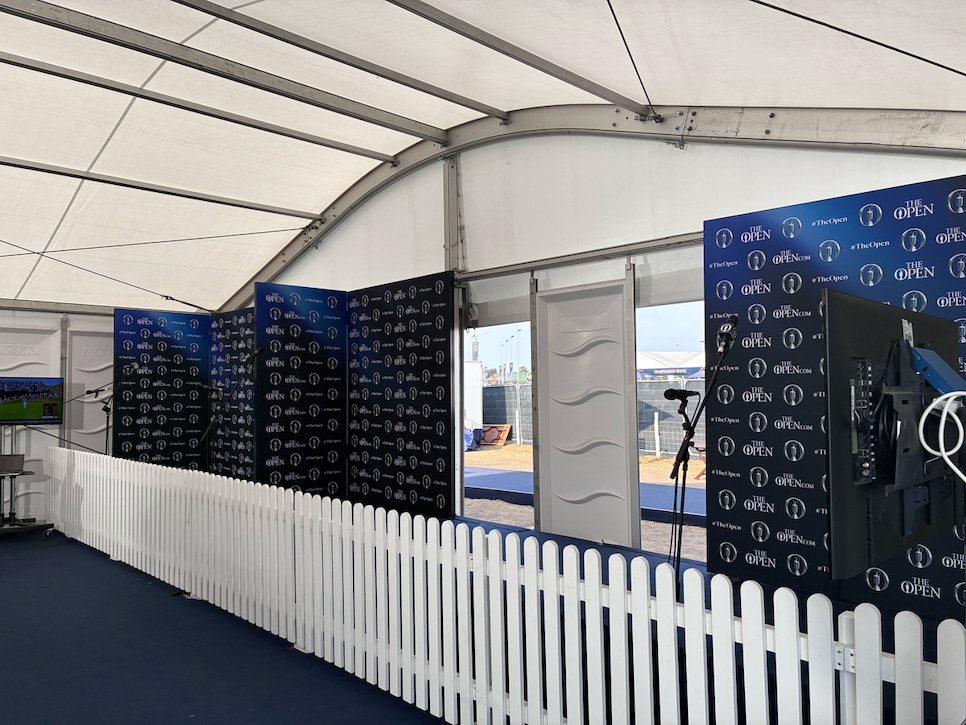
The media interview area at the Open.
On Thursday, I was that crazy. So here are the 19 things I learned from listening to the players over four straight hours.
1. You’ve likely heard by now that the course is baked out and brown, and balls are rolling to such a degree that tee strategy becomes a player’s most difficult puzzle. Their ways of explaining it were fascinating. For Dan Bradbury, a representative conundrum came on 16, where if he hit 4-iron off the tee, it lands on an upslope and leaves him a long approach, but if he clubs down to a 3-iron, it will reach a downslope and run all the way to the bunker 50 yards further on.
Bunkers, you’ve heard over and over, are death personified.
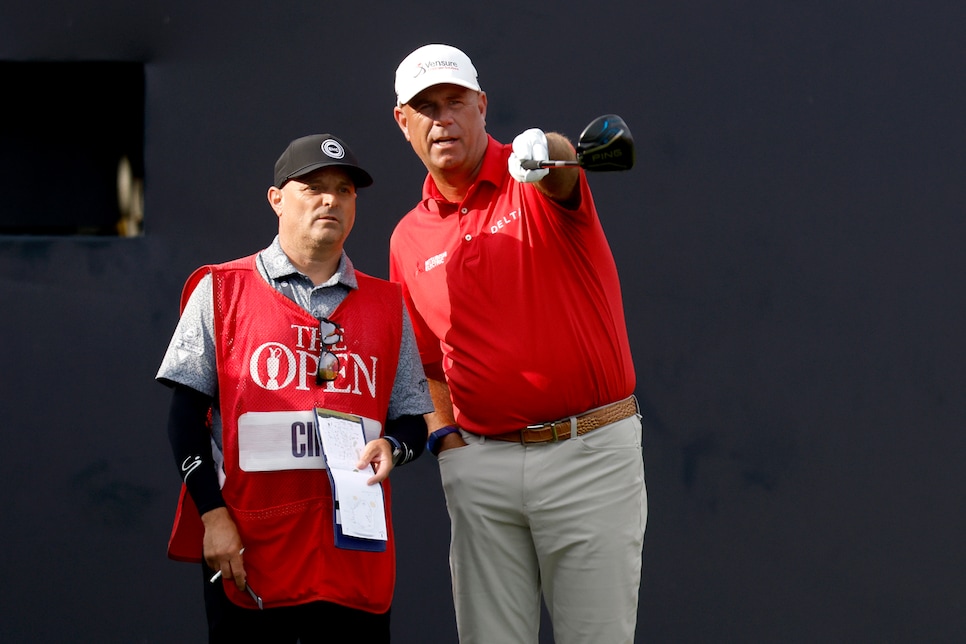
[Photo: Michael Reaves] Stewart Cink maps out a shot in Round 1.
2. I wanted to speak to someone who had struggled and could explain it, but who wouldn’t be annoyed or taciturn if he was asked to speak, and I found the perfect solution in Stewart Cink, who shot four-over 74.
“This is not the Birkdale I’ve ever seen before,” said the four-time Birkdaler. “The main thing is if you’re going to play conservatively, you just need to know how much your ball is going to roll when you hit the fairway. You’re landing it way short of the bunkers. If you’re going to try to lay up to the bunkers at, say, 280, you’re only going to land it at like 220. But the problem with that is, if you are offline with that shot, you’re going to land it 220 in the rough and it’s going to stop.”
In other words, there’s a risk to playing safe.
3. Still, playing conservatively was the choice most players made, including Robert MacIntyre, who echoed Bradbury’s sentiment about avoiding the pot bunkers at all cost, but did significantly better than him, finishing with a 67.
“It was a test of discipline and almost acceptance,” is how he put it, adding, “I feel I was very, very cautious off the tee. But the way I’ve been playing, approach play has been really good. It was kind of the priority, get it on the short stuff and stay out of these pot bunkers.”
MacIntyre didn’t care if he left himself a long approach shot, because he had faith that if he got it close to the green, he’d save par when necessary. Even then, there are lapses of concentration, and you need to get lucky, as when his 4-iron rolled out too far on 16 but ended up even with the bunker instead of inside it.
4. However, it’s not a simple matter of just leaving the driver in the bag. You did see some of that, as when Alex Fitzpatrick spoke about adding a 2-iron—a club he didn’t seem to like very much and called “a little infuriating”—in order both to take advantage of the roll-out and to keep long shots lower when the wind kicks up. But as MacIntyre said, there are times when the wind is favourable, your shot shape fits the “safe” side of the fairway or green, and it makes sense to attack. “Driver’s not guaranteed to miss a fairway,” he said, “3-wood’s not guaranteed to hit it.” If you can be aggressive and not court disaster (which usually means hitting into a bunker), there are times when the bigger club is called for.
But when you feel you’ve solved the problem, there’s always another problem—as much as you rationalise hitting drive, the reason so many players defaulted to caution is that yes, it does bring bunkers into play, and it does bring the rough and all its horrible potential lies into play.
5. Similarly, this might be 2026’s ultimate “know where to miss” course. Bradbury spoke of his two costly errors that came because an approach was just a few yards offline, but that being offline wasn’t what killed him—it was being offline in the wrong direction. “If I had missed 20 feet left, I’d be just fine,” he said, “but because I missed four yards right, I was done.”
MacIntyre, speaking of the difficult 15th, knew that if he was going to miss, he had to miss left. Miss it right, and all of a sudden bogey becomes something you pray for, rather than try to avoid.
6. Amazingly, all of this agonising happened without much wind and with relatively receptive greens. It was a calm morning and early afternoon, and though the tucked pins somewhat made up for conditions that Henrik Stenson called “benign,” even the roll-out wasn’t as extreme as during the practice rounds (at least before the sun really began to beat down). Still, just an ounce of cross or even helping wind was enough to add extra stress. Justin Thomas used driver more often than most, primarily because he feels very confident with that club at the moment, but he described the feeling of standing on the 17 tee and not being able to envision a good result.
“Seventeen being off the left and a little bit of help, with how that fairway is, it feels kind of unhittable,” he said. “Obviously you can hit it, but because it’s downwind, the ball is getting pushed as it’s going out there, and that’s another 30 to 50 yards it’s going to roll.”
7. Other players mentioned this same phenomenon, of cross wind making it hard to hit fairways at all, and Francesco Molinari pointed out that when the wind begins to blow, as it likely will later in the week, it might have the paradoxical effect of making players more aggressive, not less.

[Photo: Sean M. Haffey] Francesco Molinari smiles on the first tee.
“I think, if it gets windier, it might change a little bit because it might become hard to hit some of the fairways with irons,” he said. “So you might just decide to hit driver and miss the fairway, but being closer to the hole rather than too far back.”
But nobody put the problem better than Alex Smalley, who introduced the complicating factors of fade vs. draw:
“When [the wind] switches out of almost due north, there’s a lot of crosswinds on the holes, which makes it difficult because you have to first figure out if you’re going to hold it into the wind or let it ride it. Then obviously what you hit off the tee then kind of determines that kind of shot.”
For Viktor Hovland, as with MacIntyre and many others, it ended up making him play safer than he had in the practice rounds, and maybe more than he had planned beforehand.
“I think in tournament conditions, it’s just a little bit easier to fall back and try to play a little bit short of a lot of these bunkers,” he said, “because you can hit driver a few more places and be okay, but you’d like to kind of take some of that luck element out of it if you feel like you’re hitting it pretty nice.”
8. Molinari’s voice is extremely deep, somehow even deeper than it sounds on TV. Victor Perez’s voice is surprisingly high. Smalley’s voice is fairly normal, but his diction is so precise that every word seems to have too much space before the next, leaving a robotic impression. Tyrrell Hatton’s voice on the podium is almost timid, and so is his body language, which makes a wild contrast with his occasional on-course rage. This has been your voice report.
9. You forget, with all the LIV misery, how funny Henrik Stenson can be. When asked if it felt like 10 years since he last won the Open, he said, “nine and a half at most.” When asked about when his LIV probation is up with PGA Tour Champions, he said, “so from end of August, they removed my ankle bracelet.” And at the end of the presser, someone asked about his hat, but he thought the man said, “house,” and after the confusion was cleared and he answered the question, I asked about his house.
“My house is in Orlando, Florida,” he said. “I’d prefer if you don’t come visit.”
10. A quick note on nerves, from Travis Smyth: “I’ve only played three majors. I still shit myself on the first tee. It’s still not easy yet. It’s never going to be easy.”
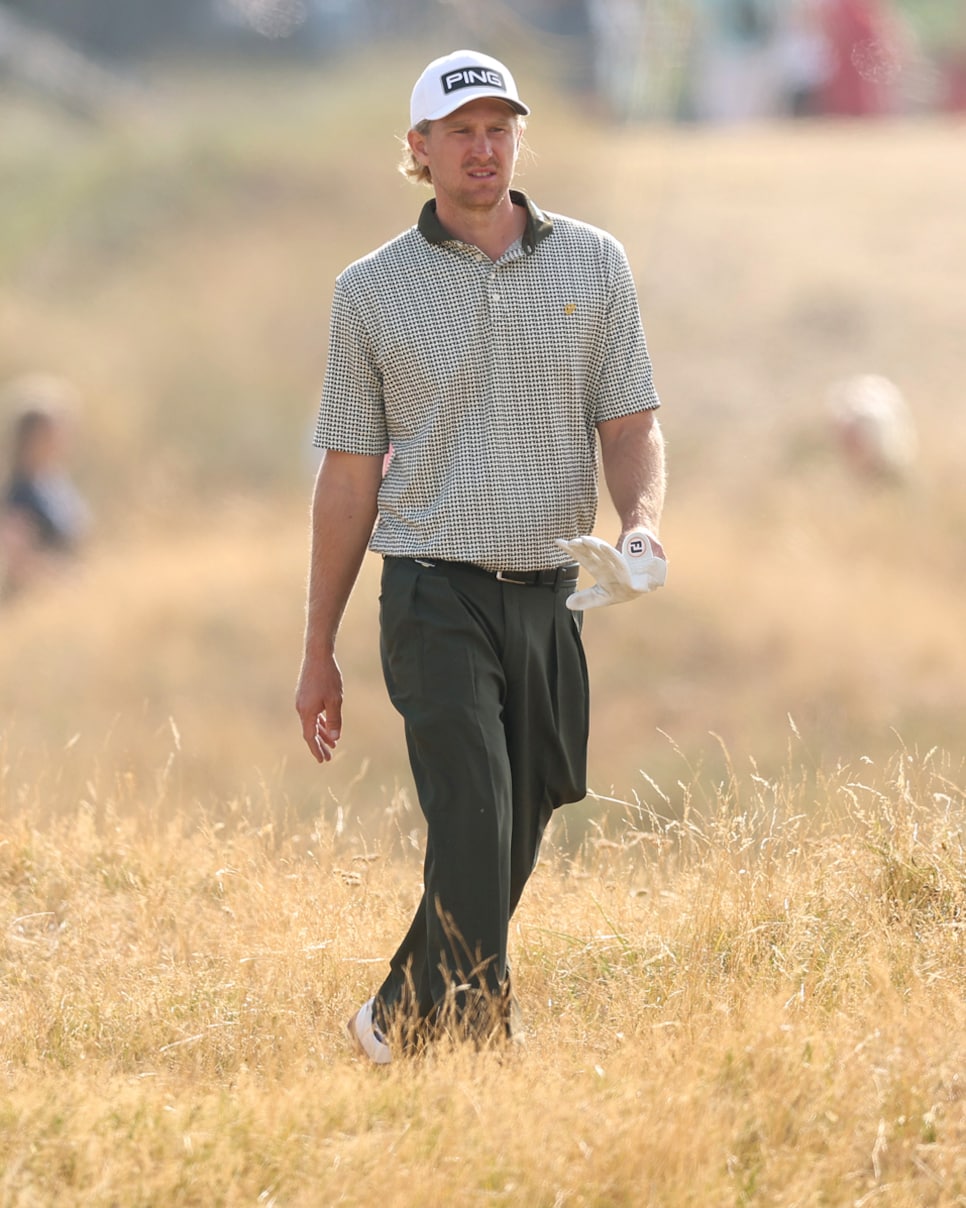
[Photo: Warren Little] Travis Smyth on the course in Round 1.
I’m sure that made the first tee shot even harder for the players who came after him. And it’s especially bad because he had the nicest pants of anyone that came through—pleated and baggy, like a 1920s Chicago gangster, but dark green. Tremendous pants.
Smyth also had the funniest take on using driver, saying that the rough is getting drier and thinner with every day.
“You can easily just hit it up the rough and get away with it,” he said. “You can get lucky out there for sure. It’s not that bad.”
So much for all the stress!
But also, Smyth ended with a 71, which brought another of Cink’s quotes to mind: “You can play from the rough most of the time, but you don’t want to play from the rough all the time. It will bite you; it’s just not going to bite you every time.”
Also tying Cink and Smyth together: Cink yanked his opening drive and lost the ball, leading to triple bogey. “Was it nerves?” I asked.
“Well, there’s excitement and anticipation, of course. It’s a major. It matters.”
So even when you’re a former champion, and a seasoned veteran, the first tee can still bring the jitters.
11. At the Open especially, there are waves of international media that come in for their players; the French for amateur Lev Grinberg and Victor Perez, the Spanish for Jose Ballester and Angel Ayora, the Japanese for Kota Kaneko, the Danes for Rasmus Hojgaard, the Brits (led by the BBC rep with his yellow mic and very loud broadcaster voice) for all the English players, and one young Norwegian from the biggest paper in Oslo (a publication that hasn’t sent anyone to the Open in a decade) for Hovland.
There was one exception, and it came when all the English rose in unison to greet Mateo Pulcini, an amateur from a very unpopular nation on this particular Thursday: Argentina, who just broke England’s heart (again) at the World Cup. He came in with a big toothy smile, having just buried a 40-foot putt on 18 and dropped the Enzo Fernandez goal celebration from the day before. He was unabashed and so friendly even the English reporters couldn’t be mad—he loved the crowds, he said, and was shocked at how few boos he got. They tried to draw him out with a question about the Falklands, but he wasn’t biting.
“I don’t want to talk politics and golf, just golf and football,” he said. “I wasn’t even going to put football with golf, but then I made a 40-footer.”
12. Very few players refuse the R&A’s requests, but there are exceptions. Justin Rose, after shooting 75, opted out. When Scottie Scheffler came in after making the various TV rounds, the R&A moderator let us know we were limited to two questions. “Try to make them ones I haven’t answered a thousand times already,” he joked, which froze everyone in their tracks.
Bryson DeChambeau, who was heard making negative comments about the media to a reporter on Wednesday, would only grant the R&A rep a series of questions in private, along with a short video, after he shot 67. He refused all TV. It’s safe to say his relations with journalists are at a low point, and the R&A’s Mike Woodcock informed the rest of us that he wouldn’t be coming to the mixed zone.
13. On that note, the room fills to capacity when the big names come in, but it’s also when the interviews themselves become less interesting, and the players more guarded due to over-exposure.
14. Two tattoo-related stories: Dan Brown, an Englishman who shot 66, has three little birds inked behind his left ear, but advised me not to ask what it meant, since it meant nothing. That one was just for looks, and so were some of the other ten he’s gotten in the past two years. Jordan Smith, on the other hand, knows exactly he got the three interlocked triangles on his right forearm; he and two other friends had a “boozy” lunch in London a couple years ago, and Googled tattoo ideas for three friends. The triangle theme is what they got. “I don’t regret it,” Smith said.
15. Speaking of Brown, he was asked about his cigarette habit (he remembered begging his father to stop smoking as a kid, which his father did, only for the son to pick up the habit), and after a quick “sorry, mom,” he confessed to having seven or eight during his round. He’s taking extra care to make sure they’re fully out when he’s done, considering that one misplaced might light the place up like a tinderbox in the dry conditions. But he joked that his results would go to hell if he stopped cold turkey. “Should they be considered a performance-enhancing drug?” I asked, but he didn’t laugh—he just said that wasn’t up to him.
16. It’s always possible to make a fool of yourself in these situations. I kept noticing players’ belts—leather, braided, patterned—and how on each of them, there was a buckle with the claret jug and the word “player” on it. Then Victor Perez came in; he wore no belt, but he had the buckle clipped to his pocket. I asked if there was some rule that they had to wear the buckle even if they weren’t wearing a belt, and he looked at me like I had three heads. Turns out, they weren’t belt buckles at all, just player ID clips, and most players happened to wear them on their belts.
17. Sartorially, a surprising number of players have little gold aglets on their shoelaces.
[Photo: Stuart Kerr/R&A] Jose Ballester during practice round.
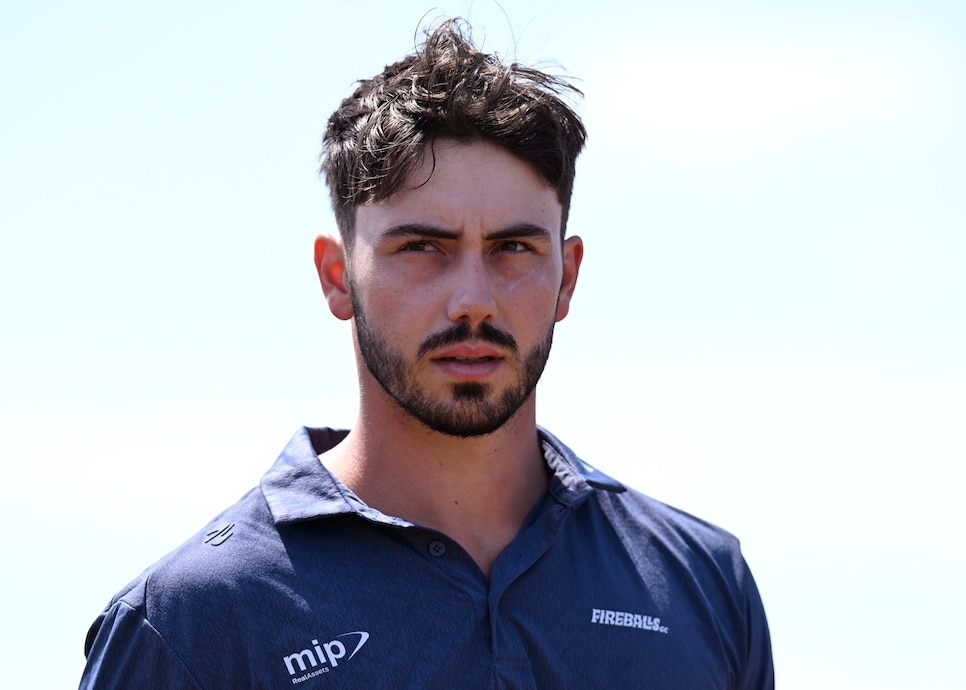
18. Ballester is a nice guy, I’m sure, but with his sharp features, he looks like a villain out of central casting.
19. Juan Luis Guillen is a consultant who is hired at most majors to help keep the ship afloat and to make sure the international players give answers in their native language. When it was Molinari’s turn to give an answer in Italian, Guillen fired off a question that sounded, to my ears, like Spanish. When I asked him after, he said, “a-ha!”, as if I’d just cracked a code.
Turns out, Guillen doesn’t speak Italian, but Molinari does speak fluent Spanish, so Guillen asked him in his own language and got the response in Italian. He’d done that often, he told me, and at one tournament, a group of impressed reporters came up to him in awe: “Your Italian is perfect!”
MORE OPEN CHAMPIONSHIP COVERAGE HERE