

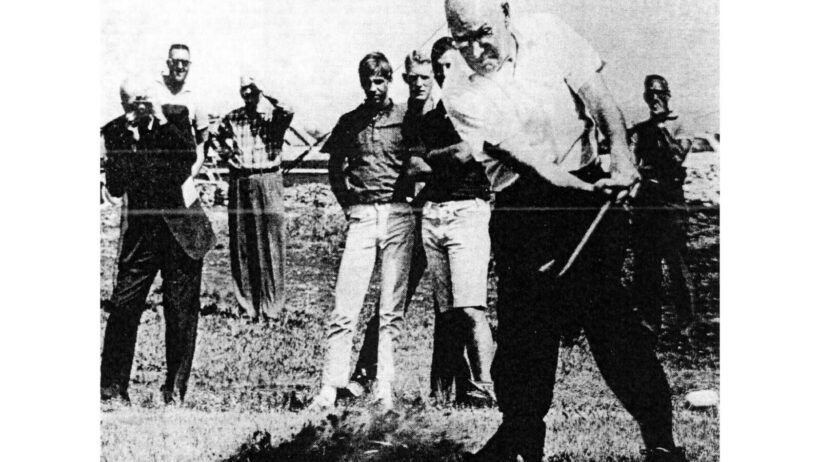
Rochester’s Soldiers Field Golf Course was dedicated in 1926, and by 1964 the historic public course was over-burdened with up to 40,000 rounds of golf each season.
On many occasions, the Soldiers Field links are “jammed to capacity,” the Post-Bulletin reported.
Some duffers, tired of long wait times to get on the course, were throwing their clubs back into the trunk of their cars and heading home to mow the lawn. “Hundreds of golfers have been turned away when the course was full,” city park officials said.
So as early as 1961, the Park Board began looking for ways to develop another public golf course in the city. It just so happened that a plot of land that had formerly been used by Rochester State Hospital for farming was now sitting vacant. The state-owned 175-acre site along U.S. Highway 14 southeast of the city seemed ideal for golf and other recreational activities.
The state legislature approved sale of the land to the city for $17,000, and by July 1, 1964, nine holes of Rochester’s second public golf course were ready for play. The newly developed land on which it was located was called Eastwood Park, a name chosen by the Park Board from among 150 suggestions.

Within the first two months, 2,500 rounds of golf had been played on the new Eastwood course, taking the strain off of Soldiers Field.
Those initial Eastwood golfers found themselves tackling a challenging course.
“Eastwood won’t allow many ‘cheap’ shots,” a Post-Bulletin headline declared after two sportswriters played a test round on the course.
“There isn’t a single hole with flat terrain,” the reporters said. “You’re either moving up or down a hill, sometimes twice between tee and green.” They concluded that “the up-and-down terrain surely doesn’t glorify the dubbed shot.” And, they said, “you’ll work up a good sweat.”
Construction of the course had begun the previous autumn, when the farm field was plowed and smoothed, and seeded with 5,000 pounds of grass seed. Working from contour maps, city golf pro Tay Keller and park superintendent William Van Hook, designed the new course. Officials of the National Golf Association paid a visit and approved the layout.
“We’ve got an awful lot of work yet to be done,” Keller said on the eve of the opening of the course. “We do plan to put in more trees and sand traps later.”
The work was hindered by a dry summer. But there was no indication that the planned opening of the final nine holes in time for the second season in 1965 would be delayed.
Meanwhile, the city worked to develop playground areas, picnic shelters and walking trails in the park.
In an editorial, the Post-Bulletin called the opening of Eastwood “a milestone” for development of park and recreation opportunities in the city. Eastwood was the largest park project in the city since Silver Lake Park had been established in the 1930s.
With IBM having located here in the 1950s, and Mayo Clinic continuing to grow, more schools, new roads and additional recreation facilities would be needed in the 1960s.
And now, Rochester finally had its second public golf course. Golf widows were no doubt thrilled.
Thomas Weber is a former Post Bulletin reporter who enjoys writing about local history.

Thomas Weber is a former Post Bulletin reporter who enjoys writing about local history.