

Tiger Woods was so good he made his rivals play worse — and it’s measurable #Shorts
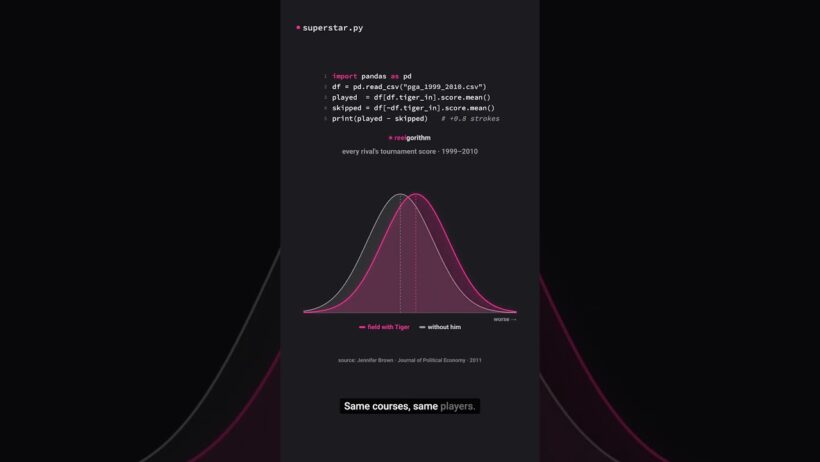
Economist Jennifer Brown (Kellogg School, Northwestern) analyzed every PGA Tour event from 1999 to 2010 and split them into tournaments Tiger Woods entered versus ones he skipped. When Tiger was in the field, the rest of the field scored about 0.8 strokes worse per tournament, and the top-ranked players competing directly with him were hit hardest — roughly 0.6 strokes worse in the first round alone, and up to about 1.3 strokes across a full event. A permutation test shows a gap this large essentially never appears by chance.
The proof it was Tiger himself and not the courses: the effect was large when he was dominant and vanished during his 2008-09 injury and off-form years. The mechanism is not nerves or riskier play — Brown’s model shows that when a competitor’s chance of winning collapses, effort rationally drops. Economists call this the superstar effect.
Methodology note: the distribution and bars use a model calibrated to Brown’s published effect size, with a real permutation test run on it; the 0.8-stroke figure is the verified result from her paper.
Source: Jennifer Brown, Quitters Never Win: The Adverse Incentive Effects of Competing with Superstars, Journal of Political Economy, 2011.
#Shorts #tigerwoods #golf #statistics #python