

SOUTHAMPTON, N.Y. — Leave it to Gary Player to call it as it is. To remove all defenses and lay down the gauntlet. He wanted to be the first to win the modern grand slam.
Player arrived at The Country Club in Brookline, Mass., as a 27-year-old South African with three major championships and one more to go. He’d won the 1959 Open Championship, the 1961 Masters and the 1962 PGA Championship, and he showed up at the 1963 U.S. Open desperate to conquer one last hurdle.
But Arnold Palmer was one away, too. Jack Nicklaus was getting close.
This new milestone was taking shape: the holy quartet, the quadrilateral, the four golf tournaments that meant the most for any golfer to conquer. It had been thrown around before, never fully agreed upon, but in the early ‘60s the consensus formed, with Palmer’s help. The Masters, U.S. Open, Open Championship and PGA Championship were the true career Grand Slam.
“I’d like to be the first to complete the whole cycle,” Player told reporters at Brookline. “It means so much to me I can’t tell you what I’d do to win this one.”’
He finished eighth that week. It took him until 1965 to win the U.S. Open at Bellerive. Gene Sarazen and Ben Hogan had also won all four, but before some were considered S-tier tournaments. Player was the first to take on the slam’s weight and win it anyway. A year later, Nicklaus took the 1966 Open to complete his own slam. Palmer never did.
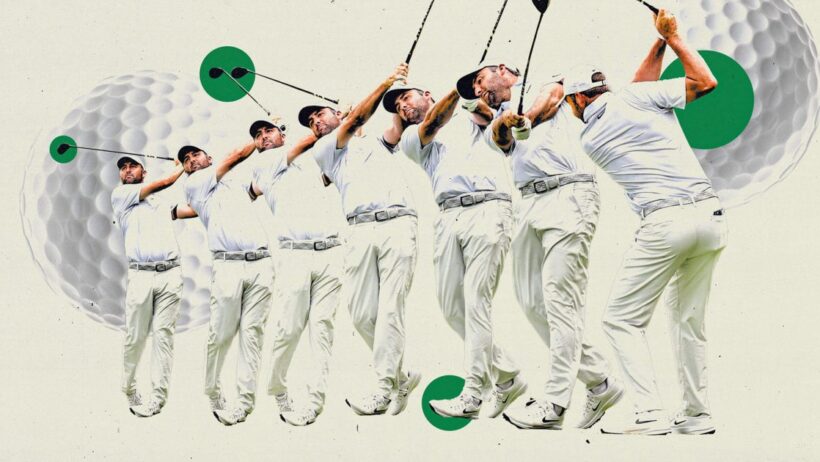
Sixty years later, world No. 1 Scottie Scheffler arrives at Shinnecock Hills Golf Club this week trying to join that most exclusive club, attempting to complete the grand slam with a U.S. Open on Sunday for his 30th birthday. He’s the heavy 9-to-2 favorite, but questions have been raised about his form.
He’d be the club’s seventh member, and just the second since Tiger Woods cruised through all four by 2000. Only Woods and Nicklaus would have completed the cycle faster, with Scheffler potentially closing the deal four years after his first Masters.
What’s the key to a successful golfer-caddie relationship?
Gabby Herzig and Lauren Morales-Jones
“For me, would it be a dream to win the U.S. Open? Of course,” Scheffler said. “But at the end of the day, the grand slam has never been a motivating factor for me. I always just wanted to be the best version of myself, and that got me this far.”
If Scheffler does not win this week, it won’t be considered by anyone to be a fatal blow. There’s not even pressure on him, really, at least in some part to his season’s results, which have been less exemplary than the past few. But from here on out, every U.S. Open for Scheffler will center on conquering this task.
Right now, it seems inevitable. But the lesson in golf history is that there’s no guarantee.
Jordan Spieth was still just 24. He was the chosen one. After his thrilling win at the Open, the three-time major champion went to the 2017 PGA Championship at Quail Hollow with an opportunity to become the youngest golfer to ever complete the slam.
“Expectations, I really don’t feel any,” he said that week. “This whole … this is a chance to complete the career Grand Slam. I’m here, so I’m going to go ahead and try. But I believe I’m going to have plenty of chances, and I’m young enough to believe in my abilities that it will happen at some point.”
That week in Charlotte, he never broke 70 and finished T28.
Nine years later, Spieth has never returned to his peak form. He’s never won another major, let alone the PGA Championship. He only has seven major top 10s in his last 34 attempts. Yes, he’s just 32. Of course, he will still have plenty more opportunities, and a second wind remains in the cards. Or, like so many before him, it just might not happen.
Tom Watson won eight majors but never conquered the PGA. His playoff loss at the 1978 PGA Championship at Oakmont may haunt him forever. Sam Snead won seven majors but never the U.S. Open, finishing runner-up three times. Same for Phil Mickelson, perhaps the man most synonymous with his close losses at the U.S. Open, finishing runner-up six times. Byron Nelson, Lee Trevino and Raymond Floyd all faded into retirement with three-quarters of a slam.

Scottie Scheffler is in good spirits to start the week at Shinnecock Hills. (Andrew Redington / Getty Images)
Palmer was even the first of the modern crew to reach three legs. The King won the 1961 Open a full year before Player reached three-quarters.
“I want to win it more than ever now,” Palmer said before the 1961 PGA.
Like so many before him, he started slow before going 69-68 on the weekend for a backdoor T5. He played it 31 more times. Won three more majors elsewhere. Never finished the cycle with the PGA Championship.
Yes, Scheffler enters this week as the betting favorite, but by his absurd standards, his probability has actually dipped. He’s been a 3-to-1 favorite the last two U.S. Opens, and this season has been… different.
Scheffler’s still been fantastic by any metric, with seven top 5s in 12 starts and no weeks worse than T24. It’s just been messier. His iron play is still the best in the world, but his strokes-gained approach is half his normal level. This year’s success has been slightly more about his elite short game and becoming a top-10 putter.
His four runner-up finishes have been impressive and frustrating, and he’s shown that anger at times on the course. It’s been fair to wonder if the difference between close calls and victories — his last was the American Express nearly five months ago — has been that tee-to-green game going from transcendent to only really good. Still, he remains the best player in the world, and Shinnecock’s brutal test should highlight his strengths even more.
And for every disappointment, there’s also McIlroy, who serves as a beacon of hope and a cautionary tale.
When McIlroy won consecutive majors to end 2014, he was on top of the world. He’d won four majors by 26, taken three legs of the slam and was considered Tiger’s successor. And for all his strengths, McIlroy thinks deeply about legacy and narrative, often to a fault. From a young age, he made no secret of his desire to win the green jacket, and nobody was more familiar with the special club than McIlroy.
“I wasn’t just playing to win the Masters,” McIlroy said recently. “I was playing to join this group of people that I dreamed of joining one day.”
But at that point in his life, he leaned all the way into the celebrity of it all. He was on the cover of multiple magazines. He did constant media. The buzz never dissipated, and McIlroy fully played his part in the hype machine.
“In hindsight, if I was really just focused on preparing the best way I could, I probably would have maybe not done as much of that stuff leading into it,” McIlroy said.
“Literally, like, everything was geared towards 2015 at Augusta and trying to get this done and going for, not just the grand slam, but my third major in a row and all that stuff. So I leaned into it. In hindsight, I maybe leaned into it a little too much. And then, as the years went by, it just felt like it was getting harder and harder.”
It wasn’t until 10 years later that McIlroy finally conquered his demons at Augusta National, and he collapsed on the green in tears, the burden he carried finally lifted.
Scheffler is nothing like McIlroy. Or Player. Or Palmer. He’s not even like Woods, who confidently said he wanted to complete the slam at St. Andrews and then won by eight shots.
But Nicklaus? Nicklaus never let the slam become a story. While so many of the press clippings from Player’s and Palmer’s major attempts were littered with tension about their desire to win the fourth leg, the Open Championship stories following Jack hardly mentioned it. He was a 7-to-2 favorite at St. Andrews in 1964 on his way to becoming the best player of his generation.
All three of Player, Palmer and Nicklaus sat at three-quarters of the slam at the time. But unlike his peers, Nicklaus never gave reporters a quote to work with on the matter. They just wrote of his dominance and power. At the absolute most, a story might calmly reference that the Open was the only one he had not won, but no more.
Why this U.S. Open course is diabolical
Gabby Herzig, Lia Griffin and more
He started slow but finished with a (course record) 66 and 68 to reach second place, but five back. The next year at Royal Birkdale, it was T12.
It was then 1966 at Muirfield when Nicklaus nearly gave the Open away (again). But tied on the par-5 17th with his co-leaders in the clubhouse, Nicklaus put his second shot to 15 feet. He tapped in for birdie to ultimately complete the slam. A decade later, he built his signature championship course in Dublin, Ohio. He called it Muirfield Village.
But maybe when people talk about Scheffler’s greatness, they make the mistake of going straight to Tiger. In many ways, his temperament is much closer to Nicklaus’.
They lack the flash and charisma of their star peers, but they win more. They use a subdued competitive drive and methodical strategy to outlast their foes. They combine their comical self-confidence with a lack of self-importance. Nicklaus even said he thinks Scheffler plays as he did.
And like Nicklaus, we haven’t seen Scheffler make anything of a quest for the grand slam. He just wants to win golf tournaments.
But when pressed on the topic Tuesday, he conceded:
“It’s kind of a funny thing. It’s like, yeah, if I win this tournament, that would be amazing, but I think then I show up the next week, and it’s like, ‘Okay, now Scottie’s won the grand slam, he’s won all these golf tournaments. Now where do we go from here?’”