

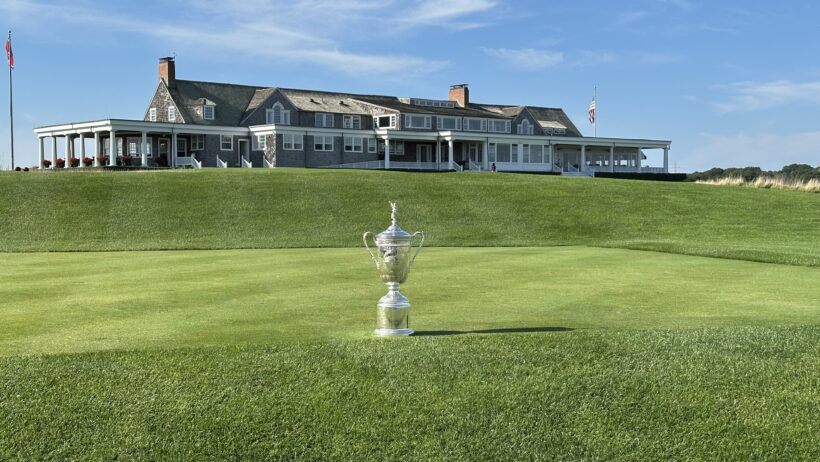
The biggest event of this summer in the Hamptons is the U.S. Open, played on the Shinnecock Hills Golf Club between June 18 and June 21. More than 100,000 people will be involved with it one way or another. This ancient golf course, opened in 1891, is the first incorporated golf club in America, and is today, as I write this, awash in huge but temporary buildings, grandstands, media tents, locker rooms and caddy shacks. It’s a small city.
A pop-up railroad station platform nearly a quarter-mile long has been constructed. A special temporary traffic lane along the Montauk Highway is now in place, as is a temporary pedestrian bridge arching over it. There are parking lots, computer facilities, helicopter pads, and watchtowers all over for this one-week-only event and all will be removed when it’s over in four days so everything can return to normal.
The U.S. Open and the Masters Tournament (held in Georgia) are the premier golf competitions in America. Winners have included Bobby Jones, Arnold Palmer, Jack Nicklaus and Tiger Woods.
And then one year there was John Shippen Jr., a 16-year-old Native American lad from the Shinnecock tribe who led the competition to almost halfway through the final round. But then, nervous, he got an 11 on the 12th hole and wound up finishing fifth.
John Shippen Jr. was born in Washington D. C. His mother was Eliza Shippen, a Shinnecock Indian. And his father was John Shippen Sr., an African American whose father – John Junior’s grandfather – was a slave.
John Sr. was a preacher at a church in Washington. But in 1888, he accepted an offer to become the Presbyterian minister for the Shinnecock tribe on their newly established Indian Reservation here. He and his wife had nine children. John Shippen Jr., the eldest, was 8 years old.
Shinnecock was quite an interesting place at that time. Twenty years earlier, the Long Island Rail Road built tracks out from Manhattan to Southampton, allowing a community of wealthy industrialists to build huge summer mansions on the ocean. In 1891, artist William Merritt Chase opened an art studio and taught the wealthy wives of the industrialists how to paint landscapes outdoors. It was called the Shinnecock Summer School of Art.
The school lasted for eight years but as the railroad locomotives came through, belching embers and smoke, numerous small fires eventually burned much of the foliage to the ground.
In early 1891, William K. Vanderbilt, who had been in Europe for much of the winter, returned, bringing a Scotsman named Willie Dunn Jr., a builder of golf courses, with him. This was a new thing to America. “We should have one of those here,” Vanderbilt told his compatriots, as he teed up a golf ball and hit it into the low-scrub rolling hills. A new game.
Vanderbilt and his friends found they loved golf and began building a clubhouse in 1892. Or to be more precise, they hired members of the Shinnecock Indian Nation, at the direction of Dunn Jr., to build it for them.
Although the local folks, mostly Southampton farmers and fishermen, were not much interested in all of this, largely because that wealthy summer colony kept to itself, the Shinnecock tribesmen became eager employees. They worked as greenskeepers, pro shop workers and caddies, and were also free to play rounds of golf in their off hours. Among them was John Shippen Jr., age 15, who on any given day, it was said, could beat any golf club member at that game on that course.
In 1895, with the clubhouse completed, it was learned that up in Newport, another summertime watering hole for the wealthy, a group had built another golf course and was inviting members of other new clubs to come to Newport for a competition. Who was the best golfer? That was the first U.S. Open.
The second U.S. Open was scheduled for Shinnecock. Each club could send their two best golfers to Shinnecock. They came from all over, including by steamship from overseas, where this interesting game was founded. It was to be quite a time.
Vanderbilt and his friends met and decided that the two best golfers in Shinnecock were John Shippen and Oscar Bunn, another Native American. A U.S. Golf Association had been formed and was putting this gathering together. There would be 48 entries from around the world. And so they announced that the entries from the home course were these two Shinnecock boys.
This created a tremendous uproar. The day before the competition, nearly half the golfers told Theodore Havemeyer, the president of the U.S. Golf Association that if the Shinnecocks played, they would not. They would not hold themselves to play against their kind.
But Havemeyer wouldn’t budge. He said that the Shinnecocks would play, and if the others would not do so, they were free to go home. With that, all who objected backed down. And the controversy ended.
The entire U.S. Open at Shinnecock took place on a single day. It consisted of 18 holes in the morning and then a second 18 in the afternoon. When the morning round concluded, the leader of the pack was this 16-year-old John Shippen Jr. The other kid, Bunn, had dropped further down the score sheet. It was Shippen’s to win or lose.
After lunch, they began the second 18. Shippen remained the leader through the 10th and 11th, but on the 12th, a par 4, he hit his tee shot into some trees on his right. He banged a few into the trees trying to get out, and carded an 11, which dropped him out of first place.
In the end, he wound up in fifth place, eight shots off the lead.
Shippen Jr. lived to the age of 88. He played in four other U.S. Opens, but never won one. For a long time, he was the golf pro at the Shady Rest Country Club in Scotch Plains, New Jersey.
But he never forgot that 12th hole all those years earlier and often told others about it. In 2018, posthumously, he was voted into the New Jersey State Golf Hall of Fame. Had he been there, he’d have loved it.
 Cartoon by Dan RattinerCartoon by Dan Rattiner