

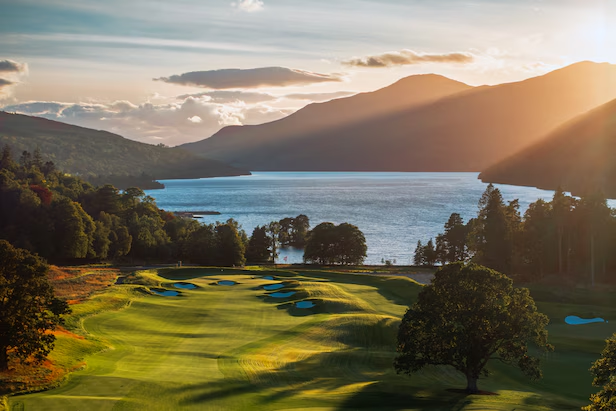
Kenmore is a postcard town in the Scottish Highlands. Surrounded by hills, the picturesque town sits in a valley on the edge of Loch Tay. Everywhere you look is beautiful. And like so many Scottish towns, there’s a castle. Built along the banks of the water, Taymouth Castle has been restored and redesigned since the first owners laid down foundations in the 15th century.
And the new owners are Discovery Land Company, which is now up to 35 properties. I traveled to Kenmore to see the newly opened golf course and take a peek at what only a few will ever get to experience.
The drive from Edinburgh takes two hours, weaving through mountains, over bridges and through forests. The landscape gets more scenic with every turn. I stopped for a coffee in Kenmore, a town I visited as a kid with my family, spending as much time in the Loch as out of it. Then it was time to head to Taymouth Castle ahead of my tee time.
“Follow the road until you come to the big castle gates,” said the man who served me my flat white at the Kenmore Village Shop. “Two big turrets, that’s the entrance.” Off I went.
Driving through the grand gates, I quickly ran out of road. Construction crews were at work. One of the workers came to my car to help. “Aye, you want to head to the other gates, on the east side.”
Of course there were two sets of “big castle gates.” This was Taymouth Castle after all.
Eventually I found my way through the correct gates, zigzagged down into the valley before being met with views of the course. The green of the fairways contrasting with the white sand in the bunkers and the blue sky (somewhat rare in October in Scotland) was a sight to behold.
I parked on the stones immediately outside the castle, recently opened after a £100m renovation by Discovery Land, and stepped out to a scene you could only compare to a period drama. Jane Austen herself would be impressed.
This was my second time arriving to play golf at Taymouth Castle. My first time was at 12 years old, on said family holiday, to play the original James Braid course, built in 1925. Now, close to the 100-year anniversary of that layout, I was here to experience the new, Tom Fazio layout. It didn’t take long to sense the differences.
Previously, the course Taymouth Castle was laid out over 200 acres of an old deer park. The layout was fairly flat, originally 12 holes then expanded to an 18-hole course, made up of a series of tight doglegs, as many Braid courses of that era were.
It didn’t take long to see that the new course is nothing like that original Braid layout. As I met Chris Campbell, the professional at Taymouth Castle, he smiled and said, “Are you ready?” with a look of someone who knew what my adventure had in store.
The initial view of the par-5 opening hole told you everything you needed to know about the new course. With Loch Tay behind you, hills all around and the castle in the distance behind the green, the elevated tee shot laid out a wide and weaving fairway of ultra-manicured grass toward a large, angled greensite. This was Taymouth Castle.
“This will be the most manicured course in Europe,” Chris told me as we drove down toward the fairway, in our golf buggy complete with leather seats that felt like we’d been upgraded at check-in.
Very little from the original Braid course remains. In fact, a lone green as you drive in the east gates remains, kept by the greenkeepers as a connection to what was created here 100 years ago. The new course is designed for those that will play here.
The purpose of the course is to host residents who buy a plot here with Discovery Land. Starting at £4 million, prospective members can choose from around 150 plots of land up in the hills, along the river or along the course. A range of activities are available to those members, from fishing to wakeboarding, clay pigeon shooting, archery, stalking, mountain biking and of course, golf.
Golf is central to all 35 Discovery Land properties. From Vegas to Portugal to Dubai to Scotland, the communities are built around golf courses. Taymouth Castle is no different. The course is split into two distinct sections: the loop, that plays back and forth beside the castle and the lochside, which plays on the west side of the land, overlooking Loch Tay and Kenmore.
By the time you reach the second hole, you get a good idea of what Fazio intended with the course. The short par 4 features a very generous landing area from where you are asked to hit a precise iron shot to a Biarritz-shaped green that is intimidatingly straight and narrow.
“Where’s my miss?” I asked Chris as I pulled an 8-iron from my bag. “There’s not a good miss, you just have to hit the shot.” he replied. Gulp.
That is what the new layout at Taymouth Castle is all about. It’s designed to be fun. Remember it’s designed for the residents of the property and catered to how they play and enjoy the game. Wide fairways are bordered with large, white-sand bunkers and followed by unique and creative green shapes and contours.
The highlight of the loop comes at the fourth hole. From another elevated teeing position, you turn to face the castle and the green laid out directly in front of it. A short, drivable par 4 will tempt most players to take on the green, while the short grass that surrounds the green and bunkers will both test and reward the best short-game players.
After a par 3 that plays alongside the castle, you loop back uphill on the seventh hole, near the entrance you drove in and the original Braid green. Before summiting to the semi-blind green, you pass “Beardie’s Well,” a stone-carved, gargoyle-like fountain that predates even the castle and was discovered when the course renovations were started. A nice reminder of the history that bestows this area of Scotland.
Before teeing off down the par-5 eighth hole toward the loch side area of the course, we stopped into the first of two comfort stations. Hidden in the trees, the quaint, modern structure welcomes you in for a bowl of venison chili, or peanut butter and jelly sandwiches, or an ice cream … pretty much anything you can think of is on offer, as is the way with Discovery Land comfort stations. Not a luxury we are used to in Scotland, however the venison chili was a welcome addition to my round.
After refueling and finishing the loop, we climbed atop the same slopes we started on and headed to the loch side. Immediately you’re struck by the views of Loch Tay, vanishing into the distance of the valley ahead of you. The layout plays around and through this side of the property.
The 11th is a long par 3, stretching back to 240 yards from the back tees that Chris convinced me to try. With the loch as the backdrop, the reverse-Redan green runs from front left to back right, around a deep bunker. Short grass and mounds to the left of the green invite you to land your ball left of the green in hopes of seeing your ball roll out on the green toward the hole. A heroic shot is required, but also rewarded. It remains the view and shot that I think about the most since playing.
The short par-4 12th is another highlight— played through a gauntlet of bunkers to a green almost split into two sides by a bunker that protrudes into the front edge of the sloped surface. Concentrating on your challenging approach shot is hard with the view.
As you turn away from the loch and back toward the castle, you tee off from Hangman Hill, which again reminds you of the history of the land on which you are walking. The former use of this hill is described by its name. Luckily visitors now face the challenge of finishing their round with a clean scorecard, rather than facing the noose of castle owners, as many did centuries ago.
After passing the second comfort station on the 13th hole, built and hidden into the grassy slopes, you play back and forth in the basin of the property before finishing with a par 5 that leads you back toward the castle—a good chance to card one more birdie before retreating into the castle for a “dram” or whatever you’ve earned through your play on the course.
Not only is the layout completely different from what the course was before, it’s honestly completely different from anything in Scotland. It’s hard to not see the influence of Augusta or Adare Manor in what has been created here. Wide, forgiving corridors of tightly-mown fairways lead to challenging, fun and creative approach shots that both repel and gather balls on the ground.
Having seen the course at Taymouth before and after the new ownership, it’s not hard to see the vast investment and improvements made. The course is unlike anything in Scottish golf and offers a modern take on what inland golf could be. Sadly, for many golfers though, it’ll be viewed like a lot of the landscapes in the highlands, from afar.