

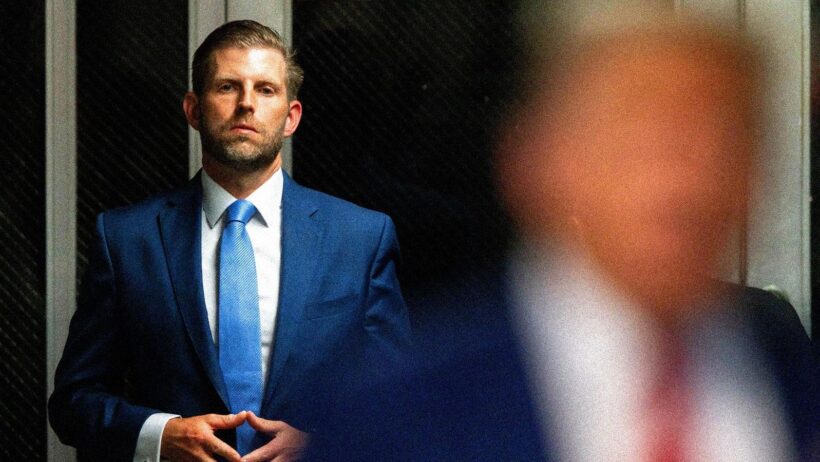
Hours before attending a state dinner with King Charles III, Eric Trump logged onto X last month to defend himself. The heir to Donald Trump’s financial kingdom had been telling investors that his publicly traded company could mine bitcoin for about half of its value, but a Forbes story had exposed that idea as a fantasy. In a five-paragraph response, the president’s son repeated his pitch, then shifted to something that had been bothering him for nearly a decade: a 2017 Forbes story about his kids-cancer charity. “This narrative—no different than when Forbes spent years attacking me for simply being a young kid who poured his heart and soul (with a record breaking 9.2% cumulative expense ratio) into saving dying children at St. Jude Children’s Hospital—is insane.”
(L-R) Eric sits with his mother Ivana in 1994, hosts The Eric Trump Foundation golf invitational in 2007 and poses with his wife Lara in 2014.
Ron Galella/Getty Images, Bobby Bank/Getty Images, Chance Yeh/Getty Images
The Eric Trump Foundation did some real good, pushing more than $25 million to St. Jude, the pediatric cancer hospital in Tennessee. Its model indeed lent itself to efficiency, focusing on fundraising while leaving more hands-on work to others. But Eric Trump’s organization also operated with a misleading sales pitch, sloppy accounting, conflicted board and unmistakable loyalty to billionaire Donald Trump, who, according to a former employee, made sure his for-profit business billed his son’s nonprofit charity. When Forbes first reported this years ago, the New York attorney general immediately launched an investigation. That was the last most people heard of it.
There’s more to the story. Thousands of pages of documents, obtained through a freedom of information request, show the depths of dishonesty underpinning Eric Trump’s sales pitch. He misrepresented how much his fundraisers spent to use his father’s golf courses, to bring in entertainers, even to supply auction items. From 2011 to 2016, Eric Trump’s organization moved at least $500,000 of charity money into his family’s properties through a series of transactions, most of which never appeared on the nonprofit’s tax filings and, therefore, remained out of the public eye—until now.
The documents also explain something that has long confounded observers of the first family: how the Trumps absorb scandal after scandal and emerge unscathed. Their strategy starts with a counterpunch, often over cable news or social media. Then it turns to defense, leveraging lawyers to bury paper trails. The Trumps bend and twist, changing practices just enough to evade serious consequences—without really budging. Then, once the legal heat passes, they emerge emboldened. They were treated horribly, they complain. They ask the public to trust them once again. Plenty do.
The Eric Trump Foundation has run this playbook beginning to end. Nine years after being engulfed in scandal, Eric’s rebranded nonprofit hosts an ever-expanding lineup of fundraisers, spending more than $500,000 a year. The events take place almost exclusively at Donald Trump’s properties.
Eric Trump, whose representatives did not respond to multiple requests for comment, began his charity with a group of well-off friends looking to do something good. “The first fundraising activity we have selected is a golf tournament,” explained an application that Eric Trump submitted to the Internal Revenue Service in 2007. “The foundation is fortunate in that our chairman’s family owns three golf courses in New York and New Jersey that we can utilize.” The charity promised it would sign no leases or agreements with companies helmed by its leaders.
For three years, it worked. From 2007 to 2009, Eric and his buddies hosted a golf invitational, spending about $50,000 annually and raising a few hundred thousand dollars a year, according to tax filings. But in 2010, things began to change. Trump Organization employees started populating the board. A year later, expenses soared to $142,000.
Ian Gillule, a former membership and marketing director at Trump National Golf Club in Westchester County, New York, pointed the finger at Donald Trump when speaking with Forbes nine years ago. “In the early years, they weren’t being billed [for the club]—the bills would just disappear,” Gillule said. “Mr. Trump had a cow. He flipped. He was like, ‘We’re donating all of this stuff, and there’s no paper trail? No credit?’ And he went nuts. He said, ‘I don’t care if it’s my son or not—everybody gets billed.’”
So everybody got billed.
After the 2011 event, the Trump National Golf Club sent the Eric Trump Foundation a $20,000 bill, a copy of which Forbes obtained through the public-records request. Below the dollar amount sits a one-sentence line: “Please feel free to contact Dan Scavino at [his phone number] if you have any further questions.” The conflict-of-interest was obvious: Scavino, who now works as deputy chief of staff in the White House, was at the time serving both as the general manager of the Trump National Golf Club and as a board member of the Eric Trump Foundation. Beneath that stood another signature, Eric Trump’s. It’s not clear whether Eric signed the bill in his capacity as an executive at the Trump Organization or in his role as head of the charity.
More invoices followed. After a break in 2012, the club charged the charity $100,000 in 2013, $88,000 in 2014, roughly $80,000 in 2015 and $99,000 in 2016. Other Trump properties got in on the action, as well. Trump SoHo—a hotel in which the first family held a roughly 18% interest in 2014 but later divested—charged the nonprofit $45,000 in 2014, at least $8,000 in 2015 and $23,000 in 2016. Mar-a-Lago collected $11,000 for a satellite event in 2016, as Donald Trump closed in on the presidency.
All in the familyThe nonprofit Eric Trump Foundation cut checks to the for-profit Trump National Golf Club for years. Dec. 13, 2011$20,000Nov. 12, 2013$100,000Dec. 22, 2014$87,665.17
Grant Lamos IV/Getty Images
Sept. 21, 2015(L-R) Donald Trump Jr., Eric Trump and Ivanka Trump attend the 9th annual Eric Trump Foundation golf invitational at Trump National Golf Club on Sept. 21, 2015. Oct. 15, 2015$78,153.93March 21, 2016$21,464.60Oct. 31, 2016$77,264.76No place like homeThe Eric Trump Foundation paid for hotel rooms, discounted 10%, at a Trump-branded property in Manhattan.
TIMOTHY A. CLARY/Getty Images
Sept. 19, 2007Donald Trump launched Trump SoHo alongside his three eldest heirs in 2007. May 22, 2014$25,910.00June 12, 2014$685.16Dec. 15, 2014$18,225.00March 25, 2015$1,570.00June 25, 2015$6,885.50Aug. 31, 2016$20,906.20Sept. 19, 2016Lara and Eric Trump attend Eric Trump Foundation golf invitational on Sept. 19, 2016, months before scandal engulfed the charity. Nov. 26, 2016$1,750.00Fine diningThe president’s private club hosted a 132-person dinner in April 2016.June 9, 2015$10,758.50
“Dear friends,” began a letter Eric Trump authored for the evening program of his charity’s 2014 fundraiser. “The Eric Trump Foundation prides itself on having one of the lowest expense ratios of any charity in the world. Today, far too many nonprofit organizations spend their money on expensive black-tie galas, A-list performers and overpriced salaries for CEOs and staff. ETF is committed to using only Trump-owned-and-operated facilities and only full-time volunteers, donated food-and-beverage products, as well as pro-bono celebrity performers, so that St. Jude receives virtually all of the monies raised.”
The events, which featured Hooters waitresses and bobblehead mini-Eric Trumps, became increasingly expensive. Big entertainers performed, many of them alumni of “The Celebrity Apprentice”: hard rockers Bret Michaels and Dee Snider, country-music acts John Rich and Big Kenny and comedians Lisa Lampanelli and Gilbert Gottfried. “They did it for free,” Eric Trump later told Forbes, despite having personally signed checks for more than $90,000.
There were also auctions, which included sports, music and film memorabilia. “It was donated,” Eric Trump said. In fact, his charity paid at least $65,000 to companies that stock such auctions. The investments didn’t always produce a return. In 2012, the Eric Trump Foundation paid $6,040 to secure fashion and jewelry items that netted $3,310. “It pains me to write this,” typed Lynne Patton, who once served as coordinator for the Eric Trump Foundation and now works as deputy assistant to the president. “Can you cut a check to ‘The RealReal’ from ETF for $6040.00. It’s not a charity. Just a luxury vendor. ET will sign on Monday. Thx! Never again. LOL.”
Then there were the chauffeurs. In the early years, the Eric Trump Foundation hired buses to take people from Trump Tower in midtown Manhattan to Trump National in Westchester County for a couple thousand dollars. Limos and personal cars showed up more in later years. Sunny’s Worldwide Chauffeured Transportation billed the charity more than $35,000 for trips that shuttled, among others, Eric Trump, his mom Ivana, Bravo’s patron saint of table-flipping and bankruptcy fraud Teresa Giudice and, per invoices obtained by Forbes, a sprinter van headed to Hooters.
Hundreds of thousands of dollars flowed to other charities, including several with clearer connections to the Trump family’s personal interests than to pediatric cancer. At least three nonprofits that received money from the Eric Trump Foundation also hosted fundraisers at Donald Trump’s golf courses. In 2013, Eric Trump spent $1,600 of the charity’s money on a decorative copper still and an antique bottle washer at a viticulture event near his family’s winery.
The Eric Trump Foundation donated plenty to St. Jude as well, increasing its largesse from $220,000 in 2007 to $2.9 million in 2016, the year of Trump’s first election. But politics also drew scrutiny. Late that year, the Daily Beast and Associated Press identified some transactions with a Trump-owned club and highlighted money going to non-cancer charities. The New York Times published a story about how an investment manager bid nearly $60,000 to get coffee with Ivanka Trump as part of an auction benefitting the Eric Trump Foundation.
The charity’s problems went beyond public relations. State law required nonprofits to approve transactions between related parties by majority vote, then document their rationale. Federal statutes demanded charities detail such transactions in their annual tax returns. Having blown past those rules, the Eric Trump Foundation opted to clean things up by, among other things, creating some distance from the Trumps themselves.
This effort culminated in a March 22, 2017 meeting with a newly constituted board of directors. Every Trump Organization employee was out, including Eric, who said he wanted to avoid an appearance problem while his father served as president: “I’m not personally soliciting any funds, and I won’t be until he is out of office.” The name of the organization changed to Curetivity. All donations would go to St. Jude. The charity appeared to be returning to its roots, when it was just a group of Eric’s friends working to help children with cancer.
There was one big problem.
Even after stepping down from the board, Eric Trump couldn’t stop himself from touting his nonprofit as “the model of charity, the model of efficiency in this country.” The Trumpian superlative tic took his boasts well beyond the general. “We have the benefit of using the best properties in the world 100% free of charge,” he told Forbes about a month after the March 2017 board meeting. “That’s why we maintain one of the lowest expense ratios ever for a charity.”
The day Forbes published its original story, Eric Trump arrived at Fox News fuming, having convinced himself the scrutiny was all part of some grand political plot. “You know what?” he said to host Sean Hannity. “I’ve never seen hatred like this. I mean, to me, they’re not even people.” He cast himself as a victim—“I got attacked today. I’ve raised $16.3 million for St. Jude”—and bemoaned “the lack of morals in society.”
Two days later, a letter arrived from the office of the New York attorney general. The authorities wanted bank statements, board-meeting minutes, donor acknowledgements and other documents. Paige Scardigli, an old college friend who served as executive director of the foundation, was with Eric at the office. “Welcome to politics, Paige,” he said, handing her the paperwork. Sheri Dillon, an attorney with deep ties to the Trump family business, provided the official response three weeks later, sending piles of documents—and asking the state to shield them from freedom of information requests.
It’s easy to see why the nonprofit wanted to hide its paper trail, which Forbes ultimately obtained. Checks to Trump properties, receipts from chauffeurs and a litany of payments to other charities sat alongside programs with hollow promises. “ETF is committed to ensuring that St. Jude receives nearly 100% of the monies raised.”
The investigation took a toll on the organization, with donations dropping by more than two-thirds in 2017 to less than $1 million. Fees for things like marketing, accounting and legal work skyrocketed from near-zero to roughly $50,000 a year. The attorney general’s office made its way through the documents by December, when it sent a follow-up letter, informing the charity of several issues: years of financial statements that did not comply with generally accepted accounting principles, a disregard for rules around self-dealing and a proliferation of misleading marketing materials. The attorney general’s office threatened the nonprofit’s registration to raise money in New York State.
A new cleanup began. The nonprofit restated three years of financials. Its directors retroactively approved transactions with the golf courses, according to notes from a January 2018 meeting. The board dismissed the hotel payments and declared purchases from the Trump family’s winery, which sent reimbursement checks along with its invoices, to be “de minimis.” One director suggested the board consider an alternate course for future events. Scardigli responded it would be more expensive, and the dissenter quickly fell in line. There was so much to consider that the board forgot about one transaction, an $11,000 payment to Mar-a-Lago, which it ratified at a subsequent meeting. Minutes from the meetings suggest no consideration of doing what Eric had been implying the nonprofit could do all along—using the Trump properties for free.
On September 18, 2017, with the state investigation fully underway, Curetivity showed up again at the Trump National Golf Club in Westchester County. The atmosphere had changed—security kept an eye out for media to turn away at the entrance, and golfers clammed up when asked what was going on at the club. “Private event, bud—I have no idea,” said one attendee. “Private property, private event.”
The nonprofit’s financial statements also became increasingly opaque. The charity had sometimes flagged payments to the Trump Organization as interested-person transactions prior to the investigation. After Eric Trump left the board, however, those disclosures stopped. The nonprofit itemized certain expenses for fundraisers, but it continued to leave the line for “rent/facility costs” blank. While authorities snooped around, the charity’s fundraising expenses declined, dropping from $384,000 in 2016 to $111,000 in 2017.
By late 2018, the attorney general’s office had told Curetivity that the probe was more about compliance than enforcement. Eric Trump reemerged. Despite his earlier pledge to distance himself while his father served as president, he began appearing again in marketing materials, which eventually referred to him as Curetivity’s founder. Expenses of the annual fundraisers shot back up, hitting a record $392,000 in 2019. Thanks to the increasingly murky paperwork, it remained unclear what portion of that, if any, went to the Trump Organization.
In 2020, Curetivity hosted a second blow-out fundraiser, this one at Donald Trump’s newly adopted home, Mar-a-Lago, spending another $309,000. In 2021, onetime Trump Organization spokesperson Amanda Kennedy joined the board. A smaller event cropped up at the Trump club in North Carolina, Lara’s home state. Another one appeared last month at a Trump course in Jupiter, Florida, which literally sits in Eric and Lara’s backyard. If the Trump Organization charges similar rates today as it did years ago, it could be generating $200,000 in yearly revenue from Curetivity, bringing its 20-year total to more than $1 million.
Representatives of the president’s son did not respond to multiple requests for comment, but Eric Trump sometimes brings up his foundation on his own terms, eager to scrub any stain lingering from the investigation. “It was probably the first time in my life I was deeply ‘hurt,’” he wrote in a memoir published last year. “In fact, I don’t think I’ll ever use that word again. I put a note on my desk that still sits there today: ‘No good deed goes unpunished.’” He attributed the scrutiny to a vast, politically motivated conspiracy between the media and law enforcement. “The foundation was squeaky-clean,” he added. “If Donald Trump were a Democrat, and if my name was Malia or Sasha, I would have been given the Nobel Peace Prize for what I created.”
Last September, Eric Trump stood in the center of the party at Trump National Golf Club in Westchester County for Curetivity’s 19th annual fundraiser, surrounded by key business partners. Yousef Al Shelash showed up from Saudi Arabia, where he chairs a real-estate firm that has signed more than $20 million of deals with the Trump family across the Middle East. Dang Thanh Tam, whose firm paid $5 million to begin collaborating with the Trumps on a hospitality project in Vietnam, came to the event as well. Mike Ho apparently attended, too. The thirty-something crypto entrepreneur runs American Bitcoin, in which Eric maintains a 6% stake worth about $75 million.
Eric’s net worth has skyrocketed since his father’s reelection, jumping from an estimated $40 million in 2024 to $300 million today. He’s now rich enough to easily cut a personal check for several million dollars directly to St. Jude. The expense ratio on that would be exactly zero—the pinnacle of charitable efficiency.
It just wouldn’t draw a ballroom full of admirers to his father’s club.
More from ForbesForbesHow Eric Trump Got Rich From Bitcoin While Losing Investors A FortuneBy Dan AlexanderForbesHow The Trumps Blew $1 Billion On BitcoinBy Dan AlexanderForbesHere’s How Much Donald Trump Is WorthBy Dan AlexanderForbesTrump’s Crypto Cronies: They Sent The President Money—And Got Off EasyBy Dan Alexander