

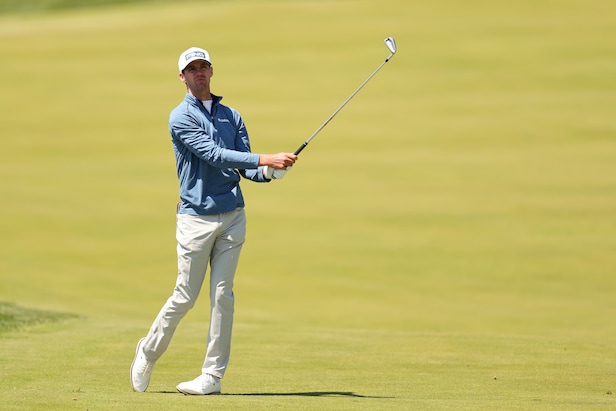
No one who played with Alex Smalley in college is surprised to see him contending in the PGA Championship. I should know—I was his teammate at Duke and was lucky enough to practice and play alongside him, learning plenty along the way.
Smalley winning on tour—or a major championship—is just a matter of time. At Duke, he was an All-American, competed for the U.S. in the 2019 Walker Cup, and graduated with the program’s all-time leading scoring record. Now with over $10 million in career earnings on the PGA Tour, it’s fun to reflect on a time when it was just a few of us on the practice facility at Duke University Golf Club.
Here’s a few things I picked up from Smalley.
1. Distance wedges are everything
I’ve never seen anyone practice shots from 50-120 yards more than Smalley. Every range session would begin the same: he’d fill two medium-sized buckets with balls and the first bucket was entirely devoted to shots under 120 yards. The Duke practice facility has numerous greens and pins for short wedge shots, and Alex would rotate around the various pins, often for 30 minutes.
His practice was never hurried; rather, he took his time to figure out the distance of each flag and would diligently go through a routine for each shot. The results showed his work. I’ve never seen a player with better trajectory or distance control with short wedge shots. His go-to wedge shot flew quite low and had a hint of draw spin—a wedge shot that I’ve found works best to control distance.
These shots helped him score so well. On the days that he was driving it well, his wedge play would give him close looks for birdie that allowed him to go low. There were times, though, that he was struggling with his ball-striking, and his wedge play kept him in the round. When he got in trouble off the tee, he would regularly chip out and get up and down from 100 yards to save par. It’s the reason I never saw him shoot more than a few over par.
2. Groove two driver swings 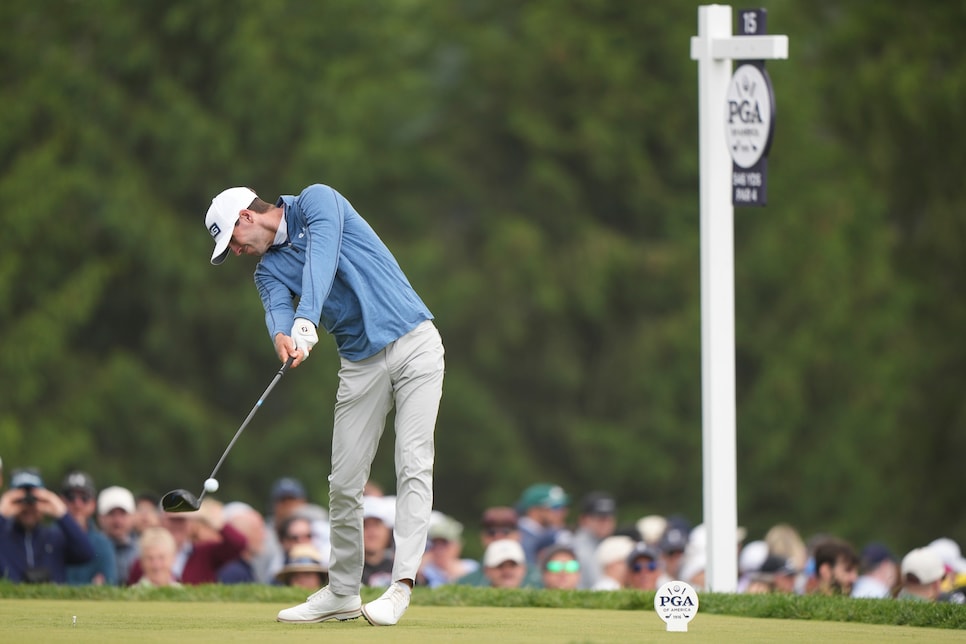
Darren Carroll/PGA of America
Smalley had elite command of his fairway-finder tee shot. In addition to practicing his normal driver swing, he would regularly tee the ball extremely low and hit stinger fade shots. These shots went remarkably low—about half the height of his normal drives, I’d say. By developing this go-to shot, Alex had an option to lean on when he was playing a tighter hole, in poor conditions, or when he wasn’t swinging his best.
The low tee height and narrower stance was the key, but when hitting these shots, he would avoid hitting down on the ball too much. That’s a common fault and spins the ball too much, Golf Digest’s No. 1 Teacher in America Mark Blackburn says.
3. Make short game practice situational
I’d estimate that between working on his distance wedges and his chipping and putting, Smalley spent 70 percent of his practice time on shots inside 120 yards. He would rarely just drop a bunch of balls around the green and hit the same chip, however. Instead, he changed up the shot he was hitting and the pin he was going for after every few shots.
Other times, he would take just one ball, a wedge and a putter and simulate on-course situations. He would throw a ball down randomly in different lies and try to get up and down, going through his entire routine. After holing out, he’d find another spot on the green and another pin. As someone who opts for block practice too much, I learned that making my short game practice situational like this improved my feel and added variety to my chipping.
The way he played these shots was interesting as well. When faced with the option of being able to go low or high with a chip or pitch shot, Alex went low nearly every time. He was never afraid to land a chip short of the green and kill the speed in a bank. I rarely saw him attempt the “hero” shot around the green. Just simple, repeatable low chips, which coincidentally (or not) is what Luke Kerr-Dineen uncovered recently in his Game Plan video on tour chipping strategies.
4. Know your shape—and stick to it
I’ll never forget one par 3 during qualifying in South Florida. It was a short hole, just 130 yards, but the pin was tucked on the far right side of the green, three or four paces from the edge. A bunker short and right punished an overly aggressive play. To my eye, the hole was asking for a soft fade, which would start just left of the hole and work back toward it.
But Alex loved to draw the ball, and he stuck to his shot even when the hole didn’t “call” for it. His shot started right of the green and drew back toward the tucked flag, finishing a couple feet away. I took so much from that one instance: If you’re comfortable with your go-to shot shape, hit it! Don’t manufacture shots that don’t require it.
MORE GOLF DIGEST PGA CHAMPIONSHIP COVERAGE
PGA Championship 101: Answering all your frequently asked questions
How to watch the 2026 PGA Championship
Power Rankings: Every player in the PGA field, ranked
Tee times for Friday’s second round
Why the PGA at Aronimink is a great fit for Philly’s everyman sports culture
What tour pros do before a major to prep
Video: Every hole at Aronimink
Bryson’s uncertain future
The crazy story of Walter Hagen and the lost Wanamaker Trophy
The most ‘PGA’ moments in PGA Championship history
This article was originally published on golfdigest.com