


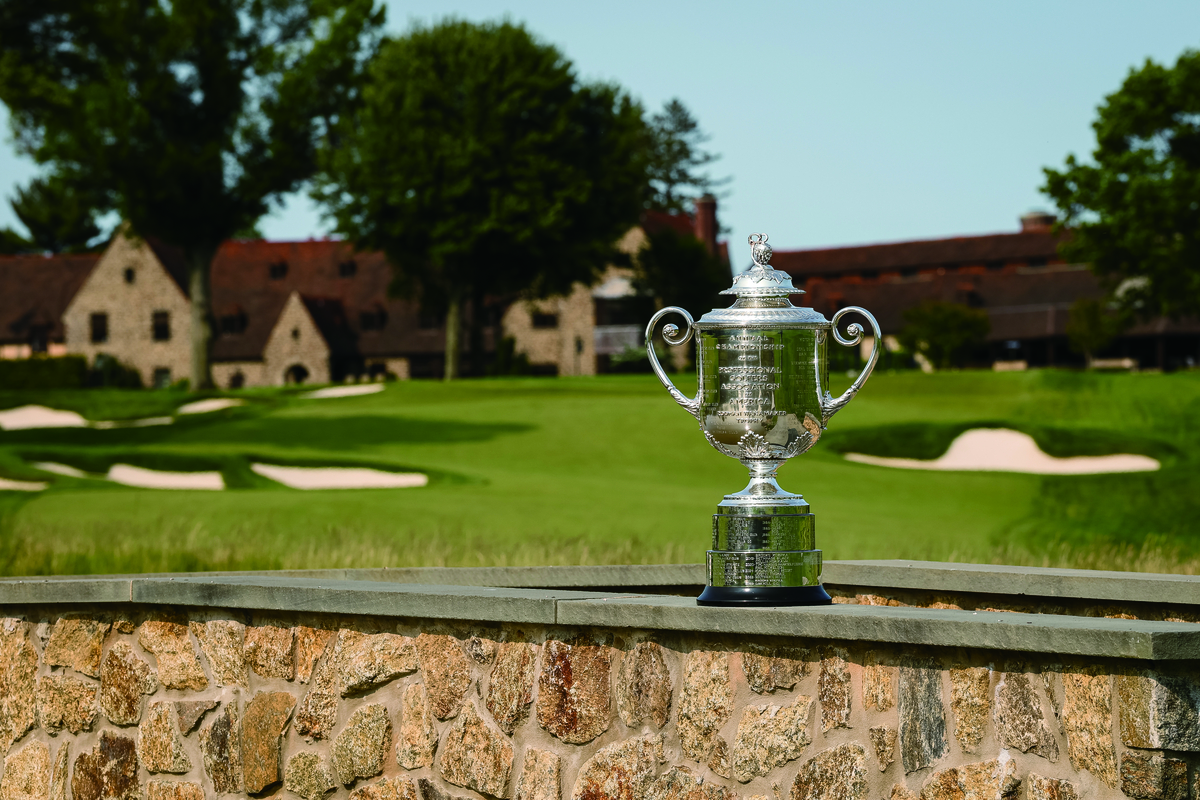
 The Wanamaker Trophy, awarded to the PGA Championship winner, displayed against the 17th hole at Aronimink Golf Club. Getty Images
The United States marks its 250th anniversary of independence this year. Philadelphia, Pennsylvania — the city of America’s founding and independence — will host various commemorative events throughout the year. The PGA Championship, the second men’s golf major of the season, will also be held for four days beginning May 14 (local time) at Aronimink Golf Club in Philadelphia to celebrate the 250th anniversary of independence.
Founded in 1896 and marking its 130th anniversary, Aronimink Golf Club has, as it turns out, led the way on both Black “golf rights” and American “golf independence.”
First, the story of Black golf rights. There was a man named John Shippen, born in 1879. His father had been a Black slave who later became a minister. When Shippen was 9, his father was appointed as a minister to the Shinnecock Indian Reservation near Shinnecock Hills (this year’s U.S. Open venue), one of the earliest golf clubs in the United States.
At Shinnecock Hills, there was a Scottish-born professional golfer named Willie Dunn Jr., who recruited people from the Indian reservation to work as course maintenance staff. He also trained some of them as caddies. Shippen worked there as a caddie and learned golf from Willie Dunn Jr.
When Aronimink Golf Club was founded in 1896, Willie Dunn Jr. recommended his outstanding pupil as the club’s professional golfer. Thanks to that, Shippen became Aronimink’s first professional golfer. He was 17 years old at the time. That year, Shippen decided to compete in the second U.S. Open. This event became the first trigger for racial discrimination issues in the golf world. At the time, Shippen’s friend Oscar Bunn, a Shinnecock Indian, also decided to participate.
Some players threatened to withdraw if the Black and Indian competitors took part in the tournament. However, then-USGA President Theodore Havemeyer held firm, saying, “We will hold the tournament even if only Shippen and Bunn compete.” The players eventually backed down, and Shippen finished tied for fifth at his first U.S. Open. A hundred years after Shippen’s U.S. Open debut, Tiger Woods made his PGA Tour debut in 1996 with his famous “Hello, World.”
The second story concerns American “golf independence.” The U.S. Open, America’s national title, was established in 1895. Through its first 16 editions up to 1910, the U.S. Open was a “playground” for British golfers from Scotland and England. American golfers could only watch as the British golfers easily carried off their national title. The United States was rapidly developing in every respect, but golf had yet to emerge from Britain’s shadow.
Finally, in 1911, John McDermott became the first American-born golfer to win the U.S. Open title. He reached the top at just 19 years, 10 months and 14 days old. McDermott’s record as the youngest U.S. Open champion remains unbroken 115 years later.
McDermott successfully defended his title the following year. Then in 1913, amateur golfer Francis Ouimet defeated Britain’s Harry Vardon and Ted Ray to win the U.S. Open. With American players winning the U.S. Open for three consecutive years, golf spread rapidly across the United States.
McDermott, the first American to win the U.S. Open, was a former caddie at Aronimink Golf Club. The person who taught him golf was Walter Reynolds, who became Aronimink’s professional golfer after the Black golfer Shippen.
The name Aronimink comes from the name of a chief of the Lenape Indian tribe, who lived in the northeastern United States, including Pennsylvania, New Jersey and New York. The farmhouse where that chief lived was once used as the clubhouse of Aronimink Golf Club.
Aronimink Golf Club carries the DNA of diversity in this way. In 2020, the KPMG Women’s PGA Championship, an LPGA Tour major, was held at Aronimink Golf Club. Kim Sei-young won the tournament that year.
At this year’s PGA Championship, hopes are high for a Korean player to win a major for the second time, following Yang Yong-eun in 2009. Kim Si-woo, who is on an upswing this year, and Im Sung-jae, who finished tied for fifth at the preceding Truist Championship, will compete, while Yang Yong-eun is listed among the entrants as a past champion.
