

 Two members of the maintenance crew at Augusta National Golf Club share a laugh during work. “Dr. Duich said it, ‘It’s 10 percent turfgrass and 90 percent people,’” Brad Owen says. (Photo: Scott Ramsay)
Brad Owen
Golf development director, North America, Turfgrass
In part two of our conversation with the longtime former senior director of agronomy at Augusta National Golf Club, Brad Owen talks about his vision for the future of the industry, his favorite spots at Augusta National and his most cherished piece of Masters memorabilia.
Golfdom: You worked at Augusta for 38 years … going back to your early days, what are some of your early memories of working there? What was it like to be at that course and still young in your career? Did you have any aha moments?
Brad Owen: I certainly do. It was the first day I arrived on the property as an intern in 1986, it was mid-March. There were going to be three of us from Penn State down there as interns. So, the younger guy had shown up a couple days before me. He came to pick me up at the shop and was going to take me out to meet Billy Fuller — it was his last Masters that year — to meet him on the course. And we’re in this three-wheeled Cushman, you remember those back in the day? And he just drives. He’s a young kid, so he’s driving fast, and he just rolls us right out on the 15th fairway in the cart. And I’m like, “Whoa, whoa, whoa!” I said, “Are you sure we can drive on this?” Because to me, that was the most pristine turf I had ever been on in my life, and only my third year in the industry. And he goes, “Oh, yeah, no problem.” And I just remember being in awe, 40-some-odd years ago, that the turf there was that special — and it still is.
Golfdom: Do you have one favorite tool to get the job done? Something that you love to operate, or that you always have with you…
 A Masters patron watches as a member of the grounds crew string-trims a bunker with precision. Owen worked every Masters from 1986 until last year, when he retired from the course and joined Turfgrass Inc. (Photo: Scott Ramsay)
Owen: I think a soil probe, as simple as that sounds. It can tell you a lot, as well as kind of validate what your eyes are telling you on the surface. As simple as that is, I would say the soil probe, but I would also add to that — the ability to walk a golf course and understand the inputs you’re doing to it, and what the effect it’s having on the surface and the playability. I’m not a good golfer, and don’t play a terribly large amount, but walking that golf course, you can pick up on whether it’s firm or not. You can tell by greens texture and density and measuring speeds, obviously, but whether they’re fast or firm? So, so much of that gets done through your feet and just through walking the property.
Golfdom: Let’s get to know you personally some. Tell me about your family, and what do you like to do for fun?
Owen: I have a grown daughter and son. My daughter is 24, and she works with a local sheriff’s office here in Richmond County. She’s doing some online school programs. And my son is in real estate here locally, he’s married and he’s a (University of Georgia) grad. So, I kind of have to be a Penn State fan and a Georgia Bulldog fan from time to time. I enjoy playing golf with my son, and my daughter likes to go out to dinner. We have good times going to the mountains, to travel to the North Carolina mountains where I grew up, where I got started in this business, actually. I try to play more bad golf than I used to, I enjoy working around the house in the yard and just personal travel as well.
Golfdom: So many Class A GCSAA members make the trip to Augusta every year, taking advantage of that member benefit of free admission into the Masters. So, for those guys, give me a recommendation, a great dinner spot in Augusta.
Owen: I think Frog Hollow, if you can get in down there, is probably one of the top places. Another one is Oliviana’s Italian restaurant, close to the club. But ironically, the locals don’t come out much during that week, so it’s very quiet, which you wouldn’t expect.
Golfdom: On your LinkedIn page, you have a Ford GT on there. Are you a car guy, or racing fan?
Owen: I do enjoy automobiles and racing. I’m a big Ford fan all the way around. And so that GT has just always been something that I’ve been attracted to, especially since they came back and beat Ferrari at Le Mans. So, yeah, that’s just something I identify with, something different than grass.
Golfdom: Golf fans get so excited about the Masters gear available on the course … do you have a favorite Masters item?
Owen: Wow, let me think on that for a second … I’ve been fortunate to get a lot of that Masters memorabilia, but probably my favorite … it’s a golf bag that’s similar to what the membership can purchase. That’s my favorite.
Golfdom: I’ve got to ask… does Brad Owen have a Masters garden gnome in his yard?
Owen: Not a single gnome.
Golfdom: Thank you! That’s rewarding.
Owen: It’s just not something I can aspire to (laughs).
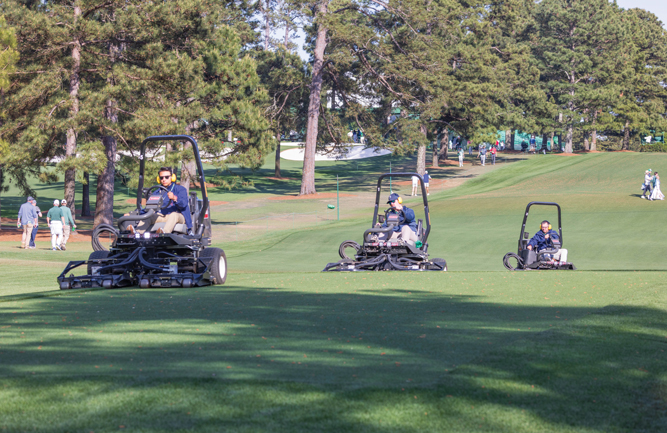 Owen believes autonomous mowers will grow in popularity in the future. He says he prefers autonomous greens mowers over fairway mowers but adds that autonomous fairway mowers are steadily improving. (Photo: Scott Ramsay)
Golfdom: What’s your favorite spot on the golf course, to watch, or when you were working?
Owen: I would probably have to put several together.
Standing on what we call ‘the top of the hill,’ the top of the golf course, which looks out through holes 1, 9, 18 and 10 and kind of down through the middle of the golf course, in the evenings or mornings. It’s such a beautiful time on a golf course as you know, with the shadows and sun coming up or down.
No. 1 green is probably my most favorite green complex and surface … just the contouring and the elevation around it. And you know how you’re able to view it as a patron, and then to putt on that green. And then see the pros, how they play into hole No. 1, which can be very difficult. And then certainly, Amen Corner behind 12 tee, up on the hill, looking at 11 green. Twelve green and 13 tee is another one of those places you like to go to just reflect at the right time of day and take it all in.
 Rory McIlroy defended his Masters title, edging Scottie Scheffler by one stroke at 12-under. (Photo: Scott Ramsay)
Golfdom: I’m curious, because you’re a soft-spoken, humble guy … when you get on an airplane and someone asks you what you do, are you truthful? Or do you tell them you sell insurance in hopes of ending the conversation? Because I imagine people would want to talk your ear off once they found out what you do.
Owen: I hope it takes a while for them to get to where I actually work. So, I might say, ‘I’m in the golf industry.’ Then I might say, ‘I’m a superintendent of a golf course.’ And if they keep asking, they might drill down, and ultimately, I’ll tell them, but it’s not out of avoidance. Again, I’m blessed to have that opportunity, and I don’t want to come across as some cocky guy from some famous golf club. That’s just not how I want to be perceived.
Golfdom: What do you think is the future of golf maintenance? What do you foresee in the next 10, 20 years for the folks who read Golfdom?
Owen: I think autonomous mowing (is coming) for sure. I wish we had stuck with an autonomous greens mower, because I thought that was more practical than several fairway units. But that’s getting better, the fairway mowing.
I think (artificial intelligence) is going to impact everybody, is going to become something that helps in our predictive models of disease management, or turfgrass fertility, even playability, I could see it relating to that. We do a lot of data reading of numbers prior to the tournament at the Masters, and then during the week of, we would predict where the conditions were going to go based on weather, humidity, inputs and mowing and rolling. I think AI can help a lot of superintendents with that going forward.
One thing that I think has been kind of overlooked over the past 40 years, I hope that we’ll spend more time with our young people, teaching them to manage people, teaching them to be leaders and supervisors and assistants going down the road. I don’t think there’s enough focus in school on preparing people to be in that role. And again, we think it’s all about growing grass. And Dr. (Joseph) Duich said it, “It’s 10 percent turfgrass and 90 percent people.”
There’s such a thing, and you’ve heard of it before, called EQ, emotional intelligence, that’s been around since the ’80s in the business world. But I think it could become taught and become a valuable tool for people to have. It helps you recognize and have self-awareness about how you are and how other people can relate to you or not relate to you. And I just think that topic, and the development of leaders in school, will increase and become more of a focus and have more of an importance going forward.