


Aronimink Golf Club will host the 2026 PGA Championship. Here’s everything you need to know about the Donald Ross-designed venue, including a full hole-by-hole course guide and what to watch out for.
Set just outside Philadelphia in Newtown Square, Pennsylvania, Aronimink Golf Club brings serious pedigree to the 2026 PGA Championship.
Founded in 1896, the club has long been regarded as one of America’s great championship venues, having previously hosted the PGA Championship, the US Amateur, the Senior PGA Championship, the BMW Championship, and the KPMG Women’s PGA Championship. Gary Player won the only previous men’s PGA Championship held here in 1962, while Justin Rose won the AT&T National at the course in 2010 and Keegan Bradley claimed the BMW Championship here in 2018.
But Aronimink’s real identity comes from the golf course itself. Donald Ross’s 1928 redesign is often spoken about as one of the architect’s finest works, combining strategic bunkering, bold green contours, and constant elevation change to create a layout that rewards control and decision-making more than brute force.
Players will need to shape tee shots, manage awkward angles into greens, and handle some of the most demanding putting surfaces they’ll face all year.
At 7,394 yards and playing to a par of 70 for the PGA Championship, it is no pushover on the scorecard either.
Here’s a hole-by-hole look at what awaits the PGA Championship field for the second major of the year.
Hole 1 – Par 4, 434 yards
A deceptively demanding opener. The tee shot plays downhill from near the clubhouse, before the approach climbs back up to a green with significant back-to-front movement. Fairway bunkering right can pinch the landing area, while misses around the green are quickly punished.
What to watch: Nerves + awkward first approaches.
Hole 2 – Par 4, 413 yards
A left-bending par 4 where positioning from the tee matters more than outright distance. The landing zone is partially obscured and falls away from left to right, making commitment essential. The green is generously sized but heavily contoured.
What to watch: Players bailing right and facing tricky approaches.
Hole 3 – Par 4, 455 yards
One of the more strategic driving holes on the front nine. Bunkering forces a decision off the tee: take on the aggressive line for a better angle or play safer and accept a tougher second shot into a relatively shallow green.
What to watch: Conservative tee shots leading to tricky approaches.
Hole 4 – Par 4, 457 yards
Another exacting two-shotter. The uphill drive can tempt longer hitters to challenge the bunkers, potentially leaving only a short iron in. But poor execution quickly turns this into a scrambling hole.
What to watch: Risk-reward aggression from bombers.
Hole 5 – Par 3, 171 yards
Classic Ross design. Not especially long, but visually intimidating thanks to sand wrapping around much of the green complex. Precision matters far more than power here.
What to watch: Distance control to tucked pins.
Hole 6 – Par 4, 402 yards
A short-ish par 4 on paper, but far from straightforward. The dogleg right and heavy bunker presence create choices off the tee, while the green itself offers plenty of subtle trouble.
What to watch: Smart course management vs unnecessary heroics.
 Hole 7 – Par 4, 431 yards
Another dogleg right, this time with a blind element from the tee. The real defence is the sharply contoured green, where finding the wrong section could turn birdie hopes into bogey threats.
What to watch: Aggressive approaches getting rejected.
 Hole 8 – Par 3, 242 yards
A brute. One of the longest par 3s on the property, playing downhill but still demanding a serious carry, depending on setup. Club selection becomes critical.
What to watch: Hybrids and long irons into a par 3.
Hole 9 – Par 5, 605 yards
The front nine’s lone par 5 is a proper test. Long, uphill, and heavily bunkered in the key landing zones, this is unlikely to be a routine birdie chance.
What to watch: Whether players attack in two or play it as a three-shot hole.
Hole 10 – Par 4, 472 yards
An immediate examination after the turn. A strong drive is needed to set up any realistic birdie chance, but the green complex is one of the most severe on the course, with water, rough and awkward recovery areas all in play.
What to watch: Short-game disasters.
 Hole 11 – Par 4, 425 yards
One of Aronimink’s nastiest greens. Precision into the putting surface is everything here, as approaches that land in the wrong spot can spin or roll dramatically backwards.
What to watch: Balls refusing to stay put.
Hole 12 – Par 4, 466 yards
A likely card-wrecker. Elevation changes complicate both shots, while bunkering squeezes the tee ball and the uphill approach demands a fully committed strike.
What to watch: Momentum swings.
Hole 13 – Par 4, 385 yards
Short by modern major standards, but potentially one of the most entertaining holes all week. Depending on setup, it could tempt players into attacking the green, bringing both reward and disaster into play.
What to watch: Risk-reward fireworks.
Hole 14 – Par 3, 216 yards
A stern one-shotter framed by sand. Missing the green leaves an awkward recovery, so many players may happily take the center of the putting surface and move on.
What to watch: Sensible golf vs flag-hunting.
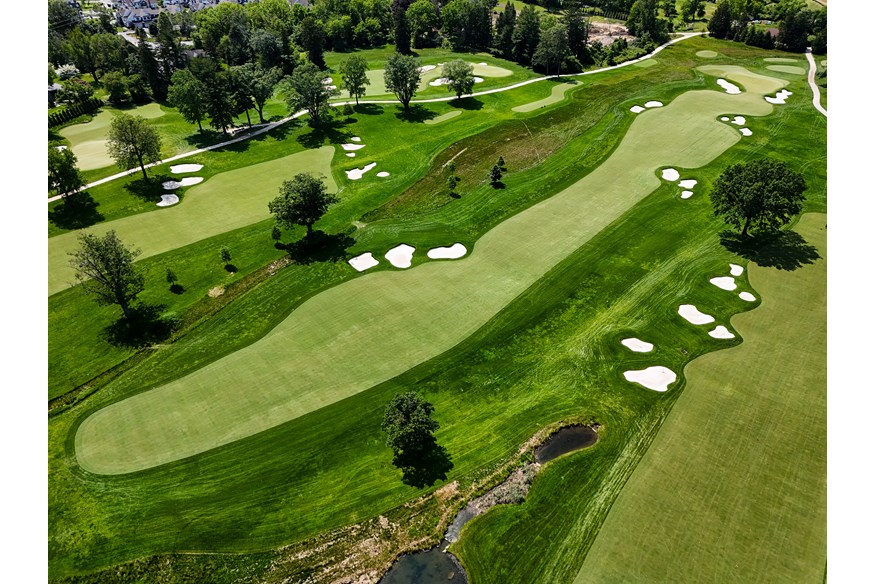 Hole 15 – Par 4, 546 yards
An absolute monster. Length alone makes this one of the standout tests on the course, but smart use of the fairway contours can help players gain precious extra yards.
What to watch: Mid- and long-irons into a par 4.
Hole 16 – Par 5, 555 yards
Finally, a genuine scoring chance. Plenty in the field will fancy reaching in two, but holding the shallow green is another matter entirely.
What to watch: Eagle attempts.
Hole 17 – Par 3, 229 yards
This has late-Sunday drama written all over it. Water lurks left, the putting surface is expansive, and the safe route often leaves a difficult lag putt.
What to watch: Championship-defining swings.
Hole 18 – Par 4, 490 yards
A proper finishing hole. A demanding drive sets up an uphill approach into a large, tiered green where awkward pin positions could create real chaos.
What to watch: Final-hole leaderboard drama.