


I review the McLaren Golf Series 3 iron and reveal why this is the most interesting release of the year so far – for good and bad reasons.
McLaren are a heavyweight in the automotive industry, well-known for making very fast, premium cars for consumers and motorsports. Their World Championship-winers for 2025 was a surprise to no one, but the 2026 debut of the McLaren Golf Series 3 irons was rather the opposite.
Rumors circulated the golf industry for months as to what was going to be unfolded first, until teasers of the Series 3 and Series 1 irons surfaced on social media.
Consumers and media alike all began asking the same question: McLaren makes some of the best cars in the automotive scene, but can they produce some of the best irons in golf?
The Series 1 are a muscleback iron, in the bag of ambassadors Justin Rose and Michelle Wie.
The Series 3 are aimed towards the mid-to-high handicapper, offering more forgiveness in a friendlier shape for the everyday golfer.

The McLaren Golf Series 3 irons are their first official release, with the Series 1 to officially hit the shelves very shortly. Since the official release, social media has erupted to lament one specific element of the product: the price tag.
An eye-watering £360 per iron has even the McLaren purists raising their eyebrows at what is a controversial release for many reasons.
I’ve spent the last week testing the player-friendly McLaren Golf Series 3 irons, and whilst I’m still confused as to which iron category they fit into and who they are trying to target, I can give some very positive and negative feedback about this product.
Take a deep breath, let’s get into it.
McLaren Golf Series 3 irons : Quick verdict
A premium mid-handicap iron that sounds and feels absolutely brilliant in comparison it its competitors, however the price and overall aesthetics will have consumers wondering why they’re double the price of other OEM’s.
Looks, sound and feel – 4/5
The TG rankings always group up these three elements, but in this case it’s a real tale of two halves.
For an iron set that is £360 per club, the looks do not represent that. Take a look at McLaren Golf’s competitors at that price point. Miura, Itobori, Fujimoto. They all lie in the Japanese Domestic Market, with looks that simply scream premium. Elegance, excitement, an aesthetic dream that any golf purist would love to have in their golf bag.
With the McLaren Golf Series 3, calling the aesthetic marmite would be flattering.
With a brief survey internally at Today’s Golfer alongside 10 other club golfers at Hever Castle Golf Club, the responses were somewhat damming. One out of 20 of the participants said they liked the looks of the McLaren Golf Series 3 irons. Spoilers: that one person was me!

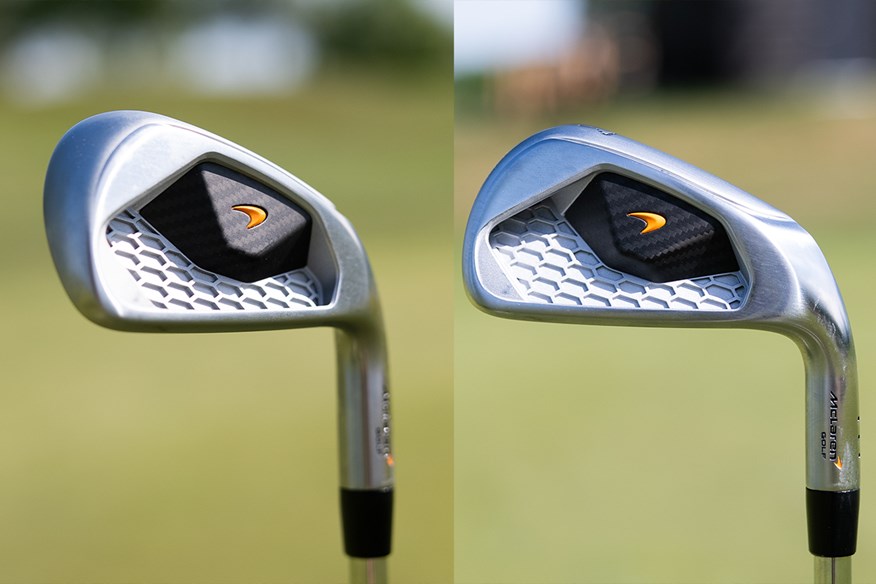
Although I can appreciate the looks do not go up against other models in a similar price bracket, I do enjoy the shelf appeal in the bag. I believe if the McLaren Golf Series 3 irons were rivalling the TaylorMade P790’s and other Player’s Distance models, the opinion would be far more positive. The papaya orange alongside the carbon fiber bonnet and structural mesh does feel rather ‘gen z’ in its approach, but in the flesh it is rather daring, and did fit into my golf bag quite nicely.
Down at address, for an iron that is on the more forgiving side (as McLaren Golf loosely advertise on their website), it isn’t offensive in any way. The longer irons have slightly more offset, but nothing that pushes them towards the Ping side of the spectrum, whereas the shorter irons still have a relatively small heel-to-toe length, allowing a variety of club golfers to put these in their bags with no issues. I’m still not entirely sure where these sit in the iron categories, but I would push them towards a Callaway Ai-200, Srixon ZXi5. Player’s Distance… ish.

The sound and feel turn this iron into a completely new realm, with a beyond-premium, wonderful feel off the entirety of the face. Irons such as the Callaway Ai-200 and TaylorMade P790 all feel rather clicky off the face – they all feature a distinctive sound and feel due to their construction – but not the McLaren.
Yes, the McLaren Golf Series 3 irons come with similar construction, but the feel across the face is a lot softer, representing more of a tour-validated iron than a player’s distance model. I take no surprise in knowing that Justin Rose has put a long iron of the Series 3 in the bag, and from this element alone I would have no issues putting these in the bag.
Tech – 3.5/5
There’s a lot to unpack with the McLaren Golf Series 3 irons, and although they’ve covered a lot of bases with this player’s distance iron, it still falls somewhat flat in relation to the price tag.
At the core of McLaren Golf’s new creations is a technology known as MiM – or Metal Injection Molding. While not completely new in the world of golf equipment, the way in which McLaren are leveraging this process is certainly unlike anything we’ve seen before and could set the trends at other manufacturers in the future.
Metal Injection Molding is an advanced process that sits in between forged and cast irons, supposedly creating a mix of both constructions and thus getting the best of both processes.
I was skeptical to hear that this was the choice they went with, and we’ve seen MiM tech in other irons in the past, but the results from sound and feel do speak for themselves.
The most noticeable detail on the Series 3 is also one of the core technologies that McLaren are using to define the iron model. Labeled as their ‘Carbon Fiber Bonnet,’ in another nod to the automotive origins, McLaren are using this lightweight element to further move weight within the head, allowing them to place mass where they want, thus improving CG placement, MOI, and all-around performance. A premium piece of tech, but something we’ve seen before and advertised with a less automotive theme.
Underneath the bonnet sits a piece of tungsten metal, with a calibration range of 10-17g, concentrated into a smaller shape than in the Series 1, to move the CG lower and deeper, helping to optimize each club to promote better launch conditions and faster ball speeds.
Tungsten has also been employed in a secondary purpose, exclusive to the Series 3 in McLaren Golf’s lineup. The toe of the irons have been hollowed out to allow for the installation of tungsten plugs to the far side of each head, with more mass used as irons decrease in loft.
These weights are designed to help pull CG further towards the toe, balancing the mass of the Series 3 in a more helpful way for the majority of golfers. This shift in mass provides increased stability further away from the main axis of rotation, improving MOI (Moment of Inertia). We see this concept in a variety of different models in 2026, so there is no surprise in this being included for McLaren Golf’s forgiving iron release.
On top of the tungsten, the Structural Mesh continues over from the Series 1 to further assist in the Progressive CG pattern by helping save weight in non-essential spaces.
Like with the Series 1, there’s been special attention paid to the turf interaction that comes from a well-designed sole shaping, albeit in a more idiosyncratic fashion than you’ll see on the more compact McLaren launch iron, or, indeed, any other iron on the market, making this asset the most unique piece of the McLaren Golf Series 3 iron.
Impressive? Yes. Impressive enough for a £360 per iron? No.
Performance – 4/5
In all honesty, the McLaren Golf Series 3 irons were set up to fail before they were even released. The absurd price point alongside Series 3 being the first release (Series 1 or Series 2 should have joined them to generate more buzz than a ludicrously expensive standalone Player’s Distance iron) meant that unless there was truly something different about the Series 3 iron set, the social media buzz was going to be rather negative.
Now, if I take off my £360-per-iron glasses and view these objectively as an iron, they are a very, very high-performing product.
The heavyweights involved in the R&D process at McLaren have produced an iron that features strong (but not aggressive) lofts that still maintain a high descent angle and premium stopping power for the longer irons.

The 3-iron became my fairway finder over 36 holes, with 160 mph ball speed the norm but a high ball flight to go with it, meaning I could attack par 5s and find the fairway – a truly versatile iron set.
Mishits were very flattering – noticeable in feedback to my eye but not to my playing partners. When I struck the McLaren Golf Series 3 irons out of the toe or heel, I lost roughly a club’s distance, which didn’t impact my overall score.
These were certainly high launching and high-spinning (a touch too high), but i’m not viewing this as a negative for an iron that’s involved in a category whereby the results are sometimes the opposite. This iron presents characteristics of a blade, whilst offering forgiveness of a players distance iron. A tempting combo.
Shot Type Ball Speed (mph)Backspin (RPM)Carry (yds)Total (yds)7 Iron142.67960192194
Final Verdict – 4/5
This feels like a very bizarre review, because despite the negative feedback I have specified in this article, I will likely be putting the McLaren Golf Series 3 irons in the bag. They have superb sound and feel for their iron category, and are very friendly on mishits at higher speeds, which ticks all the boxes I’m looking for in an iron in 2026.
However, when the price is factored in, this launch does seem a little silly.
A premium, successful, high-value golf product has to earn its right to be there. In the western hemisphere, brands such as PXG, Honma and others have tried and failed to sit on this throne, and I can’t help but think McLaren will go down the same route if they continue with this price tag.
If the McLaren Golf Series 3 irons came out at a similar price point to the best Player’s Distance irons of 2026, then the overall response would have been much more positive.
To be blunt, just because you make fast and expensive cars, it doesn’t mean you can make expensive golf clubs. You have to earn that by gaining the trust of perhaps the most fickle consumers in the world.
Time will tell as to how McLaren Golf will fare in today’s ever-changing market, and although the McLaren Golf Series 3 iron is very high performing, it’s a very worrying position they’ve put themselves in going forwards.
Similar irons to consider