

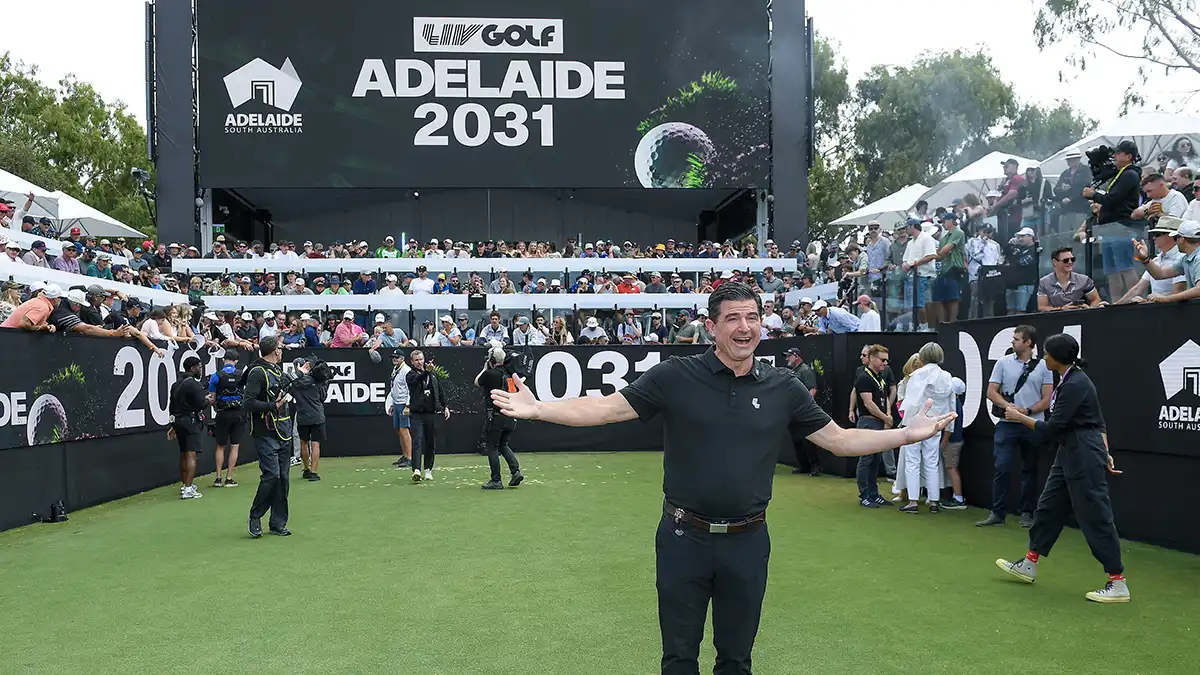
Australian golf has always had a bit of a chip on its shoulder. Not without reason. We produce world-class players, we love the game, and we understand it as well as anyone.
But when it comes to seeing the best in the world up close, we have spent years making do with scraps. A big event here, a one-off appearance there, and plenty of late nights watching tournaments played on the other side of the world.
RELATED: ‘I haven’t been asked that before’: Cam Smith stunned by retirement talk as LIV future questions swirl
Then along came LIV Golf, and it hit differently. It has not just been ‘another’ tournament added to the calendar. It has felt like it always belonged. A reminder of what golf in this country can look like when we are not treated as an afterthought. If it disappears, it will not just leave a gap. It will leave the game here far worse off. That’s a fact.
Let’s start with the obvious: LIV brought incredible players to Australia in a way we simply do not see anymore. Not occasionally, but consistently. Seeing names like Bryson DeChambeau, Jon Rahm and Phil Mickelson competing on our soil is not something Australian fans should take for granted.
For years, the only way to get names like that here was to pay overs and hope for the best. Even then, the fields were often thin and the buzz faded quickly. LIV changed that. It built a product where top players were already part of the system, we had our own team, and Australia became not just a stop on the journey but THE stop. That made it a completely different proposition.
When it is LIV Golf week in Adelaide, you can feel it. Not just in the galleries, but in the way people talk about the event. The city is buzzing and the tournament matters to the people there. It has quickly become a bucket-list trip and feels like something you need to be at. It also feels global, which is exactly what golf should be. LIV fields are international and pull talent from everywhere. Europe, Asia, Africa, the Americas. That mix gives the event a different energy. It reflects modern golf rather than the narrow version we are often served.
For Australian fans, that’s all we wanted. We have always taken pride in the global nature of the sport. Our players travel, compete, and win all over the world. Seeing that same international flavour at home makes the experience feel bigger and more relevant and it’s in our backyard. Ours.
Then there is the crowd. You cannot ignore it. More than 115,000 people across the week in Adelaide was not normal for golf in this country, nor is the 44 percent who travel from interstate, including the boys I met this year who drove 27 hours one way across the Nullabor to be at the Grange Golf Club. That kind of turnout tells you the appetite is there.
Australian golf fans will show up if the product is right. This is where LIV shifts the dial. It does not just appeal to the traditional golf fan. It brings in a different crowd. Younger, more casual, and more open to a version of golf that does not feel locked in the past.
For a long time, golf has struggled with that audience. It has leaned heavily on tradition, which matters, but is not enough anymore. LIV found a way to keep the core of the game intact while making the experience more engaging. The team format, the music, the atmosphere. It all adds up to something that feels fresh and more in tune with what the modern golf fan wants.
This is essential because the game is changing. In Australia, there are around 480,000 golfers with handicaps. But there are 3.5 million more who play socially, hit balls at the range, or engage with the game casually. That is the future of the game. Most of them will never join a club or get a handicap, and that does not make them any less important.
LIV understands this. It speaks to that broader group. It makes golf feel accessible, not exclusive, and has helped to grow the game in a way traditional tournaments have struggled to do.
If LIV Golf was to ever fade away, the question is simple. What replaces it? Because the answer cannot be a return to how things were. That model was already under pressure, some would say broken in Australia. Relying on the national open and hoping to attract a few big names each year is not a long-term strategy. It is expensive, unpredictable, and often underwhelming.

Yes, last year’s Rory McIlroy-led Australian Open hit differently and was a real step in the right direction, but for how long after Rory goes? We have been here before. Paying significant appearance fees for a headline act, only for the rest of the field to lack depth. Prizemoney of $2.4 million will just not cut it (for the player managers anyway). We will need to find a way to at least triple that.
Trying to generate excitement around events that do not quite deliver is not a criticism of the people running them. It is just the harsh commercial reality of the environment. With current TV numbers, meaningful broadcast money is unlikely. At times, it feels like Australians would rather play golf than watch it, a bi-product of the game and how accessible it is down here.
RELATED: The future, funding, format and Bryson. LIV Golf CEO reacts to uncertainty facing his tour
The final round of The Players Championship is a good example. The average audience across Fox Sports was 29,000. That’s right, I didn’t leave a zero off, just 29,000 (and the total reach across the 5+ hours of broadcast was just 271,000).
It is easy for critics to point at LIV’s TV ratings, but the PGA Tour is not exactly engaging Australian golfers. Cricket’s Big Bash League games this season averaged more than 800,000, and even the A League soccer sits just under 400,000.
LIV Golf Adelaide this year cut through as an event. The Anthony Kim victory drew an average audience of 285,000 on Channel 7, and even some of the harshest critics admitted they enjoyed the result. This highlights something bigger. The global structure of golf is out of balance. It’s not global, it’s too US-centric. The PGA Tour has enormous influence and knows it. But its focus simply sits between New York, Florida and Los Angeles.
There has been little real interest in growing the game internationally for years. Markets like Australia, South Africa, Europe and parts of Asia have often been left to fend for themselves. That is why LIV Golf found an opening, albeit with the benefit of sovereign wealth fund backing. It stepped into underserved markets where there was real demand but not enough supply and proved those regions can deliver when given the chance.
Meanwhile, Golf Australia and the PGA of Australia have been working across the years to keep this country relevant. Senior management attends The Masters and The Open Championship annually (and even the Olympics), we are told, building relationships and looking for opportunities for the sport Down Under. From a fan’s perspective, they will hope these relationships bear fruit in terms beyond just the Aussie Open winner teeing it up at Augusta or for the Auld Claret Jug. We will need more than this.
In the past 10 years, the Presidents Cup in Melbourne has been a highlight, but it comes at a significant cost and is not something that happens regularly enough. When it does, it relies heavily on government funding. Figures between $15 to $20 million are what sources have told Australian Golf Digest is the asking price, and that is a significant outlay for Victoria, a state already under serious financial pressure.
LIV Golf Adelaide offers a different model. It is not a one-off. It builds year on year. It creates momentum and gives fans something reliable to look forward to. It also delivers between $80-$100 million in economic benefit for South Australia. That consistency matters for a state now focusing on key events. It also keeps golf in the national conversation, builds long-term value, and gives sponsors and young players something to buy into. It also raises the bar for tournaments in Australia. Leaders now have a clear benchmark to aspire to, and the expectation is no longer occasional success. It is sustained relevance for the most popular sport in the land.
 LIV Golf CEO Scott O’Neil has the product – Australia has proved that. Can he find the right investors for 2027 onwards?
The bigger picture is simple. Australian golf has spent years trying to stay relevant in a global game that often looks elsewhere. LIV Golf Adelaide changed that. For a moment, we were not just included. We were central. It brought elite players here. It attracted big crowds. It engaged new fans. It made golf feel important again. That is what Australian fans want. To see the best in person, on home soil. To attend events that feel worth their time and money. To feel connected to the global game. LIV Golf Adelaide has delivered that, and it is what Australian golf deserves.
So, to answer the question I have been asked 100+ times in the past few weeks:
Is LIV Golf dead?
Knowing those behind it, far from it. There is a massive opportunity to rethink the structure of global golf (leaving the US aside). Take the DP World Tour and the Asian Tour and create a clear framework with those tours, working in alignment as a more connected system, with regional swings.
Then add some marquee and elevated events using national opens as the canvas (Australian Open, Japan Open, Spanish Open, etc), then through the season these tie into LIV Golf events (maybe 5-8 events a year across Australia, South Africa, UK, Korea, Japan, Spain and maybe even an event in the US).
Not at the end, not as one block, but interlocked as the ‘Global Tour’ would pause for each LIV Golf event, just like the English Premier League, La Liga & Serie A does with their ‘international breaks’.
Is this good for the global game? 100 percent it is. Will this feed and grow the game? Yes. Is it something Australian golf fans want? Totally.
And, most importantly, is this something someone would invest in? Time will tell. Watch this space.
•Nick Cutler is the chief executive officer of CMMA Digital & Print Pty Ltd, publishers of Australian Golf Digest