


 Save
Save
You have reached your maximum number of saved items.
Remove items from your saved list to add more.
AAA
Turns out the bottomless money pit had a bottom. Or it did for the expensive experiment of LIV Golf, at least.
The withdrawal of backing for LIV Golf by Saudi Arabia’s sovereign wealth fund, the Public Investment Fund (PIF), last week showed even a trillion-dollar cash cow – fuelled by oil money and controversial geopolitical aims – has its limits. Let’s call it $8 billion.
 Saudi Crown Prince Mohammed bin Salman, with Bryson DeChambeau, Aryna Sabalenka and Cristiano Ronaldo.Artwork: Aresna Villanueva
But the PIF’s exit from LIV Golf was not just about value, but more the first big step in a wider strategic shift by the PIF and Saudi kingdom to redirect many of the billions it spends around the world to home, ahead of the 2034 FIFA World Cup.
The tactical shift has already impacted other sport properties with PIF backing, and more is forecast for both teams and athletes who have been cashing big Saudi cheques for the best part of a decade.
The PIF shift
In March, the PIF – which is chaired by Crown Prince Mohammed bin Salman – announced a strategic reboot for 2026-2030, moving away from the aggressive, high-profile global spending of the past decade and towards a more conservative, domestic-focused approach.
Saudi Arabia is the world’s biggest exporter of crude petroleum and, in 2022, state-owned oil company Aramco posted the highest recorded annual profit by a company of $223 billion.
Where once 30 per cent of the PIF’s portfolio was in foreign investments, the new plan will cap it at 20 per cent and prioritise return on investment, and legacy spending in the kingdom, in construction costs for the 2034 World Cup and the 2030 World Expo, and increased investment in grassroots sports.
“The 2026-2030 strategy marks a natural evolution as PIF moves from a period of rapid growth and acceleration to a new phase of sustained value creation, with a strengthened focus on maximising impact, raising the efficiency of investments,” the PIF said in a media release.
The Vision 2030 project was launched by bin Salman 10 years ago; a brash and controversial national transformation project designed to reduce the kingdom’s dependence on oil and diversify its economy into industries such as tourism, hospitality and property. The plans included expensive and ambitious projects such as the megacity Neom, and “The Line”, a 170km mirrored skyscraper for nine million residents in the desert.
 An aerial projection of The Line. No cars will be allowed inside.NEOM
But the PIF’s recalibration has seen many of those projects scaled back to be more achievable and affordable – “The Line” plans have been cut back drastically to between 2km and 5km, for example –but also at the heart of the new strategy is Saudi Arabia’s focus on delivering to the 2034 World Cup.
The Saudis won hosting rights for the 2034 tournament in 2024, as the sole bidder. The tournament will be played at 15 stadiums, mostly new, and the cost of construction, for football infrastructure alone, will nudge $45 billion.
What other sports will be affected?
In what many regarded as “sportswashing” of its dubious human rights record, the Saudis invested heavily in sport this decade, at home and abroad. Along with golf, football was a huge focus.
With four clubs owned by the PIF, the Saudi Pro League attracted major global names, including megastars Ronaldo and Neymar, by offering staggering salaries.
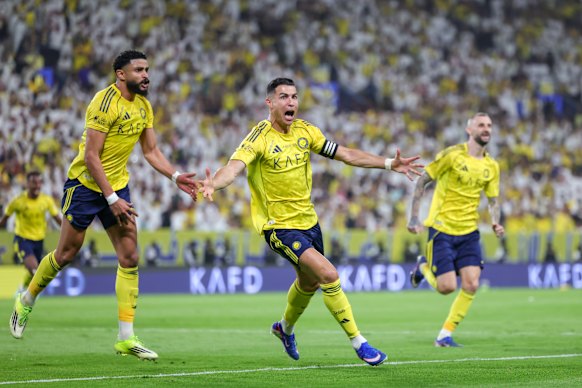 Ronaldo pockets almost $32 million a month playing for Al Nassr in Saudi Arabia.Getty Images
Ronaldo signed on for the Al-Nassr club in 2023 on a two-year deal for almost $800 million, and via subsequent contract extensions, bonuses and sponsorships, his total Saudi earnings could be as much as $1.6 billion by the time his contract ends in 2027. That’s $32 million a month.
French star Karim Benzema earns $200 million a year with Al-Ittihad. But those crazy figures are not likely to continue. The PIF recently began divesting, selling 75 per cent of Al-Hilal to a private ownership group. Al-Nassr is tipped to be next.
The PIF is also the majority owner of Newcastle United in the English Premier League, with an 85 per cent stake, but reports say that famous club won’t be sold off – for now.
 The WTA Finals will no longer be held in Saudi Arabia.Getty Images for WTA
In line with a push for its investments to be less blank cheque and more self-sustainable, the PIF reportedly views Newcastle as a traditional private equity investment and the club provides Saudi Arabia with a profile in the world’s most-watched sports league.
Other Saudi-backed sports are set to also feel the LIV-style squeeze, however.
In tennis, Saudi Arabia will not renew its deal to host the WTA finals in Riyadh after this year, and it has already stopped hosting the Next Gen ATP finals, too. The Saudi Arabia Snooker Masters – with a prize pool of almost $5 million – has also been cancelled two editions into a 10-year deal.
The LIV Golf exit will also likely spell the end of 10 “International Series” events on the Asian Golf Tour, which were established in 2022 as a pathway to qualifying for LIV, and had prizemoney pools of up to $3 million.
The long-term future of the Saudi Arabia Formula 1 Grand Prix remains up in the air, after it was cancelled last month due to the Iran war.
And the touted prospect of Saudi Arabia bidding for the 2035 Rugby World Cup has also been shelved to ensure full focus on putting on a show for the globe at the FIFA World Cup in 2034.
The wildly futuristic World Cup
Saudi Arabia will spend an estimated $43 billion on stadiums and football infrastructure alone. The plans include 15 stadiums in five cities – and 11 will be new – but there is speculation the PIF may cut that down to restrain costs.
 An image of the futuristic Prince Mohammed bin Salman Stadium, perched on the edge of a cliff.
Five of the new stadiums are forecast to cost more than $1 billion each, including the giant 93,000-seat King Salman International Stadium in Riyadh, at the hefty cost of $2.5 billion.
One of the other new venues – MBS Stadium at Qiddiya – will be a three-sided stadium and sit on the edge of a 200-metre cliff, leaving spectators to will look out over the valley.
The venue that earned headlines – and a multitude of fake images on social media – is the “Sky Stadium” at Neom, which is set to be built 350 metres above the ground as part of “The Line” (not on top of a skyscraper). That one is slated to cost $1.4 billion.
The overall predicted cost of the futuristic Neom city is $2.1 trillion. But even that is the new smaller-scale version. The WSJ revealed in 2025 that a leaked audit report predicted the full version of Neom – complete with the 170km Line – would have cost $12 trillion and not be finished until 2080.
 An artist’s impression of Neom Stadium, a football stadium in the sky perched 350 metres above sea level.New spending priorities
Saudi Arabia has also identified two new key areas in sport for heavier PIF investment: Esports and grassroots sport, with the express goal of produce homegrown Olympic medallists.
With gaming now hugely popular among Saudi youth, the PIF is pouring big money into the sector. The Saudis plan to build a $12 billion Qiddiya Gaming District, and have launched their own global gaming tournament with a $85 million prize pool. In September 2025, the PIF paid $76.5 billion for a 93.4 per cent stake in Electronic Arts (EA), giving it control over many of the world’s biggest games, including FC 26 (former FIFA) and Madden NFL.
But developing athletes to win medals in the real-life Olympics is also a significant new priority for the Saudi government, and there will be a big increase in funding for grassroots sporting programs and infrastructure.
Saudi Arabia has only ever won four summer Olympic medals. The new PIF strategy will invest in targeted zones to try to develop future Olympic and Paralympic medallists, particularly in areas such as equestrian and combat sports. Unlike some of their Gulf neighbours, Saudi Arabia doesn’t recruit potential Olympians from other countries.
Under a “Long-Term Athlete Development” model, Saudi Arabia has targeted the 12 most popular sports for “hyper-funding”: judo, taekwondo, karate, wrestling, fencing, equestrian, shooting, weightlifting, athletics, swimming, jiu-jitsu and Paralympic athletics.
Related Article
An Aussie coach could perhaps land themselves with a Ronaldo-style pay cheque, with specialist foreign coaches to be recruited, and a new $370 million sports city at Dammam has just started being built, too.
Building the next generation of athletes is another pillar of investment, with the “Mahd Sports Academy” expanding to 12 locations. It uses AI-driven scouting technology to identify athletic potential in children as young as six.
Save
You have reached your maximum number of saved items.
Remove items from your saved list to add more.
 Iain Payten is a senior sports reporter for The Sydney Morning Herald.Connect via X or email.From our partners