

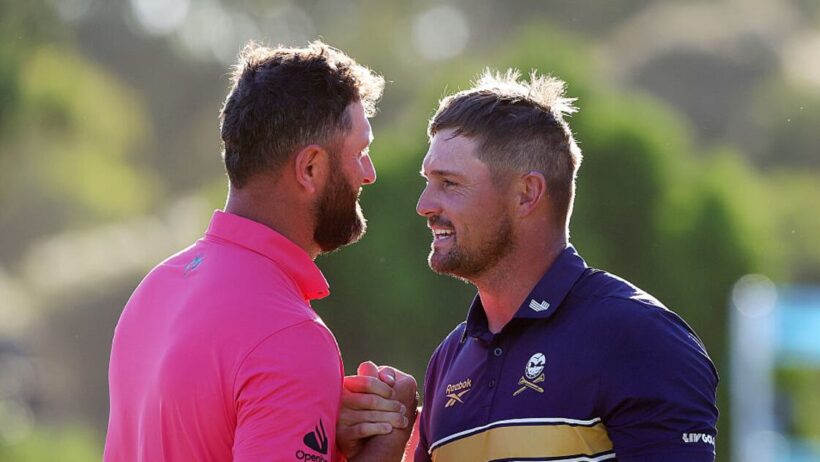
Top LIV Golf players such as Jon Rahm and Bryson DeChambeau “face very different routes back into the mainstream and different receptions” with the status of the league after this year uncertain with Saudi Arabia’s PIF pulling its funding, according to Rick Broadbent of the London TIMES. Rahm jumped to LIV “after the framework agreement had been drafted” in 2023. That “emboldened LIV” as things “appeared to be edging towards a peace accord,” and his move has “not been forgotten.” PGA Tour CEO Brian Rolapp is a businessman and “knows DeChambeau, in particular, would be good for his product — and tentative talks are believed to have been held.” However, anyone returning “from a position of weakness, with LIV fighting for its existence, will have it harder.” Meanwhile, DeChambeau “has no great love for the PGA Tour” and he “would not be universally welcomed by PGA Tour players” given that he was one of the last players to remove his name from the antitrust lawsuit originally filed after being suspended by the tour in 2022 (London TIMES, 4/30).
DRIVE FOR DOUGH: BBC.com’s Iain Carter wrote DeChambeau’s LIV contract is up at the end of this season and he earlier this spring was “looking to sign a lucrative new deal.” As the game’s “most unique character and with a substantial influencer following,” the two-time U.S. Open winner is a “crucial figure.” The task of new LIV Dirs Gene Davis and Jon Zinman is to “raise investment to replace the Saudi billions.” That would be “less difficult with DeChambeau on board.” However, his commitment “will not come cheap.” Carter: “Can they afford him? Could they afford to be without him?” (BBC.com, 4/30).
DIFFERENT STANDARD LIKELY TO EXIST: SI’s Bob Harig wrote Jordan Spieth, who was on the PGA Tour Policy Board when it was negotiating with the PIF to become an investor, is unsure whether a path for returning to the Tour “should be the same for everyone.” He said, “I know olive branches were given out a couple months ago. Brooks (Koepka) took them up on it. So I’m not sure what would now change.” PGA Tour player Brian Harman said, “Seems like they’re treating them all as a case-by-case basis. I would think that the fans want everyone to be playing together and time heals all wounds. There’s still some sentiment out here, especially with all the lawsuit stuff, that stuff’s going to be tough to get past” (SI, 4/30).
LEAVING A STAIN: GOLFWEEK’s Eamon Lynch wrote it has taken four years to “reach the moment of truth, when all the bluffing by LIV’s executives, players and bootlickers … is exposed for what it was. Undiluted bullshit.” Lynch: “The entire sport has been distorted and diminished by LIV’s existence, but an accounting of the rampant charlatanism (actual and unrealized) of recent years extends beyond the league’s players.” That includes agents who “funneled clients into this folly while skimming a hefty percentage.” Lynch: “Its lasting legacy will be laying bare an ugly truth: that many of golf’s most prominent players and entities care about fans or the good of the game only to the extent that it’s useful for public relations or taxation, but not as an operating principle” (GOLFWEEK, 4/30).
PART OF A MUCH LARGER MECHANISM: GOLF DIGEST’s Joel Beall wrote LIV Golf “was not, at its core, a golf league. It was a geopolitical instrument.” Saudi Arabia spent an estimated $5B to $8B on the venture because “soft-power exercises work.” PIF understood that associating the kingdom’s brand with the game was “worth more than any conventional PR campaign could deliver.” Beall wrote the players who signed “were not naive about this. Some convinced themselves the cause was separable from the source. Others simply didn’t care.” Beall: “What made LIV genuinely, existentially dangerous was its bottomlessness, and the greed that bottomlessness unleashed. There is no conventional competitive response to an opponent who has decided that losses are acceptable” (GOLF DIGEST, 4/30).
LOTS OF SHADES OF GRAY: In Sydney, Malcolm Knox writes LIV did not attract big U.S. audiences, though this “was never one of its KPIs.” Like all breakaway leagues, LIV’s object “was not to make money but to cause its adversary to come begging for a compromise on the rebels’ terms.” The PGA Tour, when it “saw its television ratings plummet, rallied American billionaires and corporations.” Knox wrote, “Looking at what the PGA has done to itself in reaction to the LIV threat, it’s hard to see a simple victory for good over evil. The PGA has, to a degree, LIVified itself” (SYDNEY MORNING HERALD, 5/1).